3D Printing in 2026: Additive Manufacturing Explained
A clear guide to 3D printing in 2026 — how it works, the technologies, metal and bioprinting, the shift to real production, the market, applications, and the future.
Technology · Global · 2026-09-15 · 11 min read · By John Awab
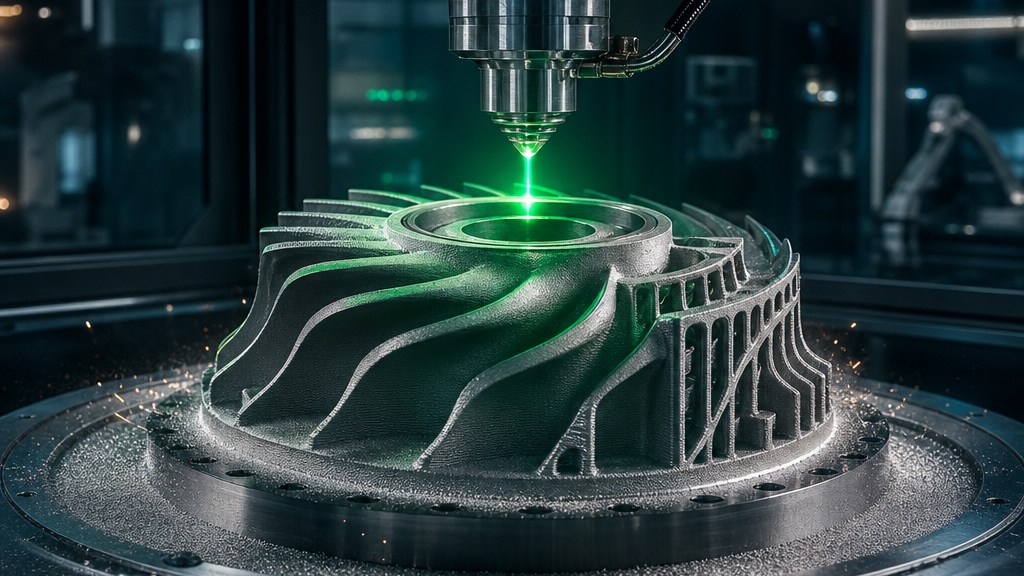
For years, 3D printing lived under a cloud of unmet hype — a fascinating novelty that could produce plastic trinkets and prototypes but never quite delivered on the promise of transforming manufacturing. That era is over. In 2026, 3D printing has quietly, decisively crossed the line from prototyping curiosity to legitimate production technology. Apple now uses metal 3D printing to make Apple Watch cases — the largest metal additive manufacturing application to date. GE produces over 100,000 metal-printed fuel nozzles for jet engines. John Deere 3D prints valves for its machinery. Dentists print patient-specific aligners and surgical guides by the millions. The technology that spent decades "about to change everything" is now actually doing it — not by replacing traditional manufacturing, but by carving out the growing set of jobs it does uniquely well.
This guide explains what 3D printing is, how it works, the main technologies, the crucial shift to production, metal printing and bioprinting, the market, real applications, the challenges, and where it's heading. (Market figures vary by source and scope, so treat them as estimates.)
What Is 3D Printing?
3D printing, more formally called additive manufacturing (AM), is the process of creating three-dimensional objects by building them up layer by layer from a digital design. The name captures the key distinction: traditional "subtractive" manufacturing carves an object out of a larger block of material (like milling or machining), while additive manufacturing adds material only where it's needed, building the object from the ground up.
This fundamental difference gives 3D printing its signature advantages. Because objects are built layer by layer from a digital file, it can create complex geometries impossible or impractical to make any other way — internal channels, lattice structures, organic shapes. It enables mass customization, since changing the design just means changing the file, with no new tooling required. It reduces material waste, using only what the part needs. And it allows rapid iteration, turning a design change into a new physical part in hours. These strengths define where 3D printing wins against conventional methods.
How 3D Printing Works
The basic workflow is consistent across technologies. It starts with a digital 3D model, created in CAD software or from a 3D scan. Software then "slices" that model into hundreds or thousands of thin horizontal layers and generates instructions for the printer. The printer builds the object by depositing, fusing, or solidifying material one layer at a time, each layer bonding to the one below, until the complete object emerges. Depending on the technology and material, the part may then need post-processing — removing supports, curing, cleaning, heat treatment, or surface finishing.
The magic is in that layer-by-layer construction: by breaking a complex 3D shape into simple 2D layers, the printer can build almost any form a designer can imagine.
The Main Technologies
"3D printing" isn't one technology but a family of them, each suited to different materials and applications:
- Fused Deposition Modeling (FDM) — the most common and accessible, melting plastic filament and extruding it layer by layer. It powers the vast majority of desktop printers.
- Stereolithography (SLA) and resin printing — using light (a laser or projector) to cure liquid resin into solid layers, producing high detail and smooth surfaces, popular in dentistry, jewelry, and prototyping.
- Selective Laser Sintering (SLS) — using a laser to fuse powdered material (usually nylon), producing strong functional parts without needing support structures.
- Metal additive manufacturing — the highest-value frontier, including Laser Powder Bed Fusion (LPBF), binder jetting, and Directed Energy Deposition (DED). These build metal parts from powder or wire, enabling production of complex, high-strength components in titanium, aluminum, steel, and superalloys.
- Multi Jet Fusion (MJF) — a powder-and-inkjet approach known for speed and production-grade plastic parts.
Each technology occupies a niche defined by material, precision, speed, and cost — and choosing the right one is central to using 3D printing effectively.
The Big Shift: From Prototyping to Production
The defining story of 3D printing in 2026 is its transition from a prototyping tool to a genuine production technology. For decades, additive manufacturing was used mainly to make quick prototypes and one-offs; now it's producing real, end-use parts at scale. High-volume, production-grade systems — multi-laser metal printers and large-format polymer machines — are becoming mainstream on factory floors, with companies deploying fleets of printers to produce end-use parts and taking advantage of shorter lead times and design flexibility that traditional manufacturing can't match.
Several forces drive this shift. Metal AM is booming — Apple's adoption of LPBF for watch cases validated it as a true production technology, and analysts expect the metal segment to grow over 25% annually, fueled by aerospace, automotive, and energy demand. Cost per part is falling as printer productivity rises, prices drop, and thicker layers speed things up. Desktop print farms — arrays of inexpensive machines running in parallel — can now outperform expensive industrial printers on cost and throughput for many jobs. And software and AI are increasingly central, optimizing designs specifically for additive manufacturing (a practice called Design for Additive Manufacturing, or DfAM) and automating workflows. The industry's own phrase for the moment: 3D printing is getting a second wind.
Metal 3D Printing and Bioprinting: The Frontiers
Two areas represent the cutting edge of what's possible:
Metal additive manufacturing is where the highest value sits. The market is splitting into two directions: on one side, commoditization and lower-cost parts driving mass production of millions of components for consumer electronics, dental, and machinery; on the other, high-end critical parts for demanding applications like hypersonics, space, and aerospace. Technologies like binder jetting (long "more in PowerPoint than on the factory floor," now maturing into real production) and DED (excellent for repairing high-value parts like turbine blades, as well as producing new ones) are having breakout moments. Multi-metal printing — combining different metals in a single part — is an emerging frontier.
Bioprinting — 3D printing with living cells and biomaterials — is one of the most remarkable and fastest-growing frontiers. It's used to create tissue models for drug testing, patient-specific medical implants, and, in the long term, holds the aspiration of printing functional human tissues and organs. Combined with additive manufacturing's broader role in medicine — patient-specific implants, surgical guides, prosthetics, and dental devices produced rapidly and affordably at scale — healthcare has become one of the technology's most transformative application areas.
The Market
The 3D printing market is large and growing rapidly. Estimates place the global additive manufacturing market somewhere around $28–38 billion in 2026 (encompassing hardware, materials, software, and services), with projections reaching well over $150 billion by the early 2030s at compound annual growth rates commonly cited in the 20–24% range — figures vary by how the market is defined, but all point to strong, sustained growth. An estimated 3.5 to 4.5 million 3D printers shipped globally in 2025, the vast majority of them affordable desktop FDM machines under $1,000 — with the sub-$300 segment, led by manufacturers like Bambu Lab, Creality, and Anycubic, being the single largest growth driver, democratizing the technology for hobbyists, schools, and small businesses. North America leads the market (holding roughly a third of global share, driven by aerospace, defense, and healthcare adoption), while Europe and Asia-Pacific grow quickly. The metal segment commands the largest share of revenue by material, reflecting its high value.
Real-World Applications
3D printing has moved deep into industry:
- Aerospace and defense — an early, aggressive adopter, using metal AM for lightweight structural components, and famously fuel nozzles (GE Aviation produces over 100,000 metal-printed nozzle tips) and satellite parts.
- Healthcare and dental — patient-specific implants, surgical guides, prosthetics, hearing aids, and custom dental aligners produced at scale, one of the fastest-growing segments.
- Automotive — prototyping, tooling, and increasingly end-use and performance parts.
- Consumer electronics — now including mass-production metal parts like Apple's watch cases.
- Industrial machinery — functional components and spare parts printed on demand.
- Construction — 3D-printed buildings and structures, an emerging frontier using large-scale concrete printing.
- Consumer and hobbyist — a thriving desktop market for makers, education, and small-scale production.
The unifying thread: 3D printing excels wherever complexity, customization, low volume, or rapid iteration make traditional manufacturing costly or slow.
The Challenges
Despite its momentum, 3D printing faces real limitations worth honest acknowledgment. Speed and scale remain challenges for very high-volume production, where traditional methods like injection molding are still far cheaper per unit for simple parts made in the millions. Material costs can be high, especially for metal powders and specialty materials. Post-processing adds labor, time, and cost that's often underestimated. Quality consistency and certification are demanding, particularly for critical aerospace and medical parts. Workflow labor intensity must be reduced to bring AM to larger-scale production. And a persistent skills gap means finding people who can design for and operate additive systems remains difficult. These are the practical realities behind the enthusiasm, and addressing them — especially cost, speed, and automation — is central to the industry's continued growth.
The Future
3D printing's trajectory points toward becoming a standard, integrated part of manufacturing rather than a niche or novelty. Expect metal AM to keep booming and driving high-value production; cost per part to keep falling as productivity rises and machines get cheaper; AI and software to play an ever-larger role in design optimization and automation; hybrid manufacturing (combining additive and traditional methods) to grow; bioprinting and construction printing to advance from frontier to practical use; and desktop printing to keep democratizing the technology. The long-arc vision — distributed, on-demand, customized manufacturing that produces parts where and when they're needed — is steadily becoming real. After decades of promise, 3D printing in 2026 is finally delivering, not as the replacement for all manufacturing it was once hyped to be, but as a powerful, growing, and increasingly essential complement to it.
Conclusion
3D printing, or additive manufacturing, builds objects layer by layer from digital designs — enabling complex geometries, mass customization, reduced waste, and rapid iteration that traditional manufacturing can't easily match. Spanning technologies from accessible desktop FDM to high-value metal LPBF and cutting-edge bioprinting, it has finally crossed the threshold from prototyping novelty to genuine production technology in 2026, validated by applications from Apple's watch cases to GE's jet-engine nozzles.
The market is growing strongly, metal AM and bioprinting are pushing the frontiers, and applications span aerospace, healthcare, automotive, and beyond — even as real challenges around speed, cost, and post-processing keep it a complement to rather than a replacement for conventional methods. Understanding 3D printing reveals a technology that has quietly matured into one of manufacturing's most important tools, reshaping how — and where — the physical world gets made.
Want more? Explore AxionSquare for ongoing coverage of 3D printing, advanced manufacturing, and the technologies building the future.
Frequently Asked Questions
What is 3D printing?
3D printing, or additive manufacturing, is the process of creating three-dimensional objects by building them up layer by layer from a digital design. Unlike traditional "subtractive" manufacturing that carves objects from a larger block, it adds material only where needed. This enables complex geometries, easy customization, reduced material waste, and rapid iteration from a digital file.
How does 3D printing work?
It starts with a digital 3D model (from CAD software or a scan), which software slices into thin horizontal layers. The printer then builds the object by depositing, fusing, or solidifying material one layer at a time, each bonding to the one below, until complete. Depending on the technology, parts may need post-processing like support removal, curing, or heat treatment.
What are the main types of 3D printing?
The main technologies include FDM (melting and extruding plastic filament, the most common), SLA and resin printing (curing liquid resin with light for high detail), SLS (fusing powder with a laser for strong parts), metal additive manufacturing (LPBF, binder jetting, DED for metal parts), and Multi Jet Fusion (fast production-grade plastic parts). Each suits different materials, precision, and applications.
What is 3D printing used for in 2026?
Applications span aerospace and defense (lightweight and structural metal parts, jet-engine nozzles), healthcare and dental (patient-specific implants, surgical guides, aligners, prosthetics), automotive (prototyping and end-use parts), consumer electronics (like Apple's metal-printed watch cases), industrial machinery, construction (printed buildings), and a thriving desktop/hobbyist market. It excels where complexity, customization, or rapid iteration matter.
Is 3D printing replacing traditional manufacturing?
Not replacing — complementing. In 2026, 3D printing has become a genuine production technology, but traditional methods like injection molding remain far cheaper per unit for simple, high-volume parts. 3D printing wins where complexity, customization, low volume, or rapid iteration make conventional manufacturing costly or slow. The future is increasingly "hybrid," combining additive and traditional methods.