AI Ethics and Governance: Principles, Bias, and Global Regulation
An analysis of the operational challenges in AI ethics, focusing on algorithmic bias, transparency, and the implementation of frameworks like the EU AI Act.
Artificial Intelligence · Global · 2026-07-04 · 11 min read · By John Awab
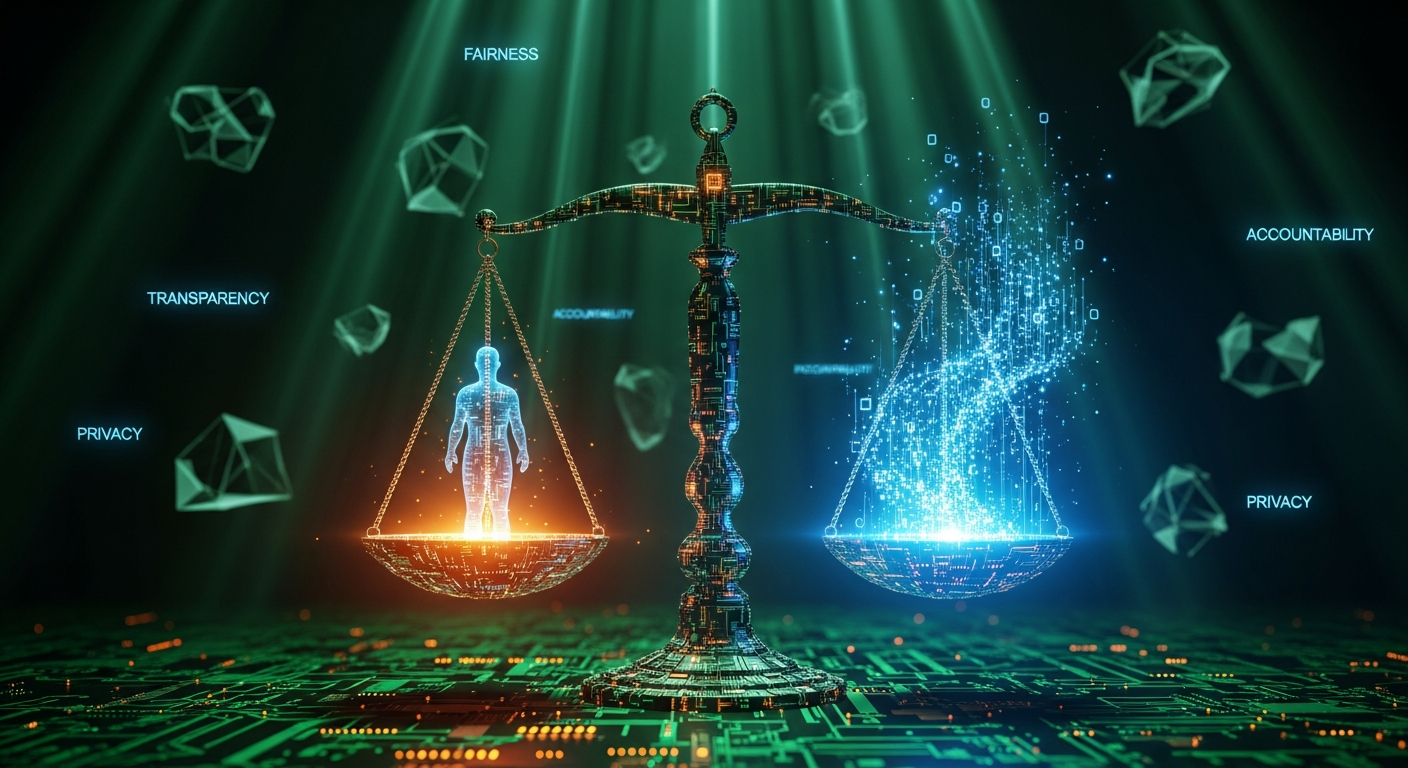
An algorithm decides whether you get the loan, make the interview shortlist, or receive a particular medical recommendation. When it's right, few notice. When it's wrong — when a hiring tool quietly filters out qualified candidates or a credit model discriminates without explanation — the consequences fall on real people, and an urgent question follows: who is responsible? AI ethics is the field devoted to answering that question and ensuring AI is built and used responsibly. In 2026, it has transformed from a set of aspirational principles into a working operational discipline, backed by the world's first comprehensive AI law and a growing web of regulation. Getting AI right is no longer just good practice — increasingly, it's the law.
This guide explains what AI ethics is, why it matters now, the core principles, the key challenges, the regulatory landscape, and how organizations are turning ethics into practice. (This covers a contested, fast-evolving policy area; it aims to give a fair overview of the major positions, not to advocate for any one.)
What Is AI Ethics?
AI ethics is the field concerned with ensuring artificial intelligence is developed and deployed responsibly, fairly, safely, and in alignment with human values and rights. It asks not just what AI can do, but what it should do — and how to prevent harm as AI systems increasingly make or influence consequential decisions. Closely related is "responsible AI," the practice of actually implementing these ethical principles through governance, testing, and oversight.
What's changed by 2026 is the stakes. AI now makes real decisions affecting real people — hiring shortlists, loan approvals, clinical recommendations, content moderation, and the behavior of autonomous systems. That has pushed AI ethics from a philosophical concern into a concrete, operational requirement embedded in how AI is built, bought, and regulated.
Why AI Ethics Matters Now
The reason AI ethics has become urgent is simple: AI is being trusted with decisions that carry real weight, often at scale and often opaquely. A biased hiring algorithm can systematically disadvantage groups of people across thousands of applications. An unexplained credit-scoring model can deny opportunity without recourse. An error in an autonomous system can cause physical harm. As these systems proliferate, the potential for both benefit and harm grows — and unlike a single human decision-maker, a flawed AI system can replicate its mistakes millions of times. Ethics is what stands between AI's enormous capability and the risk of large-scale, automated harm.
The Core Principles
Modern AI ethics frameworks — from the OECD to the EU's foundational "Trustworthy AI" guidelines — converge on a consistent set of principles. The most widely cited include:
- Fairness and non-discrimination — AI should not produce biased or discriminatory outcomes.
- Transparency and explainability — people should be able to understand how and why an AI reached a decision.
- Accountability — there must be clear responsibility for an AI system's behavior and consequences.
- Privacy and data governance — AI must respect data rights and handle personal information responsibly.
- Human agency and oversight — humans should be able to understand, monitor, and override AI decisions.
- Technical robustness and safety — systems should be reliable, secure, and resilient.
- Societal and environmental well-being — AI should benefit society and account for its broader impact.
These principles are meant to be evaluated throughout a system's entire lifecycle, not checked off once.
The Key Ethical Challenges
Several concrete issues dominate AI ethics in practice:
- Bias and fairness. AI trained on biased or unrepresentative data can produce discriminatory outcomes in hiring, lending, policing, and healthcare — one of the most pressing and well-documented problems.
- Transparency (the "black box"). Many powerful AI systems can't easily explain their reasoning, which clashes with the need for accountable, contestable decisions.
- Accountability and liability. When AI causes harm, assigning responsibility among developers, deployers, and users is genuinely difficult.
- Privacy and surveillance. AI's hunger for data raises concerns about consent, tracking, and mass surveillance.
- Safety and misuse. Errors, adversarial attacks, and deliberate misuse can cause serious harm.
- Misinformation and deepfakes. Generative AI can produce convincing false content; regulators are increasingly targeting the worst cases, such as non-consensual intimate imagery.
- Job displacement and autonomy. The societal impact of automation and increasingly autonomous "agentic" AI raises new governance questions.
- Environmental impact. The energy and compute demands of large AI models carry an environmental cost.
The Regulatory Landscape
Governments worldwide are responding, though the global picture is fragmented and fast-moving. The landmark is the EU AI Act — the world's first comprehensive AI law — which takes a horizontal, risk-based approach applying across all sectors. It sorts AI into four tiers: unacceptable risk (banned outright), high risk (strict obligations like risk management, data governance, human oversight, logging, and conformity assessments), limited risk (transparency duties), and minimal risk. It entered into force in 2024, with prohibitions applying from early 2025, general-purpose AI obligations from later 2025, and major high-risk obligations phasing in through 2026 and beyond. Penalties are severe — up to €35 million or 7% of global annual turnover for the worst breaches — and the Act is expected to influence global standards much as Europe's GDPR did for privacy.
The United States has taken the opposite path: as of 2026 there's no single federal AI law, but rather a patchwork of sector-specific guidance and a rapidly growing set of state laws (dozens of states have active AI legislation), alongside agencies like the FTC and FDA acting on issues such as algorithmic bias under existing authority — a landscape that has created real complexity and some legal uncertainty. The United Kingdom has favored a "pro-innovation" approach, extending existing regulators' remits rather than creating a sweeping new law. And a set of international standards — notably the NIST AI Risk Management Framework and ISO/IEC 42001 (a certifiable AI management system) — has become a common language for organizations navigating this patchwork.
From Principles to Practice
Perhaps the biggest shift in 2026 is that AI ethics has become operational rather than aspirational. Fairness, bias, toxicity, and safety checks that were once research experiments are now routine automated evaluators running in production systems. Procurement has changed too: large enterprise and public-sector buyers increasingly demand fairness-evaluation evidence, "model cards" (documentation of a model's capabilities and limits), data sheets, and incident-response plans as part of the purchasing process — before signing, not after. Organizations are appointing accountable owners, writing formal AI policies, conducting lifecycle risk assessments, and pursuing certifications like ISO 42001. The measure of an ethics program is no longer a well-written policy document but whether ethical behavior actually shows up in the system's runtime behavior. Responsible AI has become an engineering discipline.
The Innovation vs Regulation Debate
Underlying all of this is a genuine and unresolved debate about how to balance innovation with protection. The EU's model is rights-based and precautionary, prioritizing fundamental rights and safety with comprehensive rules — critics argue this risks slowing innovation and burdening smaller companies, while supporters say it builds essential trust and protects people. The US and UK approaches lean innovation-first, favoring lighter-touch, sector-specific oversight — critics warn this leaves gaps that allow real harms, while supporters argue it preserves the flexibility to innovate quickly. Reasonable people disagree, and the tension reflects deeper questions about risk, values, and who bears the cost of getting AI governance wrong. The rise of increasingly autonomous agentic AI is adding new urgency and new questions to this debate. There's no consensus answer, and the balance struck will vary by jurisdiction and evolve as the technology does.
The Future
AI ethics will only grow more central as AI becomes more capable and pervasive. Expect continued regulatory development and gradual convergence toward international standards, deeper integration of ethics tooling into AI development, growing attention to the governance of autonomous agents, and rising demand for professionals who can bridge ethics, law, and engineering. The core challenge will persist: harnessing AI's immense benefits while preventing its harms, in a way that's fair, transparent, and accountable. As AI weaves ever deeper into consequential decisions, the discipline of doing it responsibly moves from the margins to the center of the entire field.
Conclusion
AI ethics is the essential work of ensuring artificial intelligence serves people fairly, safely, and accountably rather than causing large-scale automated harm. Anchored in principles like fairness, transparency, accountability, and human oversight, it confronts concrete challenges — bias, black-box opacity, privacy, safety, and misinformation — that carry real consequences as AI makes more of the decisions shaping our lives.
In 2026, ethics has become operational and increasingly legal, led by the EU AI Act and a patchwork of global regulation, and implemented through evaluators, governance, and standards embedded in production. The debate over how to balance innovation and protection remains genuinely open, with thoughtful arguments on all sides. Understanding AI ethics is essential not just for builders and regulators, but for anyone whose life is increasingly touched by automated decisions — which, by now, is everyone.
Want more? Explore AxionSquare for ongoing coverage of AI ethics, artificial intelligence, and the technologies reshaping our world.
Frequently Asked Questions
What is AI ethics?
AI ethics is the field concerned with ensuring artificial intelligence is developed and used responsibly, fairly, safely, and in alignment with human values and rights. It asks not just what AI can do but what it should do, and how to prevent harm as AI systems increasingly make consequential decisions. Related is "responsible AI" — the practice of implementing these principles.
What are the main principles of AI ethics?
Widely cited principles include fairness and non-discrimination, transparency and explainability, accountability, privacy and data governance, human agency and oversight, technical robustness and safety, and societal and environmental well-being. These are meant to be evaluated across an AI system's entire lifecycle, not checked once.
What is the EU AI Act?
The EU AI Act is the world's first comprehensive AI law, taking a risk-based approach that sorts AI into four tiers — unacceptable (banned), high risk (strict obligations), limited (transparency duties), and minimal risk. It carries penalties up to €35 million or 7% of global turnover and is expected to influence global AI standards much as GDPR did for privacy.
Why is AI bias such a big concern?
AI trained on biased or unrepresentative data can produce discriminatory outcomes in high-stakes areas like hiring, lending, policing, and healthcare. Unlike a single human decision, a biased AI system can replicate its mistakes at massive scale, systematically disadvantaging groups of people. This makes bias one of the most pressing and well-documented ethical challenges.
How do companies implement AI ethics in practice?
In 2026, AI ethics has become operational: companies run automated fairness, bias, and safety evaluators in production, document models with "model cards," conduct lifecycle risk assessments, appoint accountable owners, and pursue certifications like ISO 42001. Procurement increasingly requires fairness evidence and incident-response plans, making ethics an engineering discipline rather than a policy document.
Sources and further reading
- European Parliament - EU AI Act Summary — Legislative framework and requirements for AI safety and ethics
- NIST AI Risk Management Framework — Standards for operationalizing AI ethics and risk management