AI Infrastructure in 2026: The Compute Buildout
A clear guide to AI infrastructure in 2026 — the data centers, GPUs, power, and cooling behind AI, the trillion-dollar buildout, why power is the constraint, and the bubble debate.
Artificial Intelligence · Global · 2026-09-15 · 11 min read · By John Awab
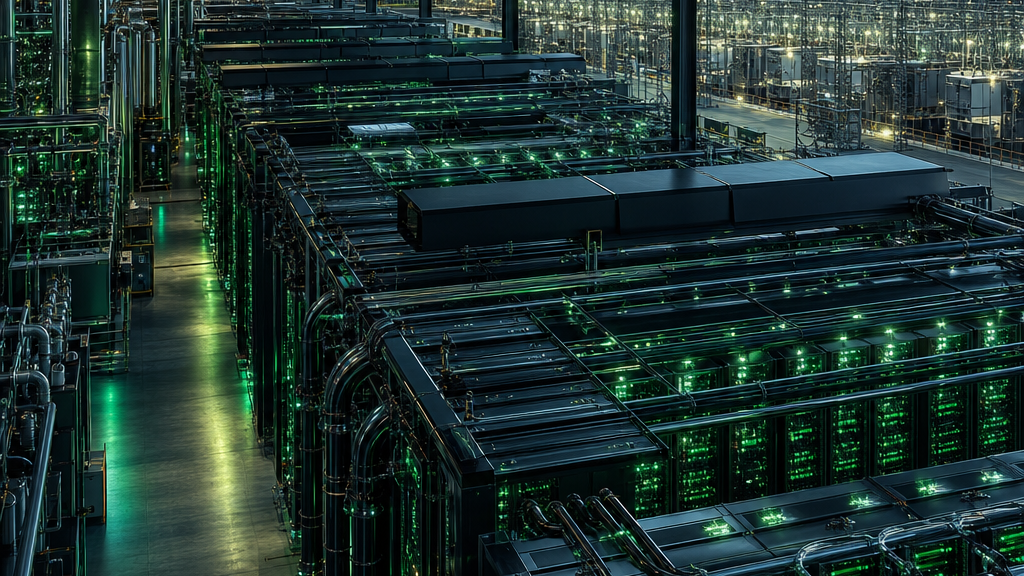
Behind every AI chatbot response, generated image, and autonomous agent sits a physical reality most people never see: warehouse-sized buildings packed with specialized chips, drawing as much electricity as a small city, cooled by industrial plumbing, and costing tens of millions of dollars per megawatt to build. This is AI infrastructure — the compute, data centers, power, and cooling that make artificial intelligence possible — and in 2026 it has become the site of the largest, fastest capital buildout in the history of technology. The world's biggest companies are collectively spending upward of $700 billion in a single year on it, a figure that dwarfs entire industries. The AI revolution isn't just a software story; it's one of the most consequential infrastructure booms of our time, and it's straining electrical grids, reshaping real estate, and provoking fierce debate about whether it's a supercycle or a bubble.
This guide explains what AI infrastructure is, the physical stack behind AI, the staggering scale of the buildout, why power has become the binding constraint, the key players, the challenges, and the bubble question. (Figures vary by source and change fast, so treat them as estimates.)
What Is AI Infrastructure?
AI infrastructure is the physical foundation that powers artificial intelligence: the data centers, computing hardware, power systems, cooling, networking, land, and construction required to train and run AI models at scale. When people talk about AI, they usually mean the models and applications; AI infrastructure is everything underneath — the "picks and shovels" of the AI gold rush.
The easiest way to misunderstand it is to treat it as simply buying chips. Accelerators (the specialized processors) are the headline, but they account for a shrinking share of the total. By one 2026 analysis, roughly 75% of hyperscaler capital spending is tied to AI-specific infrastructure — and of that, more than 60% goes into power infrastructure, cooling systems, and data center construction rather than the compute hardware itself. AI infrastructure is a full stack of interlocking physical systems, and understanding it means looking well beyond the GPU.
The Physical Stack Behind AI
AI infrastructure is built in layers, each essential:
- Accelerators (the compute layer) — the core unit is the AI accelerator, a processor purpose-built for the massive parallel computation AI demands (GPUs and other "XPUs"). Leading systems pack dozens of these into a single rack — NVIDIA's flagship rack-scale systems put 72 processors in one rack — connected by high-speed backplanes and linked across facilities by vast lengths of cabling.
- Networking — the high-speed interconnects that let thousands of accelerators work together as one giant computer, since training a large model splits the work across enormous clusters.
- Power delivery — each AI server rack demands sophisticated power systems handling hundreds of kilowatts, with voltage regulators, converters, and specialized power chips flowing electricity to the GPU clusters.
- Cooling — these dense systems generate enormous heat, requiring industrial-scale liquid cooling rather than the air cooling of traditional data centers. This is one of the defining technical shifts of AI-era infrastructure.
- The data center shell — the building itself, with redundancy, land, fiber, and increasingly its own dedicated power generation.
- Power generation and the grid — connection to the electrical grid or, increasingly, "behind-the-meter" generation built specifically for the facility.
Together, these layers turn raw electricity and silicon into the computational engine of modern AI.
The Staggering Scale
The numbers behind the AI buildout are difficult to comprehend. The largest technology companies — the "hyperscalers" including Amazon, Microsoft, Alphabet, and Meta — have disclosed combined 2026 capital-expenditure guidance in the range of roughly $650–725 billion, the vast majority directed at AI compute, data centers, and networking. Individual figures are staggering: Amazon around $200 billion, Alphabet in the $175–185 billion range, Meta $115–135 billion, and Microsoft tracking toward $120 billion or more, with Oracle and others adding tens of billions each.
For context, one analysis notes the entire US energy sector spends roughly $180 billion on capital investment per year — meaning the hyperscalers are set to outspend it by roughly four times on data centers alone. Looking further out, baseline industry models project on the order of $6.7–7.6 trillion of cumulative AI infrastructure capital between roughly 2025 and 2031, with annual AI capex potentially growing from around $765 billion in 2026 toward $1.6 trillion by 2031. Over 23 gigawatts of data center capacity was under construction globally by late 2025 — about three-quarters of it in the US — and estimates suggest roughly 100 gigawatts of new capacity could come online between 2026 and 2030. This is capital deployment at a scale and speed rarely seen in economic history.
Power: The New Binding Constraint
Here's the single most important shift to understand about AI infrastructure in 2026: the bottleneck is no longer chips — it's power. For years, the constraint was securing enough GPUs. Now, hyperscalers report their markets are supply-constrained on infrastructure, and the scarcest resource has become electricity and the equipment to deliver it.
The reason is simple physics: AI data centers consume staggering amounts of power, and building them faster now depends on power strategy rather than pouring concrete faster. Developers must answer a gating question before anything else — can the local utility actually deliver the required megawatts in the tenant's timeframe? Available power, substation proximity, transmission constraints, and interconnection-queue position have become the make-or-break factors. Power infrastructure alone drives an estimated 30–40% of total facility cost.
This has triggered a scramble for electricity. Operators are moving into secondary markets as prime locations like Northern Virginia (the world's largest data center hub) hit capacity limits. They're increasingly pursuing "behind-the-meter" generation — building dedicated power (including deals for solar, storage, and even nuclear) rather than waiting in grid queues, a shift signaled by large acquisitions of power companies by tech giants. Global hyperscale capacity dedicated to AI is projected to expand dramatically — by one estimate from around 11.5 gigawatts in 2026 to over 43 gigawatts by 2031. The AI boom has, in effect, become an energy story as much as a computing one, with real implications for electricity prices and grids.
The Economics and Financing
The AI buildout is extraordinarily capital-intensive, and a defining feature is that much of the spend goes to GPUs and compute hardware with short useful lives (a few years) compared to the buildings and power systems (decades). This "front-loaded" capex profile is reshaping how the buildout is financed. Companies are turning to debt, lease structures, and asset-backed financing — with projections of well over a trillion dollars in debt issuance over the coming years and GPU-collateralized lending scaling rapidly. Construction costs have soared: shell-and-core data center costs have risen to a global average around $11 million per megawatt (up from under $8 million in 2020), while AI-optimized facilities with high power density and liquid cooling clear $20 million per megawatt, and all-in AI builds including the GPU fit-out run $30–40 million per megawatt. The scale of capital involved, and the shorter refresh cycles of the compute layer, are pulling data centers into the same underwriting models as power and real estate — and driving increased M&A and joint ventures as owners seek scale.
The Key Players
The AI infrastructure ecosystem spans several layers. The hyperscalers (Amazon/AWS, Microsoft, Google, Meta) are the largest buyers, building for their own use and cloud customers. Chipmakers lead by NVIDIA — the dominant accelerator supplier, whose data center revenue reached roughly $93.7 billion in its fiscal 2026 — alongside AMD, Broadcom, and the foundries (TSMC) and equipment makers (ASML) beneath them. Specialized "neocloud" providers like CoreWeave and Nebius rent out GPU capacity. Power and cooling suppliers, electrical-equipment makers, and construction and real estate developers form the physical build-out layer. And large sovereign and private capital is flowing in through mega-projects and dedicated AI infrastructure funds. Notably, China is building its own AI infrastructure on a different model, with companies like Alibaba and ByteDance committing tens of billions, reflecting the geopolitical dimension of the compute race.
The Challenges and the Bubble Debate
The AI infrastructure boom faces serious challenges, and honest observers acknowledge genuine uncertainty:
- Power availability — the binding constraint, with grids strained and equipment (transformers, switchgear, power chips) in short supply.
- The bubble question — the central debate. The spending is enormous, and a real question hangs over whether AI revenues will ultimately justify this record infrastructure investment. Optimists point to strong revenue growth at AI companies (OpenAI reportedly reaching around $20 billion in annual recurring revenue) and argue infrastructure suppliers are delivering real earnings, not just hype. Skeptics warn the capex has run far ahead of proven returns, that short-lived GPUs could become stranded assets, and that debt-financed buildouts carry real risk if demand disappoints. Both views are seriously held, and the truth likely depends on whether AI adoption and monetization keep pace with the physical buildout — which no one can predict with certainty.
- Supply-chain strain — the buildout is stressing supplies of everything from power chips (made on mature nodes that haven't seen matching investment) to electrical equipment.
- Grid and community impacts — rising electricity demand raises concerns about prices, emissions, and local grid strain.
- Execution risk — some operators face distress when they can't secure power or execute, and analysts expect consolidation.
The honest framing: AI infrastructure is simultaneously one of the most important buildouts of the era and one of its biggest financial bets, with the "supercycle versus bubble" question genuinely unresolved.
The Future
AI infrastructure will remain a defining economic force. Expect the buildout to continue at massive scale (hyperscalers report demand outpacing supply), power to remain the central constraint driving innovation in generation, storage, and behind-the-meter solutions, and efficiency improvements in chips and cooling to become increasingly important as energy limits bite. Expect continued financial engineering to fund it, ongoing consolidation, and — hanging over everything — the unresolved question of whether returns will justify the investment. Whatever the answer, AI infrastructure has already reshaped technology, energy, real estate, and capital markets, and its trajectory will be one of the most consequential economic stories of the decade.
Conclusion
AI infrastructure is the vast physical foundation beneath artificial intelligence — the data centers, accelerators, networking, power, and cooling that transform electricity and silicon into computational intelligence. In 2026, it has become the largest and fastest capital buildout in tech history, with hyperscalers spending upward of $700 billion in a single year and cumulative investment projected in the trillions.
The defining realities are that AI infrastructure is far more than chips (power, cooling, and construction dominate the spend), that power has replaced compute as the binding constraint, and that a genuine debate rages over whether the returns will justify the extraordinary investment. Understanding AI infrastructure reveals the physical machinery and colossal economics behind the AI revolution — a buildout reshaping grids, real estate, and markets, and a bet whose ultimate payoff remains one of the great open questions of our time.
Want more? Explore AxionSquare for ongoing coverage of AI infrastructure, semiconductors, AI in business, and the technologies powering the future.
Frequently Asked Questions
What is AI infrastructure?
AI infrastructure is the physical foundation that powers artificial intelligence — the data centers, computing hardware (accelerators/GPUs), power systems, cooling, networking, land, and construction needed to train and run AI models at scale. It's the "picks and shovels" beneath AI models and applications. Notably, most of the spending goes to power, cooling, and construction rather than the chips themselves.
How much is being spent on AI infrastructure in 2026?
The largest tech companies (hyperscalers like Amazon, Microsoft, Alphabet, and Meta) have guided to combined 2026 capital spending of roughly $650–725 billion, mostly for AI compute and data centers. For scale, that's about four times the entire US energy sector's annual capital investment. Baseline models project cumulative AI infrastructure investment on the order of $6.7–7.6 trillion between roughly 2025 and 2031.
Why is power the main constraint for AI data centers?
AI data centers consume enormous amounts of electricity, and the ability to build them now depends on securing power rather than construction speed. Developers must confirm the local utility can deliver the required megawatts in time — factoring in substation proximity, transmission limits, and interconnection queues. Power infrastructure drives an estimated 30–40% of facility cost, and prime markets are hitting capacity limits, pushing operators toward secondary markets and dedicated generation.
Why do AI data centers need liquid cooling?
AI accelerators packed densely into racks generate enormous heat — far more than traditional servers. Air cooling can't handle these power densities, so AI-era data centers increasingly require industrial-scale liquid cooling, where coolant is circulated directly to the hardware. This shift to liquid cooling is one of the defining technical changes of AI infrastructure and adds significantly to facility cost and complexity.
Is AI infrastructure spending a bubble?
It's genuinely debated. The spending is enormous and has, by some measures, run ahead of proven AI revenues, and short-lived GPUs could become stranded assets if demand disappoints — real risks given the heavy debt financing. Optimists counter that AI revenues are growing strongly and infrastructure suppliers are delivering real earnings. Whether it's a supercycle or a bubble likely depends on whether AI adoption and monetization keep pace with the physical buildout — which remains uncertain.