Computer Vision: Architectures and Industrial Applications
An overview of the $24–32 billion computer vision sector and its transition from experimental research to critical industrial infrastructure.
Artificial Intelligence · Global · 2026-06-23 · 11 min read · By John Awab
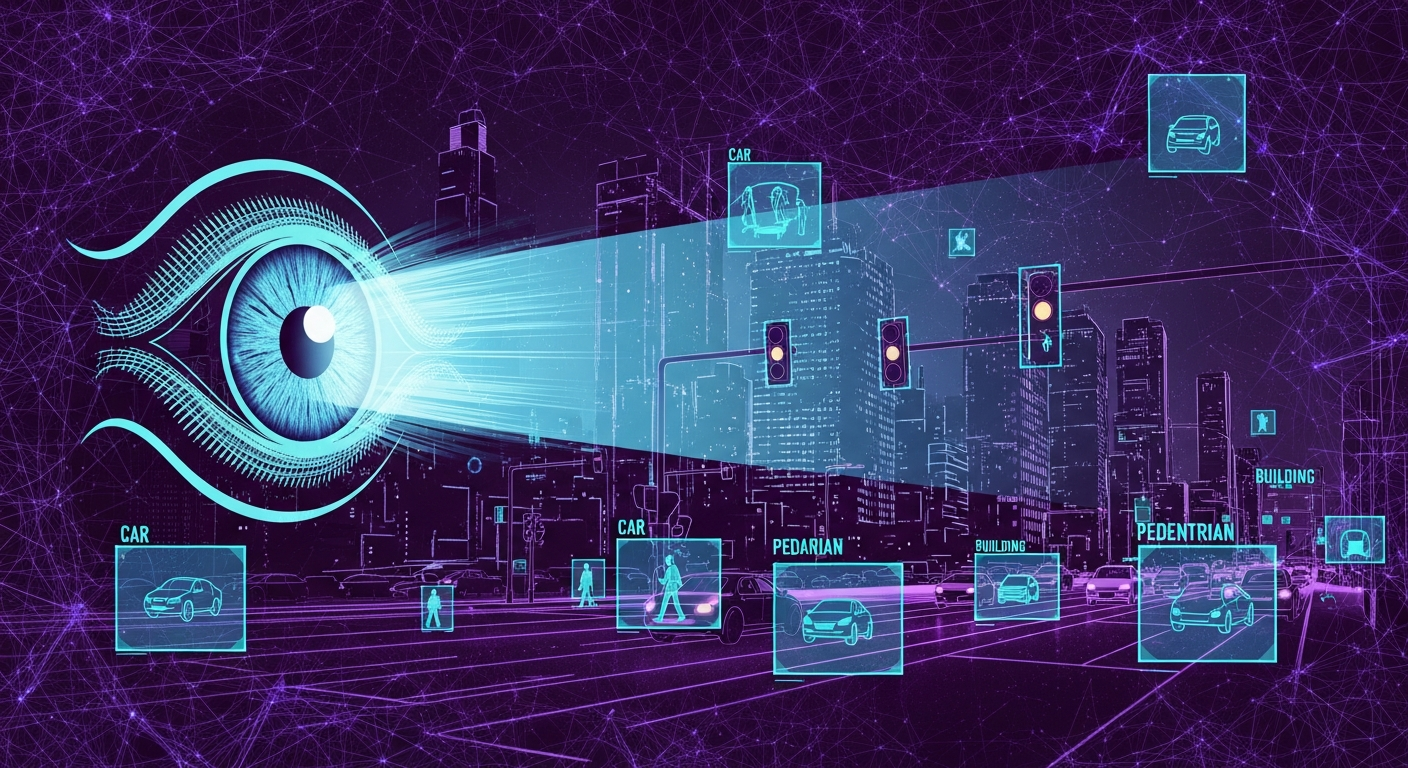
A self-driving car reading the road, a factory camera catching a defect human eyes would miss, a phone unlocking at a glance, a medical scan flagged for a radiologist — all of these are computer vision at work. The branch of artificial intelligence that teaches machines to "see" and interpret the visual world has quietly become mission-critical infrastructure across industry. No longer an experimental curiosity, computer vision now powers a market worth roughly $24–32 billion and growing, embedded in everything from factory floors to hospital imaging suites.
This guide explains what computer vision is, how it works, its core tasks, the trends reshaping it in 2026, where it's used, and the challenges that remain. (Market figures vary by source and scope, so treat them as estimates.)
What Is Computer Vision?
Computer vision is the field of AI that enables computers to derive meaning from images and video — to detect, classify, and understand objects, people, and scenes much as humans do with their eyes and brain. Where a human glances at a photo and instantly recognizes a dog, a stop sign, or a friend's face, computer vision aims to give machines that same ability to perceive and interpret visual information automatically.
It's a subset of artificial intelligence and a close cousin of machine learning, focused specifically on the visual world. The goal isn't just to "see" pixels but to understand what they mean — turning raw images into actionable insight.
How Computer Vision Works
Modern computer vision is built on deep learning. Rather than hand-coding rules for what a cat looks like, engineers train neural networks on large sets of labeled images, and the network learns the visual patterns itself. For years the workhorse was the convolutional neural network (CNN), which scans an image in pieces to detect edges, textures, shapes, and ultimately objects. More recently, Vision Transformers (ViTs) have largely overtaken CNNs for complex tasks, because they capture long-range relationships across an entire image rather than local patches.
The typical pipeline runs: collect and label image data, train a model to recognize the target patterns, validate it on unseen images, then deploy it to make predictions (inference) on new visuals — increasingly in real time. As with all machine learning, the quality of the training data is decisive: garbage in, garbage out.
The Core Tasks of Computer Vision
Computer vision breaks down into several fundamental tasks:
- Image classification — labeling what an image contains (e.g., "this is a cat").
- Object detection — locating and identifying multiple objects within an image, drawing boxes around each.
- Image segmentation — classifying every pixel to outline exactly where objects are, down to their shape.
- Facial recognition — identifying or verifying individuals from their faces.
- Optical character recognition (OCR) — reading text from images and documents.
- Object tracking — following objects across video frames.
- Pose estimation — detecting body or joint positions.
- 3D vision and depth estimation — understanding spatial structure and distance.
Most real-world systems combine several of these to accomplish a goal.
What's New in 2026
The field has shifted markedly. Vision Transformers now handle messy real-world variation better than older architectures. Foundation and multimodal models — which process images alongside text and audio — enable richer scene understanding and even "zero-shot" recognition, where a system identifies new objects from a text prompt without being retrained for them. Edge AI runs vision models directly on devices (cameras, drones, vehicles) for millisecond, low-latency inference without a round-trip to the cloud — critical for autonomous vehicles and industrial cameras. Synthetic data generated by AI is reducing the expensive burden of labeling real images. And the lab-to-production gap has become the defining engineering challenge: getting models to work as well on a factory floor or hospital camera as they do on clean benchmark datasets.
Where Computer Vision Is Used
Computer vision has spread across virtually every sector:
- Manufacturing — the dominant market, where vision systems perform quality inspection, catching defects at line speed around the clock, guiding robots, and monitoring worker safety.
- Automotive — object recognition for self-driving cars and driver-assistance systems; robotaxi services now run driverless in multiple cities.
- Healthcare — analyzing medical images, assisting diagnosis, guiding surgery, and accelerating drug discovery through microscopy analysis.
- Retail — checkout-free stores, shelf monitoring, and virtual try-on.
- Agriculture — assessing crop health and optimizing yields from drone and ground imagery.
- Security and smart cities — surveillance, traffic monitoring, and infrastructure inspection.
- Logistics, construction, and sports — tracking, safety, and performance analytics.
A recent analysis of hundreds of thousands of real projects found computer vision is now treated as essential operational infrastructure rather than an experiment.
The Lab-vs-Production Gap
The central challenge of computer vision in 2026 isn't whether the technology works — it's making it work reliably in your specific environment. Off-the-shelf vision tools that dazzle in demos frequently stumble in production, where lighting shifts, camera angles vary, and real-world conditions defy clean benchmarks. Bridging this gap usually requires custom development: gathering representative training data, adapting models to the actual deployment conditions, and validating thoroughly before trusting results in safety-critical settings.
Privacy, Ethics, and Regulation
Because computer vision often involves cameras and people, it raises serious privacy and ethical questions — especially facial recognition and surveillance. Regulators are responding: Europe's data-protection and AI rules, along with a growing patchwork of US state AI privacy laws, are tightening how visual data can be collected and used, and demanding transparency about automated decisions. Bias is another concern, as vision models can perform unevenly across different groups if training data doesn't represent them well, raising questions of fairness in high-stakes uses like hiring, policing, and healthcare.
How Computer Vision Fits With Other AI
Computer vision doesn't operate in isolation. It's a specialized branch of AI built on deep learning, and it increasingly blends with other fields: multimodal models fuse vision with the language understanding of large language models, robotics and autonomous vehicles depend on vision to perceive their surroundings, and AR/VR and spatial computing rely on real-time scene understanding. Understanding computer vision alongside machine learning, generative AI, and LLMs reveals a converging AI stack where visual, linguistic, and reasoning capabilities increasingly work together.
The Future
Expect computer vision to grow more capable, contextual, and embedded. Foundation and multimodal models will deepen scene understanding, edge deployment will put real-time vision in ever more devices, 3D and video understanding will mature, and synthetic data will further reduce the labeling bottleneck. As the technology becomes cheaper and more accessible — available even to small companies through cloud APIs — visual intelligence will become a routine product capability rather than a specialist research domain.
Conclusion
Computer vision is the branch of AI that gives machines sight — using deep learning, and increasingly Vision Transformers and multimodal models, to turn images and video into understanding. Through core tasks like classification, detection, and segmentation, it now drives manufacturing inspection, autonomous vehicles, medical imaging, retail, agriculture, and far more, in a market worth tens of billions and climbing.
The technology has crossed from research into production, but real success hinges on bridging the lab-to-production gap, handling data and privacy responsibly, and integrating vision with the broader AI stack. As foundation models, edge computing, and synthetic data advance, computer vision is becoming one of the most pervasive and powerful forms of AI — quietly reshaping how the world is seen, measured, and automated.
Want more? Explore AxionSquare for ongoing coverage of computer vision, machine learning, AI, and the technologies shaping the future.
Frequently Asked Questions
What is computer vision?
Computer vision is the field of AI that enables computers to derive meaning from images and video — detecting, classifying, and understanding objects, people, and scenes much as humans do. It's a subset of AI focused on the visual world, turning raw pixels into actionable insight.
How does computer vision work?
It relies on deep learning: neural networks are trained on large sets of labeled images to learn visual patterns. Convolutional neural networks were long the standard, but Vision Transformers now lead for complex tasks. The pipeline runs from data collection and labeling to training, validation, and real-time inference.
What are the main tasks in computer vision?
Core tasks include image classification (labeling an image), object detection (locating multiple objects), image segmentation (classifying every pixel), facial recognition, optical character recognition (OCR), object tracking, pose estimation, and 3D/depth understanding. Real systems often combine several.
What is computer vision used for?
Applications span manufacturing (defect inspection), automotive (self-driving cars and driver assistance), healthcare (medical imaging and diagnosis), retail (checkout-free stores), agriculture (crop monitoring), security and smart cities (surveillance and traffic), plus logistics, construction, and sports analytics.
What is the biggest challenge in computer vision today?
The main challenge is the gap between lab and production: off-the-shelf tools often fail in real environments where lighting, angles, and conditions vary. Bridging it requires custom development, representative training data, and rigorous real-world validation — plus careful handling of privacy and bias.