Digital Twin Technology: Applications in Industrial Optimization
Technical breakdown of digital twin architecture, integrating IoT and AI for real-time asset monitoring, performance modeling, and predictive maintenance.
Technology · Global · 2026-08-20 · 10 min read · By John Awab
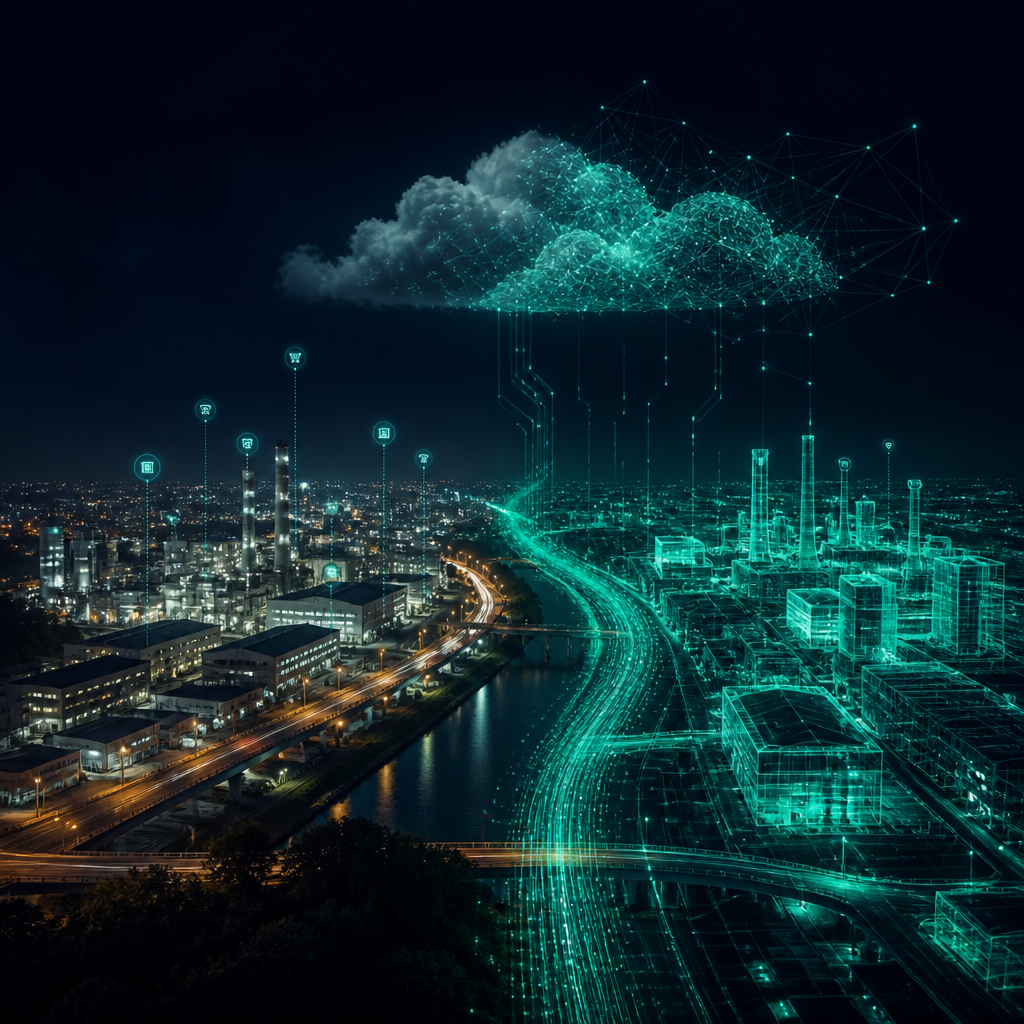
Imagine having a perfect, living virtual copy of a jet engine, a factory, an entire city — or even yourself — that updates in real time as its physical counterpart changes, letting you test ideas, predict failures, and optimize performance without touching the real thing. That's a digital twin, and in 2026 it has moved from an industrial buzzword into one of the foundational technologies of digital transformation. Powered by a convergence of the Internet of Things, artificial intelligence, and cloud computing, digital twins let organizations experiment in a risk-free virtual world before acting in the costly physical one. The concept is spreading fast — from the factory floor into energy grids, hospitals, city planning, and now even the office, where AI-driven "virtual colleagues" are the latest frontier.
This guide explains what digital twins are, how they work, the main types, the transformative AI convergence, real-world applications, the market, the challenges, and where the technology is heading. (Market figures vary widely by source and scope, so treat them as estimates.)
What Is a Digital Twin?
A digital twin is a dynamic, virtual representation of a physical object, system, or process that is connected to its real-world counterpart and updates in real time using live data. It's crucial to understand what separates a true digital twin from a simple 3D model or simulation: the live, two-way data connection. A digital twin isn't a static blueprint — it continuously receives data from sensors on the physical asset, mirroring its current state, behavior, and conditions, and can send insights or instructions back.
This living link is the defining feature. A 3D model shows what something looks like; a simulation shows how something might behave; a digital twin reflects how a specific, real thing is actually behaving right now, and how it's likely to behave next. That connection to reality — powered by continuous data exchange — is what makes digital twins so powerful, and why experts caution against calling anything without that continuous data flow a genuine "twin."
How Digital Twins Work
A digital twin is built from a stack of technologies working together. Sensors and IoT devices on the physical asset collect real-time data — temperature, vibration, pressure, location, performance metrics. That data flows via connectivity (increasingly 5G for speed) to the digital model. Cloud and edge computing provide the processing power to run the twin, with edge handling time-sensitive processing close to the source. Analytics and AI interpret the incoming data, identify patterns, and generate predictions. And a modeling and simulation layer — often combining physics-based models with AI — lets the twin not just mirror the present but simulate future scenarios.
The result is a continuous loop: the physical asset feeds data to its twin, the twin analyzes and simulates, and the insights flow back to optimize the real asset. This "sense, model, predict, optimize" cycle is what turns raw sensor data into operational intelligence.
The Types of Digital Twins
Digital twins exist at different scales, commonly categorized into a hierarchy:
- Component (or parts) twins — the smallest unit, modeling a single component like a specific motor or valve.
- Asset (or product) twins — modeling a complete product or piece of equipment, like an entire jet engine or vehicle, showing how its components work together.
- System (or unit) twins — modeling how multiple assets function together as a system, like an entire production line or power plant. System twins have become the dominant category as enterprises seek to optimize interconnected operations rather than isolated parts.
- Process twins — the largest scale, modeling entire processes or operations, like a whole factory, supply chain, or even a city, to optimize how everything works together.
This hierarchy lets organizations start small — twinning a single critical component — and scale up to modeling entire systems and processes as value is proven.
The AI Convergence: The Defining Shift
The most important development in 2026 is the fusion of digital twins with artificial intelligence, transforming them from passive mirrors into intelligent, predictive systems. Traditional digital twins reflected the present and required humans to interpret them. AI-driven twins analyze their own data to identify patterns, forecast failures before they happen, recommend corrective actions, and increasingly act autonomously.
A key maturation is the integration of physics-based simulation with AI, enabling a "train-simulate-deploy-optimize" lifecycle that compresses the time from concept to live deployment. Rather than simple 3D modeling, the market now demands precise, simulation-ready digital environments where AI can be trained and tested virtually before real-world rollout. This shift — from digital replicas to intelligent, AI-driven systems — is what's turning digital twins from a monitoring tool into a genuine decision-making and automation engine. The synergy runs both ways: digital twins give AI a rich, realistic environment to learn in, and AI gives digital twins the intelligence to predict and optimize.
Real-World Applications
Digital twins have moved well beyond theory into wide practical use:
- Manufacturing — the flagship use case. Digital twins enable real-time production monitoring, predictive maintenance (spotting equipment failures before they happen), virtual prototyping, and production-line optimization, dramatically reducing costly unplanned downtime.
- Energy and utilities — twinning power plants, grids, and wind farms to optimize output, predict maintenance, and manage complex systems.
- Healthcare — modeling organs, medical devices, or even patient-specific twins to plan treatments, test scenarios, and improve outcomes without physical risk.
- Automotive and transportation — one of the fastest-growing sectors, twinning vehicles for design, testing, and performance optimization.
- Smart cities and infrastructure — modeling buildings, transport networks, and entire cities to plan development, manage resources, and improve sustainability.
- Aerospace and defense — a mature adopter, twinning aircraft and complex systems for engineering and maintenance.
- The office — a striking new frontier: AI "digital twin" virtual colleagues designed to act as extensions of a worker, drafting emails and scheduling by pulling context from calendars, CRMs, and other systems.
The common thread is measurable value — reduced downtime, better asset performance, improved design, and smarter decisions.
The Market
The digital twin market is among the fastest-growing in enterprise technology, though estimates vary considerably by scope. Placements commonly put the market around $35 billion in 2026, with projections ranging from roughly $73 billion by 2027 (in more aggressive analyses citing ~60% annual growth) to $260 billion by 2033 at a compound annual growth rate above 30%. Whatever the precise figure, every forecast agrees the market is scaling rapidly. Growth is driven by accelerating Industrial IoT adoption, maturing AI-powered simulation, rising demand for real-time operational intelligence, and falling implementation costs (as cloud, edge, and analytics mature) that are opening digital twins to mid-market and smaller companies previously priced out. North America leads (around 38% share, with strong cloud ecosystems and defense digital-engineering investment), while Asia-Pacific grows fastest, propelled by industrial digitalization in China and manufacturing expansion in India. Governments are also institutionalizing digital twins — through the EU's Industry 5.0 framework, US infrastructure programs, and national digital-twin initiatives — as a competitiveness priority.
The Challenges
Digital twins face real hurdles that temper the enthusiasm:
- Data quality and integration — a twin is only as good as its data; poor or disconnected data undermines the whole model, and the biggest failure mode is building "twins" without genuine continuous data exchange.
- Cost and complexity — while falling, building and maintaining sophisticated twins still requires significant investment and expertise.
- Integration with legacy systems — connecting twins to older equipment and IT systems is genuinely difficult.
- Cybersecurity — a digital twin connected to critical physical infrastructure is a potential attack surface, raising serious security concerns.
- Skills and data governance — organizations need the talent and data practices to build and act on twins effectively.
- Supply-chain and hardware costs — trade and tariff pressures have raised the cost of sensors and industrial hardware, nudging some adopters toward software-centric approaches.
The clearest guidance from analysts: focus on sectors with measurable ROI (asset-intensive industries like manufacturing and energy) and avoid twins built without the continuous data connection that makes them real.
The Future
Digital twins are set to become more intelligent, accessible, and pervasive. Expect deeper AI integration making twins increasingly autonomous and predictive; broader adoption as costs fall and cloud-based twins reach smaller companies; expansion into new domains from personalized healthcare to entire smart cities; and growing government and enterprise investment treating digital twins as core digital infrastructure. The line between physical and digital will keep blurring as twins become richer and more real-time. In the long run, digital twins may become the standard interface through which organizations understand and control their physical operations — a living mirror of reality that lets us test the future before we build it.
Conclusion
Digital twins are dynamic virtual replicas of physical objects, systems, and processes — connected by live data and distinguished from ordinary models by that continuous, two-way link to reality. Built from IoT sensors, connectivity, cloud and edge computing, and increasingly AI, they let organizations monitor, simulate, predict, and optimize their physical world in a risk-free virtual environment.
In 2026, the fusion with AI is transforming digital twins from passive mirrors into intelligent, predictive systems, while applications span manufacturing, energy, healthcare, transportation, smart cities, and even the office. Real challenges around data quality, cost, integration, and security remain, but the trajectory is unmistakable: rapid growth and deepening importance. Understanding digital twins reveals one of the foundational technologies of the digital age — a bridge between the physical and virtual worlds that is changing how we design, operate, and optimize almost everything.
Want more? Explore AxionSquare for ongoing coverage of digital twins, the Internet of Things, artificial intelligence, and the technologies shaping the future.
Frequently Asked Questions
What is a digital twin?
A digital twin is a dynamic virtual representation of a physical object, system, or process, connected to its real-world counterpart and updated in real time using live data. Unlike a static 3D model or a one-off simulation, a true digital twin has a continuous, two-way data connection that mirrors the actual current state of a specific real thing and can send insights back to optimize it.
How does a digital twin work?
It combines IoT sensors on the physical asset (collecting real-time data), connectivity like 5G, cloud and edge computing (for processing), AI and analytics (to interpret data and predict), and a modeling/simulation layer. This creates a continuous "sense, model, predict, optimize" loop: the asset feeds data to its twin, the twin analyzes and simulates, and insights flow back to improve the real asset.
What are the different types of digital twins?
They're commonly categorized by scale: component twins (a single part like a motor), asset twins (a complete product like a jet engine), system twins (multiple assets working together, like a production line — now the dominant category), and process twins (entire operations like a factory, supply chain, or city). Organizations often start with one component and scale up.
What are digital twins used for?
Major applications include manufacturing (predictive maintenance, production optimization, virtual prototyping), energy and utilities, healthcare (patient and organ models), automotive and transportation, smart cities and infrastructure, and aerospace and defense. A new 2026 frontier is AI "virtual colleague" twins in the office. The common goal is reducing downtime and improving performance through risk-free virtual testing.
What is the difference between a digital twin and a simulation?
A simulation models how something might behave under set conditions, typically as a one-off study, without a live link to a specific physical object. A digital twin maintains a continuous, real-time, two-way data connection to a specific real asset — reflecting how that exact thing is actually behaving now and predicting what it will do next. The live data connection is the key distinction.