The Global Drone Economy: Regulation and Commercial Scaling
Global drone markets are poised for significant expansion as regulatory frameworks evolve to accommodate large-scale commercial flight and complex supply chain requirements.
Robotics · Global · 2026-06-15 · 10 min read · By John Awab
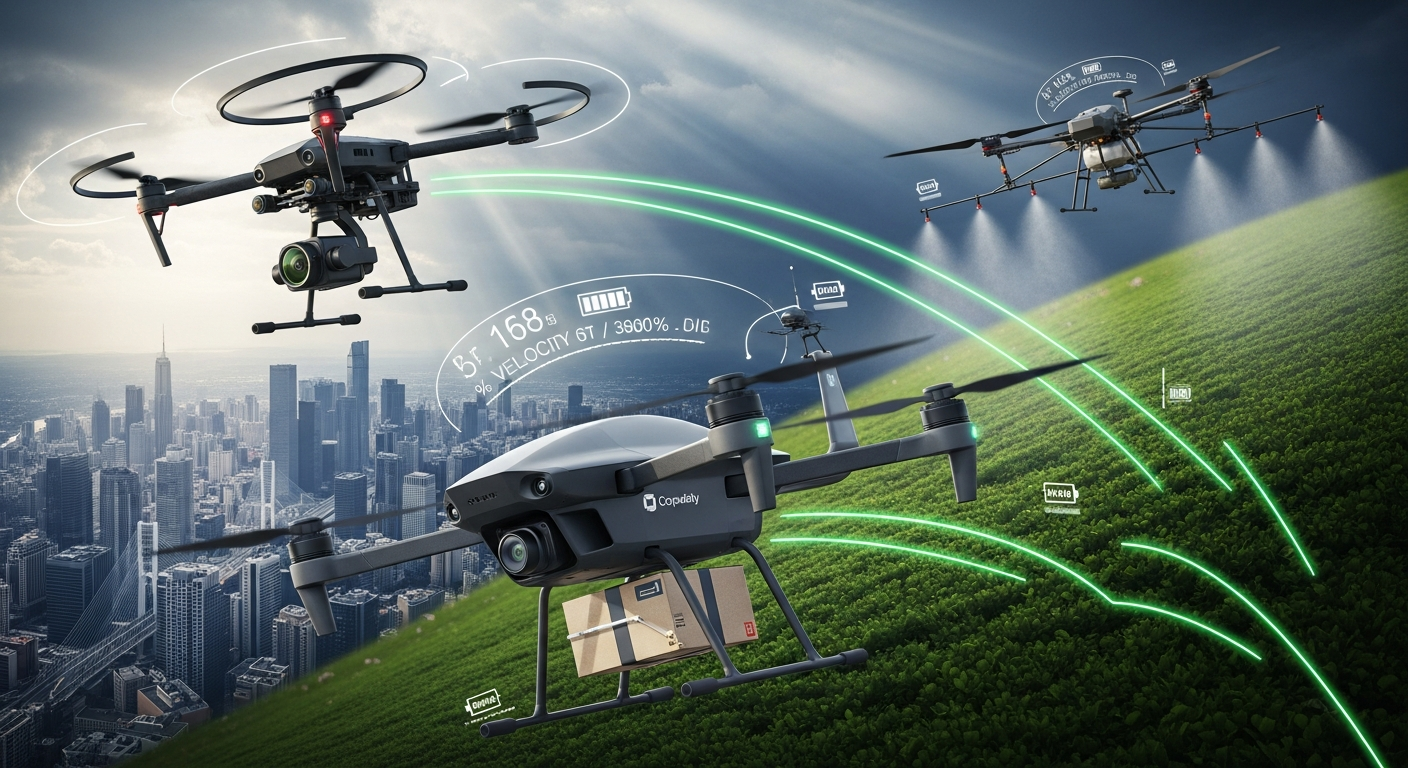
Drones have quietly become one of the most versatile robots on (and above) the planet — inspecting power lines, spraying crops, filming movies, delivering dinner, and finding lost hikers. The global drone market hit roughly $63.6 billion in 2026 and is climbing toward $127 billion by 2032. Yet 2026 is a pivotal year for two opposing reasons: long-awaited regulations are about to unlock large-scale commercial flight, even as geopolitics reshapes who builds drones and where their data goes.
This guide explains what drones are, the main types, how they work, what they're used for, the state of the market, and the regulatory and supply-chain forces shaping the industry. Whether you fly one for fun or want to understand the sector, here is the clear picture. (Market figures vary by source and scope, so treat them as estimates.)
What Are Drones?
A drone — formally an unmanned aerial vehicle (UAV) — is an aircraft that flies without a human pilot on board, controlled remotely or flown autonomously by onboard software. Drones range from palm-sized camera quadcopters to large fixed-wing aircraft, all sharing the same core idea: putting sensors, cameras, or cargo into the air without a person in the cockpit.
What makes modern drones powerful is the combination of cheap, capable hardware and increasingly sophisticated AI — letting them stabilize themselves, navigate autonomously, capture rich data, and perform tasks that once required helicopters, scaffolding, or large crews.
The Main Types of Drones
Drones come in several forms suited to different jobs:
- Consumer / camera drones — the most familiar, used for photography, video, and recreation, dominated by easy-to-fly quadcopters.
- Commercial / enterprise drones — rugged platforms with specialized sensors for inspection, mapping, and agriculture.
- Delivery drones — purpose-built to carry packages, food, and medical supplies.
- Racing / FPV drones — high-speed drones flown through first-person-view goggles for sport.
- Fixed-wing and VTOL drones — longer-range aircraft, including hybrids that take off vertically but fly efficiently like planes.
- Military drones — a large and separate segment used for surveillance and defense.
By design, most drones are either multirotor (agile, hovering quadcopters) or fixed-wing (efficient, long-range), with VTOL hybrids blending both.
How Drones Work
A typical multirotor drone generates lift from spinning rotors, adjusting their individual speeds to move and stay stable. A flight controller acts as the brain, using GPS and an array of sensors (gyroscopes, accelerometers, barometers, cameras, sometimes lidar) to know its position and orientation, hold steady in wind, and avoid obstacles. The pilot issues commands via a controller or app, while increasingly the drone flies itself — following waypoints, returning home automatically if the signal is lost, and avoiding obstacles in real time.
What Drones Are Used For
The commercial value of drones lies in specific, high-value applications:
- Photography and filmmaking — aerial shots once requiring helicopters.
- Infrastructure inspection — power lines, pipelines, wind turbines, and solar farms, keeping inspectors out of danger and cutting inspection time dramatically.
- Agriculture — precision crop spraying, monitoring, and mapping with AI-driven controllers.
- Construction and surveying — site surveys, 3D modeling, photogrammetry, and feeding digital twins.
- Delivery — food, retail goods, and especially medical supplies to hard-to-reach places.
- Public safety — search-and-rescue, firefighting support, and policing.
- Environmental monitoring — forestry, wildlife, and climate research.
Energy, utilities, construction, logistics, public safety, and agriculture are driving the strongest commercial demand.
The State of the Drone Market in 2026
The global drone market is valued around $63.6 billion in 2026, projected to roughly double to $127 billion by 2032 at about 12% annual growth, with some long-range forecasts reaching far higher. The industry is maturing from a hardware-led business into a services-and-software one — data analytics, drone-as-a-service, and mission software increasingly drive value. North America leads commercial adoption (around 38–42% share depending on segment), while Asia-Pacific is the fastest-growing region, driven by China's industrial base and adoption in agriculture.
The Regulation Story: Part 108 and BVLOS
Regulation is the single biggest gating factor for the industry. The crucial development is the FAA's proposed Part 108 framework for routine BVLOS operations, with a final rule anticipated around 2026–2027. Today, flying beyond an operator's line of sight generally requires case-by-case waivers; Part 108 would standardize and unlock these flights, removing the last major barrier to scaled commercial delivery, inspection, and agriculture. Alongside it, Remote ID (a digital license plate for drones) is now mandatory in many markets, improving accountability and airspace safety.
DJI, Geopolitics, and the Supply Chain
The other defining 2026 story is geopolitical. China's DJI dominates globally, accounting for more than 8 of every 10 drones detected and around 80% of the US consumer market. But US policy is moving to restrict new foreign-manufactured drones over security concerns, reshaping the supply chain and creating an opening for domestic makers like Skydio. Whether American and allied manufacturers can match DJI's capability at competitive prices is a defining question for the next few years.
Emerging Technology
Several advances are expanding what drones can do. AI autonomy lets drones plan and execute missions with minimal human input. Hybrid VTOL platforms, some using hydrogen fuel cells, extend flight endurance by over 200% versus battery-only systems — critical for heavy-lift cargo and long-range work. LiDAR and advanced photogrammetry improve data capture for mapping and digital twins. Supporting infrastructure is maturing too: automated "drone-in-a-box" stations allow drones to launch, recharge, and return with no human on site.
Challenges
Real hurdles remain. Privacy concerns dog camera-equipped drones flying over homes and crowds. Safety and airspace management become harder as the skies fill, demanding robust UTM and counter-drone systems. Security worries drive the hardware-sourcing debates. Battery life and payload still limit many missions. And public acceptance varies, especially for surveillance and delivery in residential areas. Resolving these is as important to the industry's future as any technical advance.
The Future
Expect drones to become more autonomous, capable, and woven into everyday infrastructure. As BVLOS rules finalize, routine drone delivery, automated inspections, and large-scale agricultural use will scale up. AI will make drones smarter and more independent, new propulsion will extend their reach, and urban air mobility may eventually put passengers in the air. The drone is evolving from a gadget and a niche industrial tool into a foundational layer of how we observe, inspect, and move things around the world.
Conclusion
Drones in 2026 are a maturing, multi-billion-dollar industry spanning consumer cameras, enterprise inspection, precision agriculture, and the high-growth frontier of delivery. Understanding the types, how they fly, and their real-world uses reveals why they've become one of the most versatile robots in existence.
The year's defining forces are regulatory and geopolitical: the impending Part 108 BVLOS rules could unlock scaled commercial flight, while restrictions on Chinese hardware reshape who builds the drones. As autonomy improves and the skies open up, drones are poised to move from novelty to essential infrastructure — quietly transforming industries from farming to filmmaking to logistics.
Want more? Explore AxionSquare for ongoing coverage of drones, robotics, AI, and the technologies reshaping how we work and move.
Frequently Asked Questions
What is a drone?
A drone, or unmanned aerial vehicle (UAV), is an aircraft that flies without a pilot on board — controlled remotely or flown autonomously by onboard software. They range from small camera quadcopters to large fixed-wing and cargo aircraft.
What are drones used for?
Common uses include photography and filmmaking, infrastructure inspection (power lines, pipelines, turbines), precision agriculture, construction surveying and mapping, package and medical delivery, public safety and search-and-rescue, and environmental monitoring.
How big is the drone market in 2026?
The global drone market is valued around $63.6 billion in 2026 and projected to reach roughly $127 billion by 2032 at about 12% annual growth. The delivery segment is growing fastest, at roughly 37% per year.
What is BVLOS and the FAA Part 108 rule?
BVLOS means flying a drone beyond the operator's visual line of sight. The FAA's proposed Part 108 framework, expected to finalize around 2026–2027, would standardize routine BVLOS operations, removing a major barrier to scaled commercial delivery, inspection, and agriculture.
Do I need a license to fly a drone?
Recreational flyers must follow basic rules and Remote ID requirements, while commercial operators in the US generally need an FAA Part 107 certification. Requirements vary by country and use, so check current local regulations before flying.
Sources and further reading
- FAA — Small UAS Regulations (Part 107) — Official US commercial drone operating requirements.