Infrastructure Expansion: The State of US EV Charging Networks
Detailed review of public charging infrastructure, including port reliability, fast-charging growth metrics, and expansion capacity.
Transportation · Global · 2026-06-09 · 10 min read · By John Awab
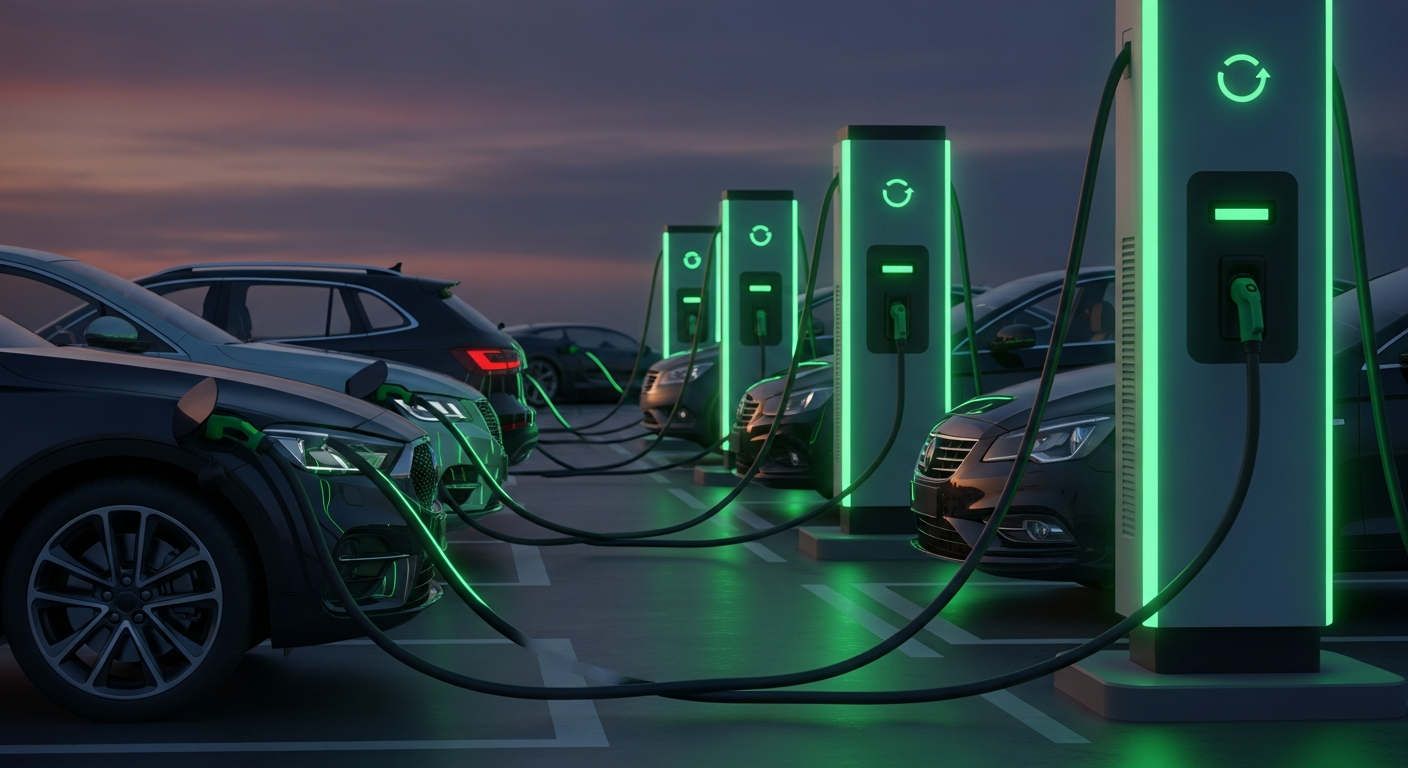
The single biggest question for anyone considering an electric vehicle is no longer "how far will it go?" but "where will I charge it?" The answer keeps getting better. The US public charging network has crossed roughly 86,000 stations and nearly 280,000 ports, growing by over a thousand fast-charging stalls a month, with reliability climbing and sites getting bigger and faster.
This guide explains how EV charging stations actually work — the levels, the connectors, the networks, the costs — and where the infrastructure stands in 2026. Whether you are a new EV owner or just trying to understand the ecosystem, here is the clear picture.
What Are EV Charging Stations?
An EV charging station is equipment that supplies electricity to recharge an electric vehicle's battery. Stations range from a simple plug in a home garage to high-powered roadside hubs that can add hundreds of miles of range in minutes.
A key distinction trips up many newcomers: a charging station is a location, while a charging port (or stall) is a single connection that charges one vehicle at a time. One station can have many ports — and in 2026, sites are getting larger, averaging close to five ports each.
The Three Levels of EV Charging
Charging is grouped into three levels by speed:
- Level 1 uses a standard household outlet (120V in the US). It is the slowest — adding only a few miles of range per hour — and best for plug-in hybrids or overnight top-ups.
- Level 2 uses a 240V supply, like a clothes dryer outlet, and is the workhorse of home and workplace charging. It can fully recharge most EVs overnight and powers the large majority of public ports.
- DC fast charging (DCFC) is the high-power option found at public hubs. It bypasses the car's onboard charger to deliver electricity directly to the battery, adding significant range in minutes rather than hours.
The practical rule: Level 2 at home covers daily driving, and DC fast charging handles road trips.
Charging Connectors and the NACS Shift
Connectors are standardizing fast. For years North America used a mix of CCS1 (the longtime standard for non-Tesla cars), Tesla's proprietary plug, and the fading CHAdeMO. In 2026 the industry is converging on the NACS (SAE J3400) standard — Tesla's connector, now adopted across the industry.
The transition is well underway: counting Tesla's huge Supercharger fleet plus growing NACS deployments by other networks, NACS now represents roughly half of fast-charging connectors, with CCS1 still the largest single share among non-Tesla networks and CHAdeMO nearly gone. Adapters bridge the gap during the changeover, and most new non-Tesla EVs are shipping with native NACS ports.
The State of EV Charging in 2026
The US network is scaling steadily. As of mid-2026 there are roughly 86,000 public charging stations with about 280,000 ports, of which around 74,000 are DC fast-charging stalls and the bulk are Level 2. California leads by a wide margin with over 20,000 stations, followed by New York and Florida.
Fast charging in particular is growing by over 1,000 stalls a month and holding its footing: reliability, utilization, and pricing stayed remarkably steady through early 2026 even as thousands of chargers came online — a sign of controlled, sustainable scaling rather than a chaotic land grab.
The Major Charging Networks
Tesla's Supercharger network remains by far the largest, with well over 36,000 stalls and roughly half of all US fast-charging ports — though its dominant share is slowly declining as rivals expand. Now that Superchargers are opening to non-Tesla vehicles, they have become central infrastructure for the whole market.
Beyond Tesla, the field is broadening fast. ChargePoint, Electrify America, and EVgo are long-established players, while newer entrants like Ionna (a joint venture of major automakers) and Red E are deploying aggressively — six of the top ten providers in early 2026 weren't even in the top ten a year earlier. The top networks still hold most ports, but that concentration is loosening as competition intensifies.
How Fast Charging Is Evolving
Three shifts define 2026's fast-charging buildout. First, bigger sites: operators are packing more ports into each location rather than spreading thin. Second, higher power: most new fast chargers are rated at 250 kW or more, non-Tesla networks increasingly install 350–400 kW units, and Tesla is rolling out 500 kW V4 Superchargers — with megawatt-level charging emerging in China. Third, better reliability: most states now see charger uptime in the 90–95% range, up from the mid-80s a year earlier, thanks to newer equipment and better network operations. Outages still happen, so reliability remains a work in progress, but the trend is clearly up.
How to Charge an EV
Most charging happens at home. A Level 2 charger installed in a garage lets owners plug in overnight and start each day with a full battery — by far the cheapest and most convenient option. Public charging fills the gaps: Level 2 at workplaces and destinations, and DC fast charging on longer trips.
Costs vary. Home charging is typically the cheapest, billed at residential electricity rates, while public fast charging costs more per kWh but still generally beats gasoline per mile. Charging time depends on the level, the charger's power, the car, and the battery's state — fast chargers are quickest from roughly 20% to 80%, after which they slow to protect the battery. Apps and in-car navigation help locate stations, check availability, and plan routes.
Challenges
Real hurdles remain. Reliability, while improving, is still imperfect — a meaningful share of chargers experience occasional outages. Access gaps persist for renters and apartment dwellers without dedicated parking, and rural coverage lags cities. Grid impact is a growing consideration as more vehicles charge, driving interest in smart and managed charging that shifts demand to off-peak hours. And the connector transition, while positive long-term, creates short-term adapter friction.
The Future of EV Charging
Expect faster, more reliable, and more seamless charging. Higher-power chargers will cut wait times, "plug and charge" will let cars authenticate and pay automatically, and standardization on NACS will simplify the experience. Looking further out, bidirectional and vehicle-to-grid charging could turn EVs into grid assets, while smart charging balances demand. The direction is clear: charging is steadily becoming as routine and predictable as refueling once was.
Conclusion
EV charging stations in 2026 are a maturing, fast-growing network — bigger, faster, and more reliable than a year ago, anchored by Tesla's Superchargers and an expanding field of competitors, and converging on a single connector standard. The infrastructure question that once held buyers back is steadily being answered.
For owners, the playbook is simple: charge at home for daily needs and lean on the growing fast-charging network for trips. As power levels rise and reliability improves, range anxiety is giving way to charging confidence — and that shift is as important to the EV transition as the cars themselves.
Want more? Explore AxionSquare for ongoing coverage of EV charging, electric vehicles, and the technology reshaping how we move.
Frequently Asked Questions
How many EV charging stations are there in the US?
As of mid-2026, there are roughly 86,000 public charging stations with about 280,000 ports, including around 74,000 DC fast-charging stalls. California leads with over 20,000 stations, followed by New York and Florida.
What are the levels of EV charging?
Level 1 uses a standard household outlet and is slowest; Level 2 uses a 240V supply and is the standard for home and public charging; DC fast charging delivers high power at public hubs, adding significant range in minutes.
How long does it take to charge an electric car?
It depends on the charger and car. Level 2 typically fully charges overnight, while DC fast charging can add a large amount of range in 20–40 minutes, fastest between about 20% and 80% before slowing to protect the battery.
What is the NACS connector?
NACS (SAE J3400) is the charging standard the North American industry is converging on in 2026 — originally Tesla's connector, now adopted across automakers and networks, gradually replacing the older CCS1 and CHAdeMO standards.
Can non-Tesla EVs use Superchargers?
Yes. Tesla's Supercharger network has opened to non-Tesla vehicles, often via a NACS adapter or a native NACS port, making the largest US fast-charging network available to most EVs.
Sources and further reading
- U.S. Department of Energy - Alternative Fuels Data Center — National counts of charging stations and ports