The Commercialization of Electric Vertical Take-off and Landing (eVTOL) Aircraft
Analyzing the shift from prototype to commercial operation for air taxi services, including regulatory progress and industry leadership by Joby and Archer.
Transportation · Global · 2026-06-20 · 10 min read · By John Awab
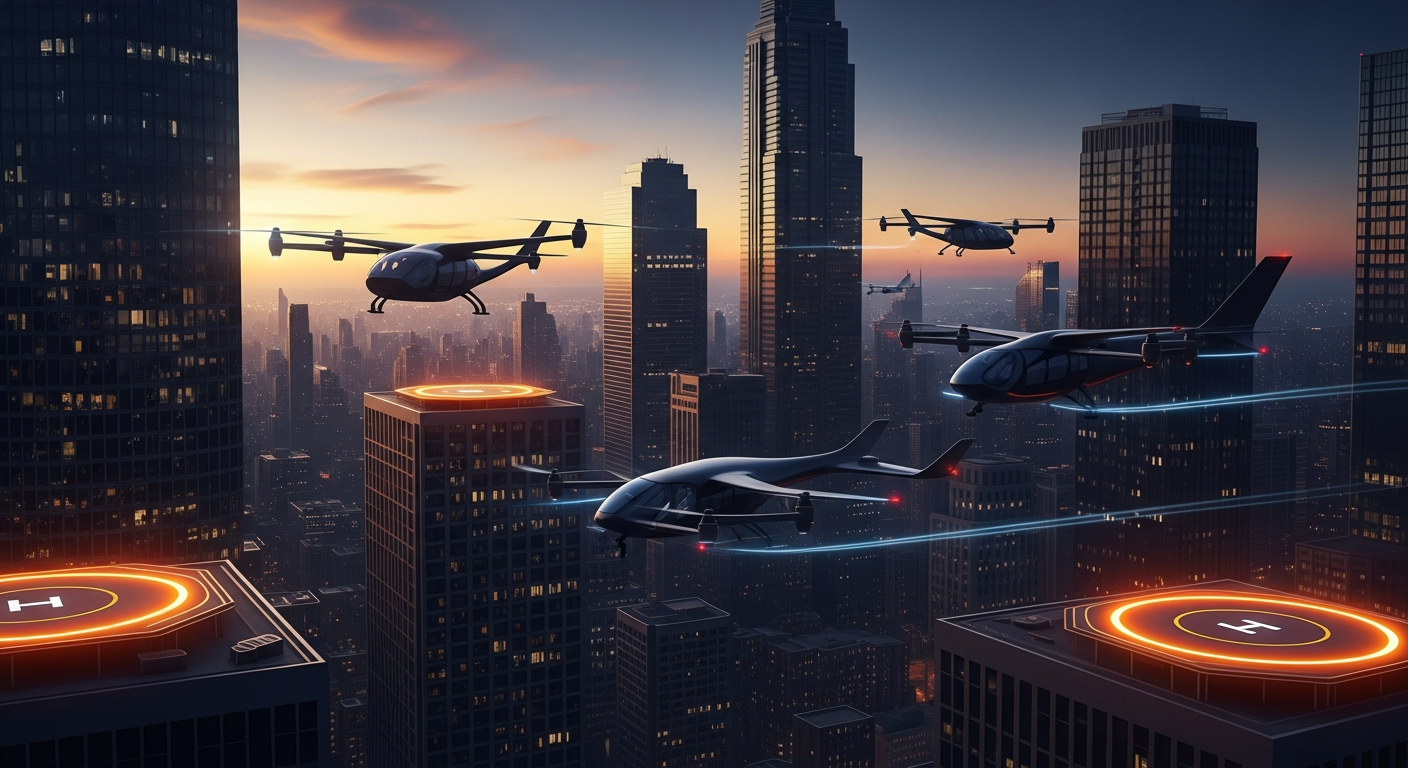
For decades, "flying cars" were the perpetual punchline of unfulfilled futurism. In 2026, the joke stopped landing. Joby Aviation flew a piloted air taxi from a Manhattan heliport, is preparing to launch commercial passenger service in Dubai, and rival Archer Aviation is gearing up in Abu Dhabi — while US regulators clear the runway for air taxis across more than two dozen states. After years of test flights and skepticism, electric flying taxis are transitioning from prototype to paying passengers.
This guide explains what flying taxis and eVTOLs are, how they work, the 2026 commercial launches, the key players, the costs, and the challenges that remain. (The industry is moving fast and several companies are publicly traded, so this is general information, not investment advice — verify the latest before acting.)
What Are eVTOLs and Air Taxis?
An eVTOL — electric Vertical Take-Off and Landing aircraft — is the technology behind the "flying taxi." As the name says, it takes off and lands vertically like a helicopter but is powered by electric motors, making it far quieter and cleaner, and most designs then transition to efficient forward flight like an airplane. An air taxi is the service: short, on-demand passenger flights over congested cities, skipping the traffic below.
Think of an eVTOL as a cross between a helicopter, a large drone, and a small electric plane. A typical air taxi today carries a pilot plus around four passengers, cruises at roughly 150–200 mph, and has a range on the order of 100–150 miles — ideal for hops across a city or to the airport that would otherwise take an hour in traffic.
How eVTOLs Work
The core innovation is distributed electric propulsion — instead of one big rotor, eVTOLs use multiple smaller electric rotors or motors spread across the aircraft. For takeoff, these point upward to lift the craft vertically; once airborne, many designs tilt the rotors or rely on a fixed wing to fly forward efficiently. Electric power makes them dramatically quieter than helicopters and produces zero direct emissions. Because they need no runway, they can operate from compact vertiports — small rooftop or ground-level pads — rather than full airports.
Why Now?
Several advances converged to make 2026 the tipping point. Better batteries and electric motors finally deliver enough power and energy density for practical flight. Advanced flight-control software keeps inherently complex multi-rotor aircraft stable and safe. And crucially, regulators have made real progress — the FAA finalized new rules for "powered-lift" aircraft and created pilot programs to integrate eVTOLs into airspace, while forward-leaning governments in the Middle East and parts of Asia have moved even faster, creating early commercial opportunities.
2026: The Year Air Taxis Go Commercial
This is the year the industry crosses the threshold. Joby Aviation — the furthest along in US certification (Stage 4 of 5), backed by Toyota as its largest shareholder, and with hundreds of test flights logged — is targeting commercial launch in Dubai, under an exclusive multi-year deal with the city's transport authority, and aims to begin US service after full FAA certification. Archer Aviation, flying its four-passenger "Midnight" aircraft, is preparing to launch commercial operations in Abu Dhabi, with US service to follow.
The Key Players
The field has consolidated around a few leaders. Joby Aviation and Archer Aviation lead the US piloted air-taxi race, both publicly traded and racing through certification. EHang leads in autonomous flight from its base in China. BETA Technologies, which completed a multi-billion-dollar IPO, takes a capital-efficient approach focused on cargo and medical logistics rather than urban taxis. Others — Wisk (autonomous), Vertical Aerospace, Lilium, and Volocopter — are at various stages of development or restructuring.
What Air Taxis Will Be Used For
Beyond the headline urban commute, eVTOLs target several uses: airport transfers (city-center to terminal in minutes), intra-city hops over gridlock, regional connections between nearby cities, and increasingly cargo and medical logistics — delivering supplies, organs, or aid quickly, including to areas hard to reach by road. Some states are even planning eVTOL networks specifically for healthcare access and disaster relief. The same vertical-flight, low-noise, zero-emission profile that makes air taxis attractive in cities also makes them compelling for medical and emergency use.
Vertiports and Infrastructure
Air taxis need somewhere to take off, land, and recharge. Vertiports — compact hubs with landing pads, fast chargers, and passenger facilities — are the equivalent of stations for this new network, and building them out is as important as the aircraft themselves. Companies are partnering with airports, real-estate owners, and cities (and integrating with ride platforms and airlines so you can book an air-taxi leg as part of a longer trip). The infrastructure rollout will heavily shape which cities get early service.
The Challenges
Significant hurdles remain. Certification is rigorous and sometimes slow, as regulators write entirely new standards for a new class of aircraft and demand aviation-grade safety. Battery range limits trips to short hops for now. Vertiport infrastructure must be built largely from scratch. Noise and community acceptance, while far better than helicopters, still matter for dense urban operation. And cost is real: early flights will be a premium service, closer to a helicopter charter than an Uber, at least initially.
The Realistic Timeline and Cost
The honest near-term picture is limited, premium, carefully staged operations — not a flying taxi on every corner. Expect initial service in a few flagship cities (Dubai, Abu Dhabi, select US locations) starting in 2026, with networks expanding through the late 2020s as certification completes, fleets scale, and vertiports multiply. Early fares will be premium, but the long-term vision — championed by operators who compare today's skepticism to the first time people saw a driverless car — is a future where air travel above cities becomes as normal as taking a train.
The Future
Looking further out, expect longer-range and hybrid-powered aircraft, a shift from piloted to autonomous operation (as EHang already demonstrates), denser vertiport networks, and gradual price declines that broaden access. If the industry clears its safety, infrastructure, and economic hurdles, air taxis could become a routine layer of urban transport — a genuine third dimension added to how cities move. The "flying car" finally looks less like a punchline and more like a timetable.
Conclusion
2026 marks the moment flying taxis stopped being science fiction. Powered by electric vertical-takeoff technology and distributed propulsion, quieter and cleaner than helicopters, eVTOLs are launching real commercial passenger service in Dubai, Abu Dhabi, and soon US cities, led by Joby, Archer, and EHang.
The vision is compelling — soaring over traffic in minutes — but the path runs through tough certification, battery limits, new infrastructure, and premium early pricing. Understanding what eVTOLs are, how they work, and who's building them reveals an industry at a genuine inflection point. The skies above our cities are about to get a lot more interesting. As always, this is general information, not investment advice.
Want more? Explore AxionSquare for ongoing coverage of eVTOLs, electric vehicles, self-driving cars, and the future of transportation.
Frequently Asked Questions
What is an eVTOL or flying taxi?
An eVTOL (electric Vertical Take-Off and Landing aircraft) is an electric aircraft that takes off and lands vertically like a helicopter but flies forward efficiently like a plane. Used as an "air taxi," it offers short, on-demand passenger flights over city traffic, typically carrying a pilot and around four passengers.
How do flying taxis work?
They use distributed electric propulsion — multiple small electric rotors spread across the aircraft. The rotors point up for vertical takeoff, then tilt or hand off to a wing for efficient forward flight. Electric power makes them quiet and emission-free, and they operate from compact landing pads called vertiports.
When can I ride an air taxi?
Commercial service is beginning in 2026, with Joby targeting Dubai and Archer preparing for Abu Dhabi, plus US pilot operations in more than two dozen states pending FAA certification. Wider availability will roll out through the late 2020s as fleets and vertiports scale.
Who are the leading flying taxi companies?
Joby Aviation and Archer Aviation lead the US piloted air-taxi race (both publicly traded), EHang leads in autonomous flight from China, and BETA Technologies focuses on cargo and medical logistics. Others include Wisk, Vertical Aerospace, Lilium, and Volocopter.
How much will a flying taxi cost?
Early air-taxi flights will be a premium service, closer to a helicopter charter than a rideshare. Operators expect prices to fall as operations scale, with the long-term goal of approaching premium ground-rideshare costs — but initial fares will be high.
Sources and further reading
- FAA Powered-Lift Certification and Integration — Regulatory clearance for eVTOL
- EASA Special Condition for VTOL aircraft — Aviation safety standards for air taxis