High-Speed Rail: Global Infrastructure Projects and Network Economics
Review of high-speed rail deployment models, analyzing international network advancements, maglev integration, and urban infrastructure ROI.
Transportation · Global · 2026-07-27 · 8 min read · By John Awab
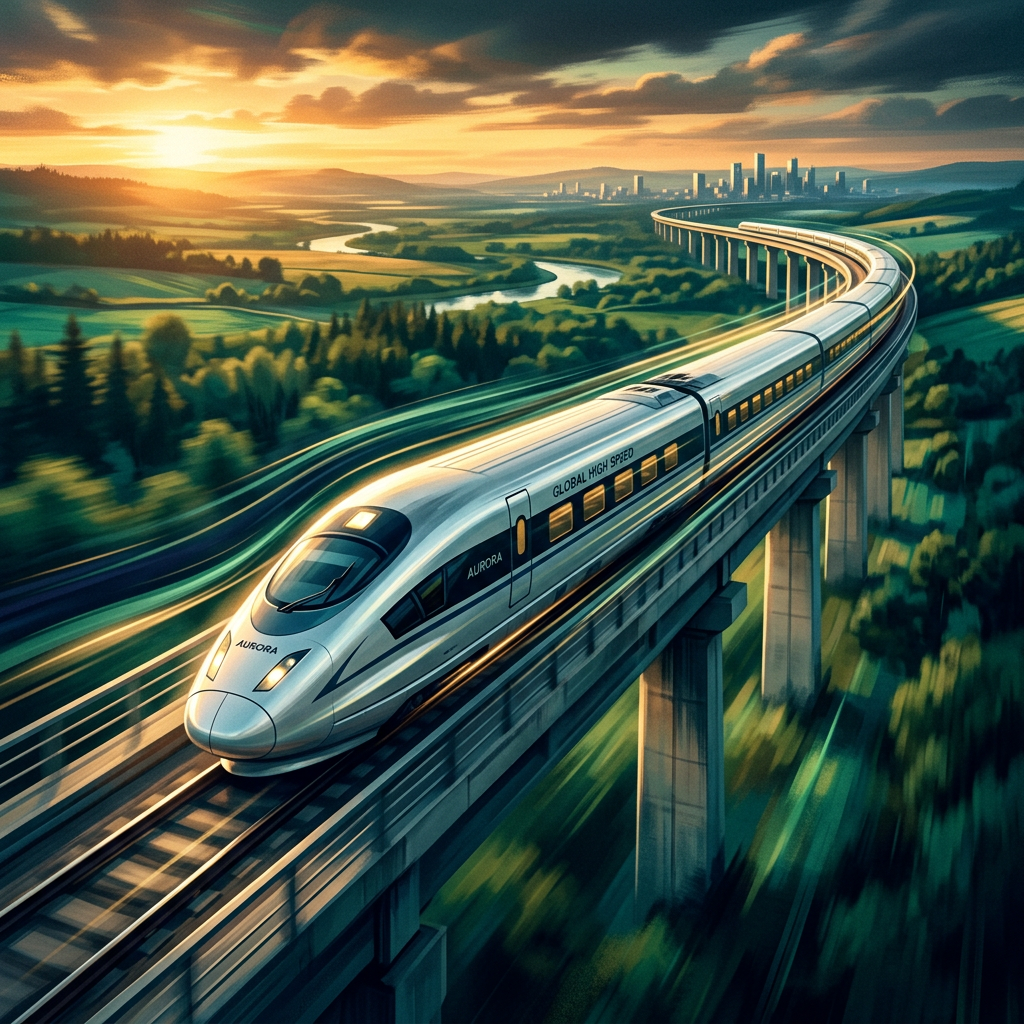
Imagine boarding a train in a city center, settling into a spacious seat, and stepping off in another major city 800 miles away just a few hours later — no security lines, no boarding gates, no tarmac delays. For hundreds of millions of people, this isn't a vision of the future; it's the daily commute. High-speed rail has quietly become one of the most transformative transportation technologies of the modern era, reshaping how entire nations move. In 2026, the technology is advancing faster than ever, with China unveiling trains that cruise at 400 kilometers per hour, the United States finally breaking ground on genuine high-speed lines, and engineers pushing toward magnetic-levitation systems that blur the line between train and aircraft. Yet high-speed rail also remains one of the most fiercely debated infrastructure investments in the world.
This guide explains what high-speed rail is, how it works, the global landscape, the technology frontier, the costs-and-benefits debate, and where it's heading. (Figures vary by source and project, so treat them as estimates.)
What Is High-Speed Rail?
High-speed rail (HSR) refers to passenger trains that operate significantly faster than conventional rail, generally at speeds of 250 km/h (155 mph) or higher on dedicated tracks. It's not just a faster train — it's an integrated system of specialized rolling stock, purpose-built track, advanced signaling, and electrification designed to move large numbers of people quickly, safely, and efficiently between city centers.
The appeal is compelling. On routes up to roughly 800 kilometers, high-speed rail competes directly with air travel — and often wins on total door-to-door time, since stations sit in city centers rather than distant airports and there's no security-and-boarding overhead. It's also far more energy-efficient per passenger than flying or driving, produces lower emissions (especially on renewable electricity), and moves enormous passenger volumes without the congestion of highways or the runway constraints of airports. For the right corridors, it's one of the most effective transportation solutions ever devised.
How High-Speed Rail Works
Several engineering elements combine to make high speeds possible. Dedicated tracks with gentle curves and continuous welded rail allow trains to maintain velocity safely. Electrification via overhead lines provides clean, consistent power without the weight of onboard fuel. Aerodynamic trainsets minimize air resistance — critical because at these speeds, roughly 95% of a train's resistance comes from air, which is why engineers obsess over nose shapes, often drawing inspiration from fast-flying birds. Advanced signaling and control systems manage trains running close together at high speed. And regenerative braking recovers energy during deceleration.
The aerodynamic challenge is central to the current frontier: increasing speed from 350 to 400 km/h raises air resistance by around 30%, so recent breakthroughs have focused on reducing drag and weight to make higher speeds energy-viable. Newer trains have cut weight by around 10% and reduced drag substantially to push past long-standing barriers.
China: The Global Leader
No discussion of high-speed rail can avoid China, which has built the most extensive network in history. China's high-speed rail network surpassed 50,000 kilometers of track in late 2025 — more than the rest of the world combined — connecting the vast majority of its large cities. This buildout, accomplished in roughly two decades, fundamentally reshaped travel across the country.
Now China is shifting from network expansion to a leap in speed, spearheaded by the CR450. Developed over five years by CRRC, the CR450 is designed for a commercial speed of 400 km/h (up from the current 350 km/h fleet), with prototypes hitting 453 km/h in trials — the highest speed ever recorded for a conventional wheel-on-rail passenger train. After extensive testing, its design finalization is expected to complete in 2026, with the flagship Beijing–Shanghai line (an ~800-mile route currently around four hours) as its likely first home, potentially cutting that trip toward 2.5 hours. A worthwhile caution: finalizing the design in 2026 doesn't automatically mean paying passengers the same year, as routes and infrastructure need preparation. China is also developing intelligent "AI+" dispatching, automated driving, and robotic maintenance for its rail future.
The Rest of the World
High-speed rail thrives across much of the globe:
- Japan — the pioneer. The Shinkansen "bullet train," launched in 1964, established the model and maintains an extraordinary safety and punctuality record.
- Europe — an increasingly connected network, from France's TGV and Spain's extensive AVE system to Germany's ICE and expanding cross-border links, with ongoing station and route expansions.
- Asia beyond China — rapid growth, including Vietnam's approved ~$67 billion line linking Hanoi and Ho Chi Minh City (construction from 2027, targeting completion by 2035), plus projects across Indonesia, Thailand, and India.
Each reflects a different balance of geography, density, and public investment — but the common thread is strong demand where population corridors suit the technology.
The United States: Playing Catch-Up
The US is a striking outlier: a wealthy, advanced nation with essentially no true high-speed rail. Amtrak's Acela on the Northeast Corridor, even with a next-generation fleet delivering faster speeds and more comfort, falls short of global high-speed standards because it shares track and faces curves that force it to slow. But 2026 marks real movement:
- Brightline West — a privately run line under construction connecting the Los Angeles area (Rancho Cucamonga) to Las Vegas (Enterprise), covering ~218 miles at up to 180–200 mph, targeting a roughly two-hour trip and first service around late 2029. Backed by private investment plus federal grants, it's a closely watched test of whether HSR can work in the US. Brightline's Florida service has also seen ridership and revenue climb, fueling optimism about American rail.
- California High-Speed Rail — the long-troubled Los Angeles–San Francisco project continues construction on its Central Valley segment, having become a lightning rod for debates over cost overruns and delays.
Federal funding has flowed toward these projects — billions in grants — even as US high-speed rail policy remains politically contested and inconsistent, a pattern that stands in sharp contrast to the sustained state investment behind networks abroad.
The Technology Frontier: Maglev and Beyond
Beyond conventional wheel-on-rail, magnetic levitation (maglev) represents the next frontier. Maglev trains use powerful magnets to float above the track, eliminating friction and enabling far higher speeds. China has developed a 600 km/h maglev system and is conducting route-planning studies, explicitly aiming to fill the speed gap between conventional high-speed rail and air travel — a maglev network could make intercity trips competitive with flying over much longer distances. Other experimental concepts, including vacuum-tube "hyperloop" ideas, remain largely unproven. Meanwhile, incremental innovation continues on conventional systems: new lightweight materials, hydrogen-powered intercity trains for non-electrified routes, and AI-driven operations. The field is advancing on multiple fronts at once.
The Market
The global high-speed rail market reflects this momentum. Estimates place it around $40 billion in the early 2020s, with projections to roughly $75 billion by the early 2030s, though figures vary by source and scope. Growth is driven by urbanization, climate goals pushing travelers toward lower-emission transport, government infrastructure investment, and the technology's proven success in dense corridors. Beyond the trains themselves, high-speed rail spurs substantial economic activity — real estate development around new stations, construction employment, regional economic integration, and rail-technology innovation.
The Great Debate: Costs vs Benefits
High-speed rail is genuinely contested, and both sides have real arguments worth understanding.
Proponents point to compelling benefits: dramatic travel-time savings, substantial emissions reductions versus flying and driving, relief of highway and airport congestion, economic development along corridors, high capacity, and safety. Where geography and density align — dense population corridors of the right length — high-speed rail has proven transformative, as China, Japan, and Europe demonstrate.
Skeptics raise serious concerns: the enormous upfront capital cost (lines can run tens of billions of dollars), frequent cost overruns and delays (California being a prominent example), uncertain ridership in car-dependent or lower-density regions, long payback periods, and the argument that funds might achieve more via other transport investments. In sprawling, less dense countries, the economics are far less favorable than in dense corridors.
The honest synthesis: high-speed rail's success depends heavily on context. It excels in dense, appropriately spaced corridors with supportive land-use and sustained public investment, and struggles where those conditions are absent. It's neither a universal solution nor a boondoggle — it's a powerful tool whose value is highly situational. Reasonable people weighing the same evidence reach different conclusions depending on the specific corridor and their assumptions about ridership, emissions, and opportunity cost.
The Future
High-speed rail's global trajectory points upward, albeit unevenly. Expect China to continue leading, rolling out the CR450 and advancing maglev; Asia to see rapid expansion; Europe to keep densifying its network; and the US to reach an inflection point as Brightline West and California test whether American high-speed rail can finally materialize. Technologically, expect faster conventional trains, progress on maglev, greener propulsion, and AI-driven operations. As climate concerns intensify and urban corridors grow denser, high-speed rail's appeal as efficient, lower-emission intercity transport will likely strengthen — even as the cost debates continue. The train, it seems, has plenty of track ahead.
Conclusion
High-speed rail is among the most impactful transportation technologies of the modern age — moving hundreds of millions of people quickly, efficiently, and cleanly between city centers, and competing directly with air travel on the right routes. Led by China's unmatched 50,000-kilometer network and record-setting CR450, thriving across Japan and Europe, expanding rapidly across Asia, and finally taking root in the US through Brightline West and California, it's a technology very much in motion.
It remains genuinely debated, with real tension between transformative benefits and enormous costs, and its success proves highly dependent on corridor density, geography, and sustained investment. Understanding high-speed rail — both its remarkable capabilities and its legitimate controversies — reveals a technology reshaping how nations move, and a global race that is far from over.
Want more? Explore AxionSquare for ongoing coverage of high-speed rail, electric vehicles, and the technologies driving the future of transportation.
Frequently Asked Questions
What is high-speed rail?
High-speed rail (HSR) refers to passenger trains operating significantly faster than conventional rail — generally at 250 km/h (155 mph) or higher on dedicated tracks. It's an integrated system of specialized trains, purpose-built track, advanced signaling, and electrification designed to move large numbers of people quickly between city centers, competing with air travel on routes up to roughly 800 km.
How fast do high-speed trains go?
Most high-speed trains operate between 250 and 350 km/h (155–217 mph). China's new CR450 is designed for a commercial speed of 400 km/h (250 mph), having reached 453 km/h in trials — the fastest ever for a conventional wheel-on-rail train. Magnetic levitation (maglev) trains can go faster still, with China developing a 600 km/h system.
Which country has the best high-speed rail?
China operates by far the largest network, exceeding 50,000 kilometers of track in late 2025 — more than the rest of the world combined — and leads on cutting-edge speed with the CR450. Japan pioneered high-speed rail with the Shinkansen in 1964 and maintains an exceptional safety and punctuality record, while Europe has an extensive, increasingly connected network.
Does the United States have high-speed rail?
The US has essentially no true high-speed rail by global standards — Amtrak's Acela is faster than typical trains but shares track and slows on curves. However, 2026 marks real progress: Brightline West is under construction between the Los Angeles area and Las Vegas (up to 180–200 mph, first service around 2029), and California's Los Angeles–San Francisco project continues building despite cost and delay controversies.
Is high-speed rail worth the cost?
It depends heavily on context. High-speed rail excels in dense, appropriately spaced population corridors with supportive land use and sustained investment, delivering major time savings, emissions reductions, and congestion relief. But it carries enormous upfront costs, faces frequent overruns, and struggles to justify itself in car-dependent, lower-density regions. It's a powerful but highly situational tool, not a universal solution.