Home Robotics: Current Market Penetration and Technical Capabilities
An objective assessment of consumer robotics categories, differentiating between current automated utility devices and speculative humanoid development.
Robotics · Global · 2026-08-06 · 8 min read · By John Awab
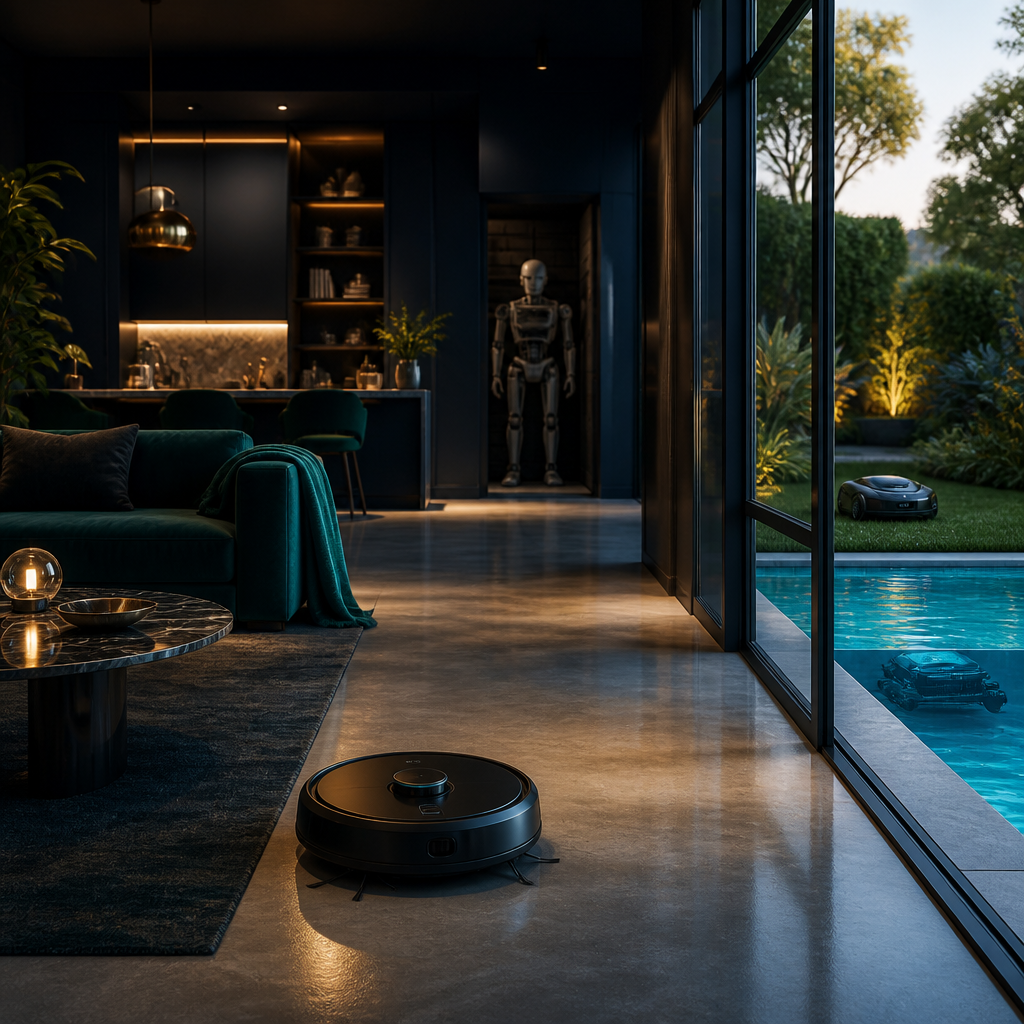
For decades, the "robot butler" has been a fixture of the imagined future — a helpful humanoid that cooks, cleans, and tidies while you relax. In 2026, that future has partly arrived, but not in the shape science fiction promised. The robots that have actually conquered our homes aren't gleaming humanoids; they're humble discs that vacuum the floor, quiet machines that mow the lawn, and tireless units that scrub the pool. Meanwhile, the humanoid home robot everyone saw demonstrated at trade shows remains, for most people, an expensive and unfinished dream. The story of home robots today is a fascinating split between what genuinely works and what's still mostly hype — and understanding the difference can save you thousands of dollars.
This guide explains what home robots are, the main categories and which ones actually deliver, the market, the key players, pricing, the challenges, and how to think about buying one. (Market figures and prices vary by source and model, so treat them as estimates.)
What Is a Home Robot?
A home robot (also called a household, domestic, personal, or consumer robot) is an autonomous or semi-autonomous machine designed to perform tasks in and around the home. These range from single-purpose cleaning devices to experimental multi-purpose humanoids. What unites them is the promise of automating domestic chores and, increasingly, providing companionship and assistance — powered by advances in AI, sensors, mapping, and connectivity that have made them dramatically smarter than the crude devices of a decade ago.
The defining reality of 2026 is that the market is bifurcated: on one side, high-volume, affordable, single-task machines that work reliably; on the other, premium, feature-rich AI companions and early-stage humanoids that promise much but deliver unevenly. Knowing which side of that divide a product sits on is the key to using home robots wisely.
Robot Vacuums: The Proven Champion
The robot vacuum is the undisputed king of home robotics — the category that proved robots could earn a permanent place in ordinary homes. Robotic vacuum cleaners account for roughly a third to a half of the household robot market by most estimates, and one industry figure notes millions of registered units in US homes alone. They've evolved from crude bump-and-turn devices into sophisticated machines with intelligent mapping, obstacle avoidance, and self-maintaining docks that empty debris and even wash and dry their own mopping pads automatically. High-end hybrid vacuum-and-mop systems now combine powerful suction with advanced navigation, and some can even detach the mop on carpet to avoid wetting it. Crucially, the category spans every budget — from capable units under $200 to premium systems around $1,500 — making it accessible to a broad range of households. This is a mature, reliable technology that millions of people depend on daily.
Robot Lawn Mowers and Pool Cleaners: Also Proven
Two other categories have quietly reached genuine maturity:
- Robot lawn mowers cut grass automatically on a schedule, and they've grown steadily as smart features, longer battery life, and weather resistance make them more appealing. Newer models use GPS and connectivity for precise, wire-free navigation. Entry models start near $800, while premium GPS units can top $2,500 — a significant purchase, but a proven one.
- Robotic pool cleaners scrub and filter pool water autonomously, typically costing between $400 and $1,500. For pool owners, they're a reliable, well-established convenience.
Together with vacuums, these form the trio of home robots that genuinely work as advertised: single-purpose, reliable, and worth the money for the chore they handle.
Companion and Social Robots: Promising but Emerging
Beyond cleaning, companion and social robots are among the fastest-growing categories — designed for interaction, entertainment, education, and especially elderly care and companionship. Powered by AI, voice recognition, and natural language processing, they can hold conversations, play games with children, assist with learning, provide reminders and monitoring for seniors, and offer a form of company. This segment is growing rapidly (with some analysts projecting companion and social robots among the fastest-growing at double-digit annual rates), driven by aging populations and improving conversational AI. These robots are useful and improving quickly, but they remain more niche than the cleaning trio, and their real-world value varies considerably by product.
Home Humanoids: The Hype and the Reality
Then there's the category that captures all the headlines: the home humanoid robot — a general-purpose, two-legged (or wheeled) assistant meant to handle many household tasks like a human helper. Companies are demonstrating impressive prototypes, and trade shows make them look ready to ship.
The reality is far more sober, and honesty here matters. Home humanoids in 2026 are best understood as early-stage platforms rather than finished helpers. They're extraordinarily expensive (often $20,000 or more, with some far higher), limited in what they can reliably do, and typically require tidy, controlled environments to function. The unpredictable clutter, varied lighting, and constant surprises of a real lived-in home remain genuinely hard for them to handle. Some are impressive technology demonstrations; a few early consumer models are shipping in limited numbers, sometimes relying partly on remote human assistance. But the vision of an affordable, autonomous robot butler that does your chores remains, for now, unfulfilled. The honest guidance most reviewers offer: skip the full-humanoid hype unless you have deep pockets and patience for an experimental product.
Other Home Robots
The category extends further: home security robots (mobile cameras that patrol your home, like Amazon's Astro, priced around $1,600 and offered in limited release), window-cleaning robots, robotic toys and educational STEM kits for children, and hobbyist drones. Each occupies its own niche between genuinely useful and mostly novelty, and buyers benefit from checking real-world reviews rather than trusting demonstrations.
The Market
The home and consumer robotics market is large and growing fast, though estimates vary by how the category is defined. The household robot segment specifically is often placed around $10–12 billion in 2026, projected to roughly double by the early 2030s at a compound annual growth rate in the mid-teens. Broader consumer robotics estimates run higher — one places the market near $28 billion in 2026, growing toward $150+ billion by 2034 at over 24% annually. Whatever the precise figure, the direction is clear: strong, sustained growth. North America currently leads the market (high consumer spending and early smart-home adoption), while Asia-Pacific is the fastest-growing region, driven by urbanization, rising incomes, and strong manufacturing in China, Japan, and South Korea. Growth drivers are consistent across sources: demand for time-saving convenience among dual-income families, aging populations needing assistance, advancing AI, declining hardware costs, and expanding smart-home ecosystems.
The Key Players
The landscape spans established cleaning-robot specialists and ambitious humanoid startups. In cleaning, companies like iRobot (the Roomba pioneer), Roborock, Ecovacs, and others compete fiercely on suction, mapping, and self-maintenance features, while outdoor specialists like Husqvarna lead robotic mowing. In the emerging humanoid space, startups like 1X (with its NEO home robot) and other well-funded ventures are racing to build the general-purpose home assistant, alongside larger technology companies exploring the category. The contrast is telling: the cleaning-robot market is a mature, competitive consumer business, while the home-humanoid market is a speculative frontier attracting enormous investment on the bet that the robot butler will eventually arrive.
The Challenges
Home robots face real hurdles. The unstructured home is the biggest: unlike a factory, a home is cluttered, unpredictable, and constantly changing, which is why general-purpose robots struggle where single-purpose ones succeed. Cost keeps advanced robots (especially humanoids) out of reach for most households. Reliability and genuine usefulness vary widely, and over-hyped demonstrations create expectations real products can't always meet. Privacy and security are growing concerns, since home robots carry cameras, microphones, and maps of your home and connect to the internet. And battery life, safety around children and pets, and ease of use all shape whether a robot actually earns its keep. The gap between a compelling demo and a dependable daily helper remains wide for the most ambitious categories.
The Future
Home robots will keep advancing on both fronts. Expect the proven categories — vacuums, mowers, pool cleaners — to grow smarter, cheaper, and more autonomous, with deeper smart-home integration and better AI. Expect companion and assistive robots to expand rapidly as conversational AI improves and aging populations drive demand. And expect home humanoids to keep improving, though a truly capable, affordable, general-purpose home robot likely remains years away rather than months. The long-run trajectory points toward homes with multiple specialized robots and, eventually, more general ones — but in 2026, the smart approach is to buy the robot that solves a specific chore you dislike, and treat the humanoid butler as a promising work in progress.
Conclusion
Home robots have genuinely arrived — just not in the form science fiction imagined. The robots that work today are the specialists: vacuums, lawn mowers, and pool cleaners that reliably handle a single chore and have earned their place in millions of homes. Companion and social robots are promising and growing fast, while the general-purpose home humanoid — despite dazzling demonstrations — remains expensive, limited, and early-stage.
The key to navigating home robotics in 2026 is separating the proven from the aspirational: buy a robot for a specific task it does well, match it to your home and budget, and approach the humanoid hype with healthy skepticism. Understanding what these machines can and can't yet do turns a potentially expensive disappointment into a genuinely useful addition to your home — and offers a clear-eyed view of a technology steadily, if unevenly, reshaping domestic life.
Want more? Explore AxionSquare for ongoing coverage of home robots, humanoid robots, and the technologies bringing automation into everyday life.
Frequently Asked Questions
What is a home robot?
A home robot (also called a household, domestic, or consumer robot) is an autonomous or semi-autonomous machine that performs tasks in and around the home — from cleaning and lawn mowing to companionship and assistance. They range from reliable single-purpose devices like robot vacuums to experimental multi-purpose humanoids, powered by AI, sensors, mapping, and connectivity.
What home robots actually work well in 2026?
The proven categories are robot vacuums (and vacuum-mop hybrids), robot lawn mowers, and robotic pool cleaners — single-purpose machines that reliably handle their chore and are used by millions daily. Companion and social robots are useful and improving fast but more niche. Full home humanoids remain expensive, limited, and early-stage for most households.
How much do home robots cost?
It varies widely by category. Robot vacuums range from under $200 to about $1,500; robot lawn mowers start near $800 and premium GPS models top $2,500; robotic pool cleaners run roughly $400–$1,500; home security robots around $1,600. Home humanoid robots are far more expensive — often $20,000 or more — and remain out of reach for most consumers.
Are home humanoid robots worth buying?
For most people, not yet. In 2026, home humanoids are best understood as early-stage platforms rather than finished helpers — very expensive (often $20,000+), limited in reliable capability, and needing tidy, controlled spaces to function. Unless you have deep pockets and patience for an experimental product, most reviewers suggest waiting and buying a proven single-purpose robot instead.
Which home robot should I buy?
Start by naming the chore you dislike most, then match it to a proven category and set a budget. A robot vacuum suits floor cleaning, a robot mower suits lawns, a pool cleaner suits pools. Check reviews for your specific home type, since a robot that excels in a small condo may struggle in a large house. Buy for a specific task rather than for general-purpose promises.