Humanoid Robotics: Industrial Deployment and Operational Reality
An investigation into the transition of humanoid robots from research to production, focusing on automotive industry use cases and commercial scalability.
Robotics · Global · 2026-06-09 · 11 min read · By John Awab
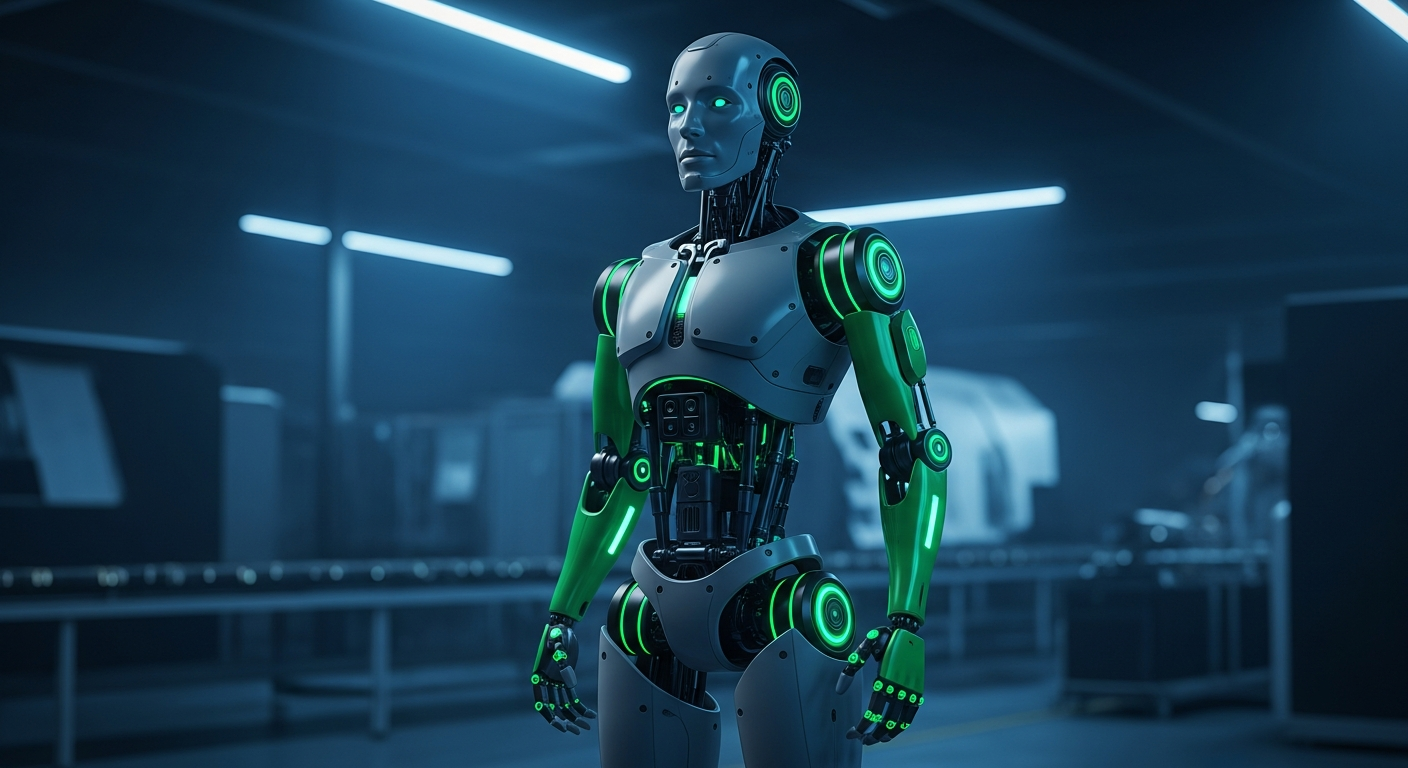
For most of the last decade, humanoid robots lived in viral videos and stage demos — impressive, but firmly in the realm of research. In 2026 that changed. Two-legged machines are now clocking real hours on automotive production lines, moving totes in warehouses, and entering limited production at some of the world's biggest companies. The era of the working humanoid has, cautiously, begun.
But the gap between the highlight reel and the operational reality is wide, and worth understanding clearly. This guide explains what humanoid robots are, how they work, which companies actually lead the field, what the machines really do today, what they cost, and where the technology is genuinely headed.
What Are Humanoid Robots?
A humanoid robot is a robot built to resemble and move like the human body — typically with a torso, two arms, two legs (or a wheeled base), hands, and a head packed with sensors. The goal is not to mimic humans for novelty but to create a general-purpose machine that can operate in spaces designed for people.
That distinguishes humanoids from traditional industrial robots, which are usually fixed arms optimized for one repetitive task. A humanoid is meant to be flexible — to walk where a person walks, grasp what a person grasps, and switch between jobs.
Why a Human Form?
The case for the humanoid shape is simple: the world is already built for humans. Factories, warehouses, stairs, doorknobs, shelves, tools, and vehicles are all sized and designed around the human body. A robot with roughly human proportions can, in theory, drop into these environments without expensive redesigns. That promise — one machine that fits everywhere people work — is what has drawn billions in investment.
The counterargument is that the human form is also hard to engineer and not always the most efficient shape for a given task. Balance on two legs, dexterous hands, and operating safely around people are genuinely difficult problems. The humanoid bet is that solving them once unlocks enormous flexibility.
How Humanoid Robots Work
A modern humanoid combines several hard technologies:
- Locomotion and balance. Walking on two legs while staying upright on uneven ground requires constant real-time adjustment, driven by motors (actuators) in the joints and feedback from balance sensors.
- Dexterous hands. Manipulating varied objects — the thing humans do effortlessly — remains one of the toughest challenges. Robotic hands are a major focus of current redesigns.
- Perception. Cameras, depth sensors, and tactile pads let the robot see and feel its surroundings.
- The AI "brain." This is where the 2026 leap lives. AI lets humanoids understand instructions, recognize objects, plan actions, and increasingly learn tasks rather than being hand-coded. So-called robot foundation models and embodied AI push toward machines that generalize across many jobs.
- Power. Battery life and energy efficiency are practical constraints that shape how long a robot can work between charges.
The Companies Leading Humanoid Robots in 2026
A handful of companies have moved from prototype to real deployment.
Figure AI
Figure has the most credible commercial track record. Its Figure 02 robot spent roughly eleven months on the BMW production line in Spartanburg, accumulating over 1,250 operating hours and contributing to the production of more than 30,000 vehicles — a verified, productive deployment with a Fortune 500 customer. Its newer Figure 03 targets broader use, with a planned European deployment at BMW's Leipzig plant, and its purpose-built BotQ factory is targeting around 12,000 units a year.
Agility Robotics
Agility occupies a singular position as the humanoid company most clearly generating commercial revenue. Its Digit robot moves totes in warehouse settings, with units deployed at major logistics and manufacturing operations after extended pilots.
Tesla Optimus
No humanoid generates more attention — or debate — than Tesla's Optimus. Tesla is repurposing manufacturing capacity at its Fremont facility for Optimus production, developing a new Gen 3 design with redesigned hands and a dedicated inference chip. CEO Elon Musk has set aggressive targets, including a retail price below $20,000–$30,000 at volume and millions of units. The reality check: Optimus's deployed evidence is limited compared with dedicated competitors, and external availability is widely expected around 2027–2028. Tesla's structural advantage is that its own factories serve as a massive training environment.
Boston Dynamics
Boston Dynamics' Atlas has arguably the most advanced physical capabilities of any humanoid, with units committed to Hyundai facilities. Its heritage is raw athleticism and mobility.
Apptronik, 1X, and Chinese Manufacturers
Apptronik's Apollo is being evaluated by Mercedes-Benz, and 1X Technologies is targeting home use. Meanwhile, Chinese manufacturers — Unitree, Fourier Intelligence, and AGIBOT among them — represent a fast-iterating cohort with strong government industrial support and aggressive pricing, increasingly deployed across Chinese manufacturing.
What Humanoid Robots Are Actually Used For
In 2026, real deployments cluster in structured, controlled environments:
- Manufacturing — moving parts, simple assembly, and material handling on production lines.
- Logistics and warehousing — carrying totes and loading, where repetitive movement suits current capabilities.
- Inspection and structured tasks in industrial settings.
Home use, elder care, and unstructured customer-facing roles are the long-term ambition but remain mostly future-tense, because dynamic, unpredictable environments are far harder than a factory floor. Crucially, today's humanoids supplement human workers on dull, repetitive, or physically taxing tasks rather than replacing whole jobs.
How Much Do Humanoid Robots Cost?
Pricing in 2026 spans a wide range — from around $16,000 for an entry-level model to well over $150,000 for high-end platforms — with the commercial market converging toward roughly $40,000–60,000. Tesla has set the most aggressive target at $20,000–30,000 at scale, though that depends on manufacturing execution. A growing trend is robot-as-a-service, offering humanoid capabilities for a few thousand dollars per month, which lowers the barrier for businesses wary of large upfront costs.
The Reality Check: Hype vs Deployment
This is where honesty matters. The pilots are real and the capability gains over three years ago are genuine — but several bottlenecks are underappreciated. Dexterous manipulation is still limited, operating reliably in unstructured environments is unsolved, safety certification is immature, and cost-efficient manufacturing at scale does not yet exist. Demos show best-case performance; production conditions are harder.
A useful benchmark: companies with external paying customers took 12–18 months to go from first factory pilot to signed commercial agreement. Scale deployment of tens of thousands of units is realistic toward the 2028–2029 window, not before, because every prerequisite — proven autonomy, reliability data, certification, supply chains, support — is still being built.
The Road Ahead
A reasonable timeline looks like this: through 2026–2027, humanoids handle specific, well-defined tasks in structured settings, with global numbers in the hundreds to low thousands. From 2028–2030, wider factory deployment arrives along with the first home-use products for narrow tasks. Beyond 2030 is when general-purpose humanoids could become genuinely transformative — if AI and hardware keep advancing and, just as importantly, if costs keep falling. Capability is only half the story; affordability is the other.
Conclusion
Humanoid robots in 2026 have crossed a real threshold: from research novelty to early, verified commercial deployment, led by Figure, Agility, Boston Dynamics, Tesla, and a fast-moving cohort of competitors. The promise — a flexible machine that fits the human-built world — is enormous, and the progress is genuine.
But the smart view is grounded: today's humanoids excel at narrow tasks in controlled settings and supplement rather than replace workers, with mass adoption still years away and gated as much by cost as by capability. Watch the deployment data, not the demos, and you will see the real shape of this revolution as it unfolds.
Want more? Explore AxionSquare for ongoing coverage of robotics, AI, and the machines reshaping how work gets done.
Frequently Asked Questions
What are humanoid robots used for in 2026?
Mostly structured industrial tasks — moving parts and simple assembly in manufacturing, and carrying totes in warehouses and logistics. Home, elder care, and customer-facing roles remain longer-term goals because unstructured environments are much harder.
Which company makes the best humanoid robot?
It depends on the measure. Figure AI has the strongest verified commercial deployment, Agility Robotics leads on commercial revenue, Boston Dynamics' Atlas has the most advanced physical capability, and Tesla's Optimus draws the most attention and has a powerful training pipeline.
How much does a humanoid robot cost?
Prices range from roughly $16,000 for entry-level models to over $150,000 for high-end platforms, with the commercial market converging around $40,000–60,000. Tesla targets $20,000–30,000 at scale, and robot-as-a-service options run a few thousand dollars per month.
When will humanoid robots be available for homes?
Limited home-use products for narrow tasks are expected around 2028–2030. Truly capable, general-purpose home robots depend on solving dexterity, reliability in unstructured spaces, safety, and cost — likely a 2030-and-beyond reality.
Will humanoid robots replace human workers?
In 2026 they supplement rather than replace workers, taking on repetitive or strenuous tasks in structured settings. Wider impact on jobs will unfold gradually as capability and affordability improve over the coming years.
Sources and further reading
- International Federation of Robotics (IFR) Statistics — Industrial robot installation data and market trends