Hydrogen Fuel Cell Vehicles: Heavy-Duty Applications and Infrastructure
A review of FCEV technology, examining the technical differences from battery electric vehicles and the strategic pivot toward heavy-duty and commercial transport.
Transportation · Global · 2026-07-12 · 8 min read · By John Awab
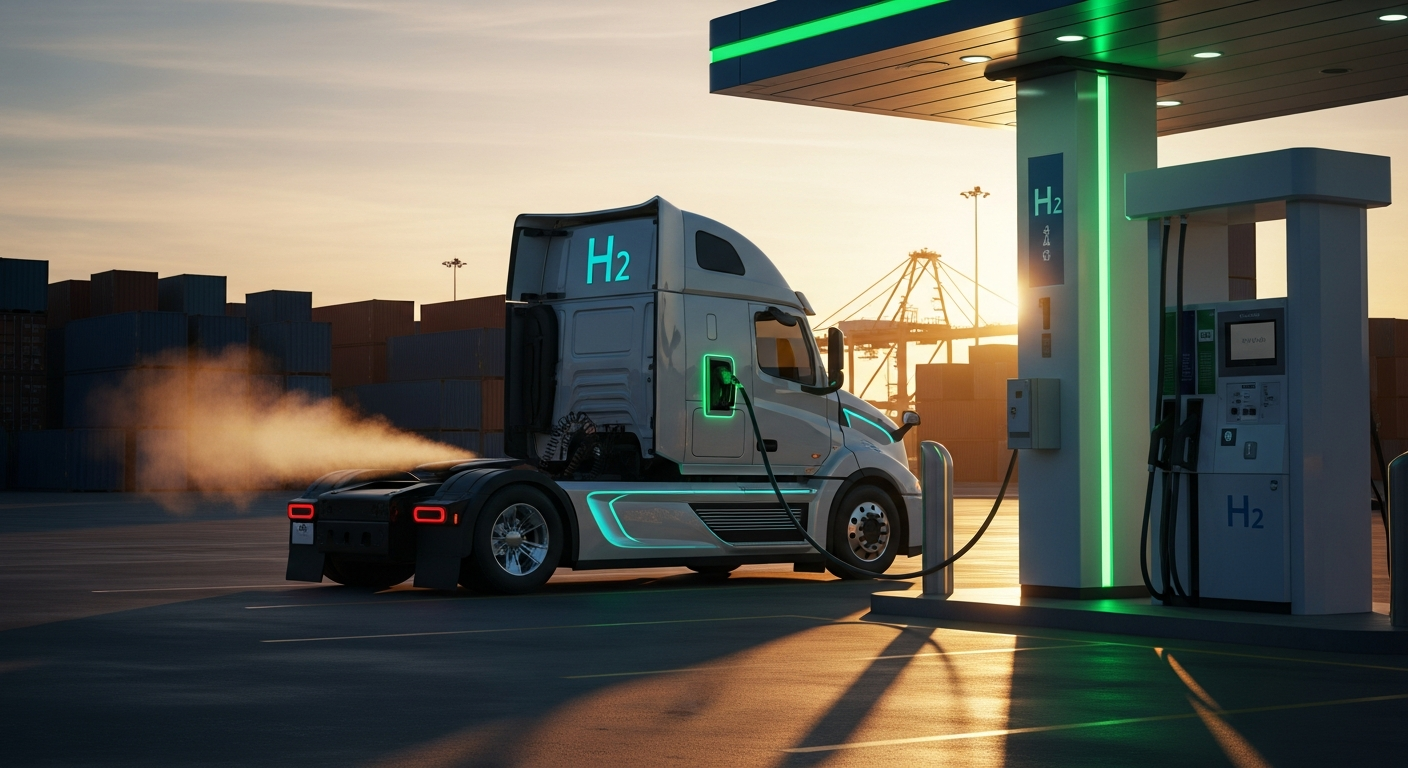
While battery electric vehicles have captured the spotlight, a different clean-transport technology has been quietly finding its niche: the hydrogen fuel cell vehicle. Instead of storing electricity in a giant battery, these vehicles carry hydrogen gas and generate electricity onboard, emitting nothing but water vapor. For years, hydrogen cars struggled to compete with batteries for the everyday driver. But in 2026, the technology is finding its real value not in passenger cars but in the heavy lifting of transport — the long-haul trucks, transit buses, and port equipment where batteries hit their limits. Hydrogen isn't beating the battery; it's carving out the territory batteries can't easily reach.
This guide explains what hydrogen fuel cell vehicles are, how they work, how they compare to battery EVs, why the industry is pivoting to heavy-duty applications, the key players, the infrastructure challenge, and the road ahead. (Market figures vary widely by source and scope, so treat them as estimates.)
What Is a Hydrogen Fuel Cell Vehicle?
A hydrogen fuel cell vehicle (FCEV) is an electric vehicle powered by hydrogen. Like a battery EV, it drives an electric motor — but instead of drawing power from a large battery pack charged from the grid, it generates electricity onboard using a fuel cell that combines stored hydrogen with oxygen from the air. The only tailpipe emission is water vapor, making FCEVs zero-emission at the point of use.
In essence, an FCEV is a hybrid of two worlds: it drives like an electric car (quiet, smooth, instant torque) but refuels like a gasoline car (filling a tank with hydrogen in minutes). That combination — electric driving with fast refueling — is the heart of hydrogen's appeal.
How Fuel Cells Work
The core technology is the fuel cell stack, most commonly a proton-exchange membrane (PEM) type. Here's the basic process: hydrogen stored in high-pressure tanks flows into the fuel cell, where a catalyst (traditionally using platinum) splits hydrogen atoms into protons and electrons. The electrons are forced through an external circuit, creating the electric current that powers the motor, while the protons pass through a membrane and recombine with oxygen to form water — the only byproduct. A small buffer battery captures regenerative braking energy and smooths power delivery.
The result is an electrochemical "engine" with no combustion, no moving pistons, and no harmful emissions. Ongoing advances — improving fuel cell efficiency, reducing expensive platinum usage, and enhancing hydrogen storage — are steadily making the technology more practical and affordable.
Hydrogen vs Battery Electric Vehicles
The central question is how FCEVs stack up against battery EVs (BEVs). Each has distinct strengths:
- Refueling speed — hydrogen's biggest advantage. Filling a hydrogen tank takes just a few minutes, versus the much longer charging times of batteries.
- Range and payload — hydrogen stores a lot of energy for its weight, so FCEVs can offer long range without the enormous, heavy battery packs that eat into a truck's cargo capacity.
- Cold-weather performance — fuel cells are less affected by cold than batteries.
But BEVs hold major advantages too:
- Efficiency — battery EVs use electricity far more efficiently; producing, compressing, and converting hydrogen loses a great deal of energy along the way.
- Infrastructure — charging is vastly more available than the tiny number of hydrogen stations.
- Cost — both the vehicles and the fuel are currently more expensive for hydrogen.
The emerging consensus isn't that one wins outright, but that they suit different jobs: batteries for most passenger cars and shorter routes, hydrogen for heavy, long-range, high-utilization applications.
The Heavy-Duty Pivot
The defining story of hydrogen transport in 2026 is its strategic shift away from passenger cars and toward commercial heavy-duty vehicles. This is where hydrogen's advantages — fast refueling, long range, and high payload — matter most, and where batteries struggle with weight and charging time. The primary value propositions are now long-haul trucking, public transit buses, and logistics and port operations.
Ports are an especially natural fit: they need trucks and terminal equipment that refuel quickly without sacrificing cargo capacity, and because they operate from fixed locations, they create concentrated, reliable hydrogen demand that justifies building refueling infrastructure. Real deployments are already proving the concept — hydrogen trucks are hauling freight in Europe, operating in North America, and moving cargo at major ports. In the US specifically, the FCEV market is transitioning from pilot programs toward early commercial deployment, led decisively by medium- and heavy-duty vehicles rather than passenger cars.
The Key Players
A focused group of manufacturers drives the FCEV market:
- Toyota — a hydrogen pioneer with the Mirai passenger sedan and Class 8 trucks operating at ports, now joining forces with Volvo Group and Daimler Truck in a hydrogen fuel cell joint venture for commercial vehicles.
- Hyundai — offers the NEXO passenger SUV (with a next-generation model launched) and the XCIENT Fuel Cell truck deployed commercially in Europe.
- Honda — one of the few remaining passenger FCEV producers.
- Commercial and component specialists — Daimler Truck, Nikola (with FCEV trucks in North America), Ballard Power Systems and Cummins (fuel cell systems), plus Chinese players like Weichai, SAIC, BYD, and Yutong driving mass bus and truck deployment.
Regionally, Asia-Pacific dominates — commanding well over half the global market — thanks to strong government backing in Japan, South Korea, and China, with Japan's Toyota and Honda being among the only commercial-scale passenger-FCEV makers. Europe is scaling hydrogen truck corridors, and North America is growing, driven by heavy-duty trucking and transit.
The Infrastructure Challenge
Hydrogen's greatest obstacle is infrastructure — the classic chicken-and-egg problem. Few people buy hydrogen vehicles because there are few refueling stations, and few stations get built because there are few vehicles. Hydrogen refueling stations are expensive to construct, and the network remains sparse, concentrated in a handful of regions (Asia leads, with pockets in California and parts of Europe). This is precisely why the heavy-duty, fleet, and port focus makes strategic sense: fixed-route fleets refueling at central depots or freight corridors sidestep the need for a vast public network. Building out hydrogen "hubs" and freight-corridor stations — supported by government programs in Europe, Asia, and US states like California and New York — is central to the sector's growth.
The Green Hydrogen Question
A crucial caveat: hydrogen is only as clean as how it's made. Most hydrogen today is "grey hydrogen," produced from natural gas in a process that emits carbon dioxide — which undercuts the environmental case. The goal is "green hydrogen," made by splitting water using renewable electricity, which is genuinely clean but currently more expensive. The economics hinge on green hydrogen costs falling (toward a few dollars per kilogram at scale), supported by production incentives. Until green hydrogen becomes cheap and abundant, FCEVs' climate benefits depend heavily on the hydrogen supply chain behind them — an honest and important qualification to the "zero-emission" label.
The Challenges
Beyond infrastructure and green-hydrogen supply, FCEVs face real headwinds. Cost remains high for both vehicles and fuel. Energy efficiency is inherently lower than battery EVs, since so much energy is lost producing and converting hydrogen. Competition from batteries is fierce and improving fast, with better range and charging eroding some of hydrogen's edge even in trucking. Supply chains depend on imported vehicles and components in many markets, and on scarce materials like platinum (though usage is being reduced). And consumer awareness of hydrogen remains low. These challenges explain why FCEV adoption has lagged BEVs and why the industry has wisely narrowed its focus to where hydrogen genuinely excels.
The Future
The outlook points to focused, commercial-led growth rather than mass passenger adoption. Market forecasts vary enormously — from steady double-digit annual growth to explosive projections — but they broadly agree the momentum lies in heavy-duty trucking, buses, and industrial equipment, especially as regulations (like the EU's CO₂ mandates) push fleets toward zero-emission procurement. Expect falling fuel cell and green-hydrogen costs, expanding freight-corridor infrastructure, and deepening automaker partnerships to share development costs. Hydrogen likely won't displace the battery for everyday cars, but as a complementary clean-transport technology for the heaviest, longest, hardest-working vehicles, its role appears increasingly secure. The future of clean transport is probably not hydrogen or batteries — it's both, each doing what it does best.
Conclusion
Hydrogen fuel cell vehicles offer a compelling clean-transport proposition: electric driving with fast refueling and long range, emitting only water vapor. After years of struggling to compete with battery EVs for everyday drivers, hydrogen has found its footing in 2026 by focusing where it truly excels — the heavy-duty trucks, buses, and port equipment where fast refueling, long range, and high payload outweigh batteries' efficiency and infrastructure advantages.
Real challenges remain around cost, sparse refueling infrastructure, energy efficiency, and the need for cheap green hydrogen to deliver on the clean-energy promise. But led by Toyota, Hyundai, and a growing field of commercial-vehicle makers, and backed by government hydrogen programs worldwide, FCEVs are carving out a durable, complementary role in the clean-transport future. Understanding hydrogen vehicles reveals that decarbonizing transport won't be a single technology's victory — it will take the right tool for each job.
Want more? Explore AxionSquare for ongoing coverage of hydrogen vehicles, electric vehicles, and the technologies driving the future of transportation.
What is a hydrogen fuel cell vehicle?
A hydrogen fuel cell vehicle (FCEV) is an electric vehicle powered by hydrogen. It drives an electric motor like a battery EV, but instead of a large grid-charged battery, it generates electricity onboard using a fuel cell that combines hydrogen with oxygen. Its only tailpipe emission is water vapor, and it refuels in minutes like a gasoline car.
How is a hydrogen vehicle different from a battery EV?
Both are electric, but a battery EV stores electricity in a large battery charged from the grid, while an FCEV stores hydrogen and generates electricity onboard. Hydrogen's advantages are fast refueling (minutes) and long range without heavy batteries; battery EVs win on energy efficiency, cost, and vastly more available charging infrastructure.
Why is hydrogen focusing on trucks and buses instead of cars?
Because hydrogen's strengths — fast refueling, long range, and high payload — matter most in heavy-duty applications where batteries struggle with weight and charging time. Long-haul trucks, transit buses, and port equipment operate on fixed routes that can refuel at central depots, sidestepping the need for a vast public hydrogen station network.
Are hydrogen vehicles truly zero-emission?
At the tailpipe, yes — they emit only water vapor. But the full picture depends on how the hydrogen is made. Most hydrogen today ("grey hydrogen") comes from natural gas and emits CO₂. Truly clean "green hydrogen," made using renewable electricity, is cleaner but currently more expensive. So FCEVs' climate benefit depends heavily on the hydrogen supply chain.
What are the main challenges facing hydrogen vehicles?
Key challenges include sparse and expensive refueling infrastructure (a chicken-and-egg problem), high vehicle and fuel costs, lower energy efficiency than battery EVs, the need for cheaper green hydrogen, strong competition from improving batteries, and low consumer awareness. This is why the industry has narrowed its focus to heavy-duty fleet applications where hydrogen excels.
Sources and further reading
- U.S. Department of Energy - Hydrogen and Fuel Cell Technologies Office — FCEV technology overview and infrastructure goals
- International Energy Agency - Global Hydrogen Review — Market data on hydrogen deployment and commercial heavy-duty trends