Industrial Robotics: Advancing Factory Autonomy
Manufacturing density for industrial robots continues to accelerate, with AI integration driving unprecedented levels of productivity and operational intelligence in global factories.
Robotics · Global · 2026-06-14 · 10 min read · By John Awab
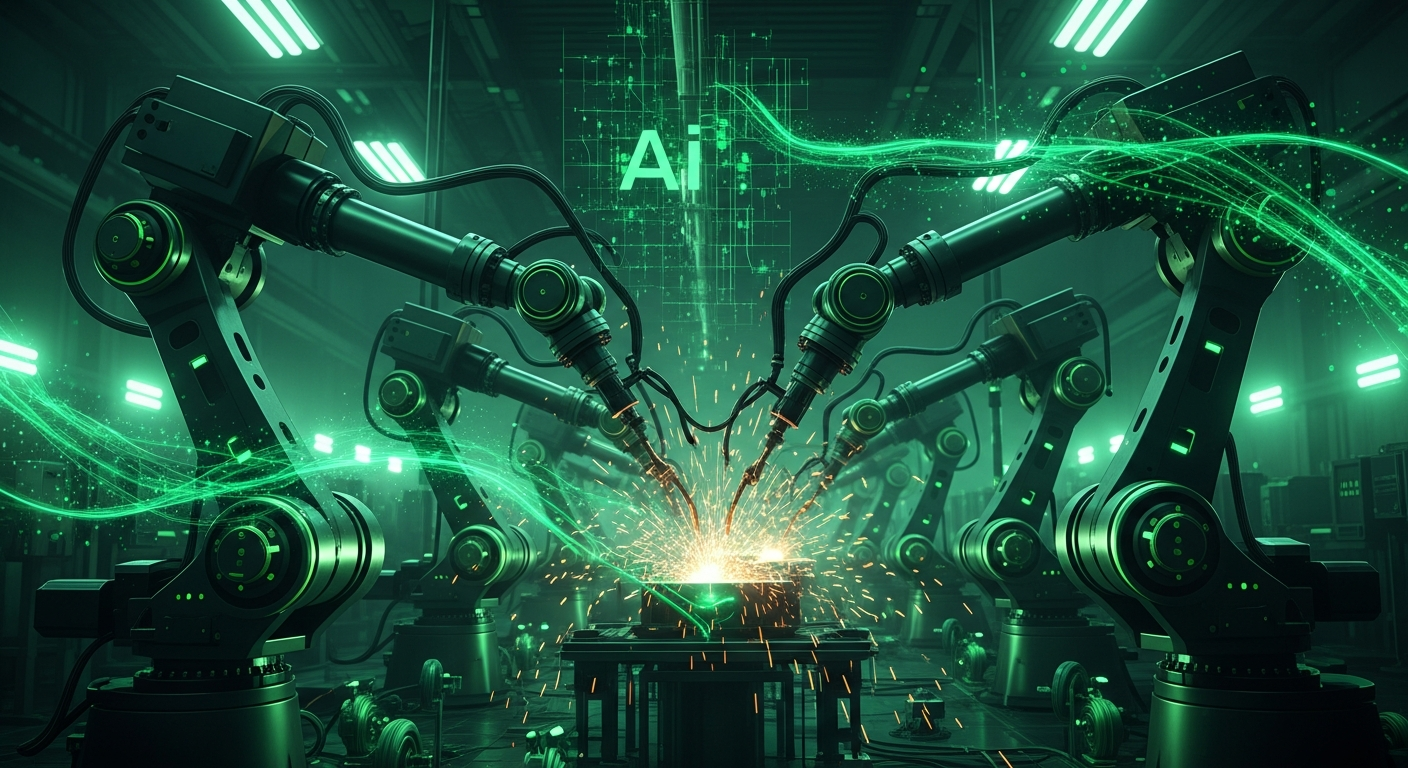
There are now an average of 162 industrial robots for every 10,000 manufacturing workers worldwide — more than double the figure from just seven years ago. The global value of industrial robot installations has hit an all-time high, and factories from Shanghai to Stuttgart to South Carolina are racing to automate. Industrial robots are no longer a futuristic novelty; they are the backbone of modern manufacturing, and in 2026 they're getting dramatically smarter.
This guide explains what industrial robots are, the main types, how they work, what they do, the state of the market, and the AI revolution transforming the field. Whether you're new to automation or want the current picture, here is the clear map. (Market-size figures vary by source and scope, so treat them as estimates.)
What Are Industrial Robots?
An industrial robot is a programmable, automated machine — usually a robotic arm — designed to perform manufacturing tasks with speed, precision, and tireless repeatability. Unlike consumer or humanoid robots, industrial robots are built for the factory floor: welding car bodies, assembling electronics, moving heavy materials, and packaging goods, often working faster and more consistently than any human could.
The defining traits are programmability (they can be reconfigured for different tasks), precision (repeatable to fractions of a millimeter), and endurance (they run continuously without fatigue). These qualities make them indispensable wherever high-volume, high-accuracy production is needed.
How Industrial Robots Work
A typical industrial robot is built from a few core parts. The arm consists of segments connected by joints (or axes) — more axes mean more flexibility, with six-axis robots able to move much like a human arm. At the end sits the end effector — the "hand," which might be a gripper, welding torch, paint sprayer, or suction tool, chosen for the task. A controller is the robot's brain, running the program that directs its movements, while sensors (increasingly camera-based and AI-driven) feed the controller real-time data about the environment.
The Main Types of Industrial Robots
Robots come in distinct configurations suited to different jobs:
- Articulated robots — the classic multi-jointed arm and the most common type (leading the market), prized for flexibility in welding, painting, handling, and heavy lifting.
- SCARA robots — fast and precise for assembly and pick-and-place in a horizontal plane.
- Delta robots — lightweight "spider"-style arms built for extremely fast picking and packaging.
- Cartesian/gantry robots — move along straight X-Y-Z axes for precise, large-area tasks.
- Collaborative robots (cobots) — designed to work safely alongside humans without safety cages, a fast-growing category.
- Autonomous mobile robots (AMRs) and AGVs — wheeled robots that move materials around facilities, central to modern warehouse automation.
Choosing the right type comes down to the task's speed, precision, payload, and workspace.
What Industrial Robots Do
Industrial robots handle a wide range of manufacturing tasks. Material handling and packaging is the largest application, covering moving, sorting, palletizing, and boxing goods. Robots also dominate welding and painting (especially in automotive), assembly of products from cars to electronics, machine tending, and increasingly quality inspection — one of the fastest-growing uses, powered by machine vision. Across these jobs, robots deliver consistency and throughput that human workers simply can't match at scale.
The State of the Industrial Robot Market in 2026
The industry is at a record high. According to the International Federation of Robotics, the global value of industrial robot installations reached an all-time peak of around $16.7 billion, with annual installation counts near historic records and forecasts pointing toward roughly 700,000 new units installed per year by 2028. Broader market estimates that include software and services run considerably higher, into the tens of billions, growing at double-digit annual rates.
Geographically, Asia-Pacific dominates, accounting for roughly half of installations and led by China (which installs more industrial robots than anywhere else), Japan, and South Korea. Europe — Germany, Italy, France — focuses on high-tech, AI-driven Industry 4.0 automation, while North American companies ordered tens of thousands of robots worth billions in the latest year. The clearest single metric is robot density, now averaging 162 robots per 10,000 employees globally — with South Korea and Singapore leading at over 1,000 per 10,000 workers.
Why Adoption Is Surging
Several forces are driving the boom. Labor shortages are acute — factories struggle to find enough people willing to do repetitive, physically demanding work, and turnover is brutal. Wage inflation has outpaced consumer prices in advanced economies, squeezing margins on labor-intensive assembly. Reshoring — bringing manufacturing back closer to home — makes automation economically attractive, and government subsidies and tax incentives are pushing factories to automate faster.
The Leading Manufacturers
The market is concentrated among a handful of giants, with the top five players holding well over half of global share. The leaders are ABB, FANUC, Yaskawa, KUKA, and Mitsubishi Electric, alongside specialists like Universal Robots in the collaborative space. These companies are investing heavily — expanding capacity, partnering on AI integration, and acquiring system integrators to broaden their reach.
The AI Revolution in Industrial Robotics
The defining 2026 trend is artificial intelligence making robots autonomous. Where traditional industrial robots blindly repeat pre-programmed motions, AI-powered robots can perceive, adapt, and make decisions. Analytical AI processes sensor data to detect patterns and predict maintenance needs; machine vision lets robots see and adjust to variation; and emerging physical AI gives robots more general capability. Roughly 40% of manufacturers are now integrating AI and machine learning into their robots, enabling real-time adaptation that was impossible five years ago.
Challenges
Hurdles remain. High upfront cost and integration complexity deter smaller manufacturers, who often lack the capital and expertise of large factories. Safety must be engineered carefully, especially where robots and humans share space. Skills gaps in programming and maintenance persist, and supply-chain pressures for components like semiconductors can delay deployment. Models like robot-as-a-service are emerging to lower the barrier for smaller firms.
The Future
Expect industrial robots to grow smarter, more autonomous, and more collaborative. AI will let them handle variation and complex tasks once reserved for humans, cobots and mobile robots will spread automation beyond big factories, and digital twins and edge AI will optimize whole production systems. The line between industrial robots and the emerging wave of humanoid factory robots will blur as physical AI matures. The trajectory is clear: factories are becoming intelligent, adaptive systems rather than fixed assembly lines.
Conclusion
Industrial robots are the engine of modern manufacturing — programmable, precise, tireless machines that weld, assemble, handle, and inspect at a scale and consistency humans can't match. With installations at record highs, robot density doubling, and AI making machines genuinely autonomous, 2026 marks a turning point from rigid automation toward intelligent, flexible factories.
Understanding the types, applications, and market forces is key to grasping where manufacturing is headed. Driven by labor shortages, reshoring, and rapid AI advances, the industrial robot revolution is accelerating — reshaping not just how things are made, but who (and what) makes them.
Want more? Explore AxionSquare for ongoing coverage of robotics, AI, and the technologies transforming industry.
Frequently Asked Questions
What is an industrial robot?
An industrial robot is a programmable, automated machine — usually a robotic arm — built to perform manufacturing tasks like welding, assembly, material handling, and packaging with high speed, precision, and repeatability on the factory floor.
What are the main types of industrial robots?
The main types are articulated (multi-jointed arms, the most common), SCARA, delta, and cartesian/gantry robots, plus collaborative robots (cobots) that work safely beside humans and autonomous mobile robots (AMRs) that move materials around facilities.
What are industrial robots used for?
They handle material handling and packaging (the largest use), welding, painting, assembly, machine tending, and increasingly quality inspection — primarily in automotive, electronics, and pharmaceutical manufacturing.
How big is the industrial robot market?
The International Federation of Robotics reports global industrial robot installations at a record value of around $16.7 billion, with annual installations heading toward roughly 700,000 units by 2028. Broader estimates including software and services run into the tens of billions.
How is AI changing industrial robots?
AI is making robots autonomous rather than blindly repetitive — using machine vision and analytical AI to perceive, adapt, predict maintenance, and handle variation. Around 40% of manufacturers now integrate AI and machine learning into their robots.
Sources and further reading
- International Federation of Robotics - Robot Density — Quantitative metrics on industrial robot density and installations.