The Internet of Things: Structural Integration and Foundational Connectivity
With over 20 billion connected devices, IoT technology now serves as foundational infrastructure for industrial, medical, and consumer networks worldwide.
Technology · Global · 2026-06-12 · 10 min read · By John Awab
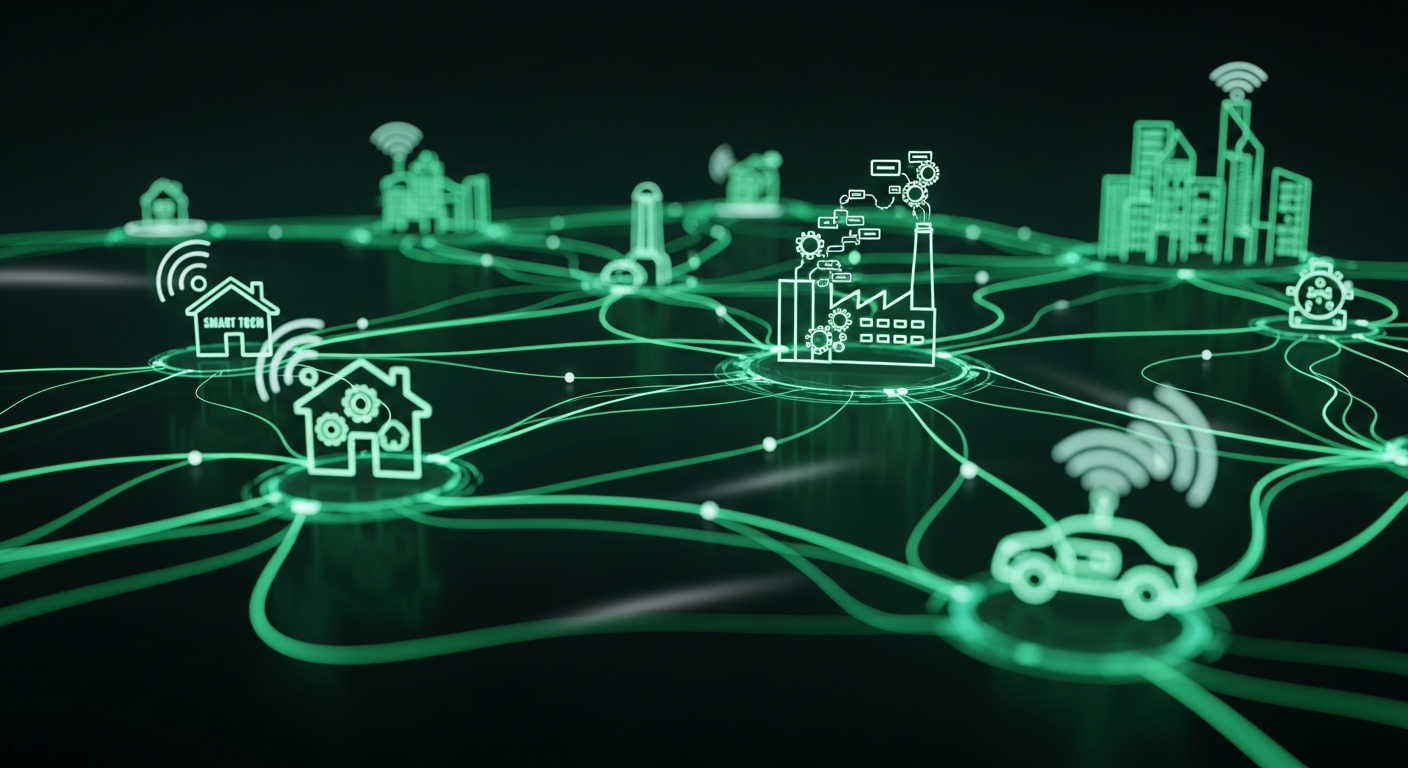
There are now roughly 22 billion connected devices on Earth — nearly three for every human being — and the number is climbing toward 40 billion by 2030. Your thermostat, your watch, the traffic lights on your commute, the machines in factories, and the sensors in hospitals are all quietly talking to each other over the internet. This vast, invisible web of connected objects is the Internet of Things, and in 2026 it has become foundational infrastructure for modern life.
This guide explains what the Internet of Things is, how it works, where it's used, the state of the market in 2026, how it's merging with AI, and the security challenges it raises. Whether you're new to the concept or want the current picture, here is the clear map. (Market figures vary widely by source and scope, so treat them as estimates.)
What Is the Internet of Things?
The Internet of Things (IoT) is the network of physical objects — "things" — embedded with sensors, software, and connectivity that lets them collect, exchange, and act on data over the internet. In plain terms, it's about giving everyday objects the ability to sense their environment, communicate, and respond, turning ordinary devices into intelligent tools.
A smart thermostat that learns your schedule, a fitness band that tracks your heart rate, a factory sensor that flags a failing machine before it breaks — all are IoT in action. The unifying idea is that physical things become data sources and actors in a connected system, rather than isolated, "dumb" objects.
How IoT Works
Most IoT systems follow a simple four-step loop:
- Sense — devices use sensors to collect data about the physical world (temperature, motion, location, heart rate, machine vibration).
- Connect — that data travels over a network (Wi-Fi, cellular, Bluetooth, or low-power options) to where it can be processed.
- Process — the data is analyzed, increasingly at the "edge" (on or near the device) for speed, or in the cloud for heavier computation.
- Act — the system responds: adjusting a thermostat, alerting a technician, or feeding insights to a dashboard.
This sense-connect-process-act cycle, running continuously across billions of devices, is what makes the IoT so powerful.
The Building Blocks of IoT
Four components make it work: devices and sensors that gather data; connectivity that moves it (Wi-Fi remains dominant at roughly a third of connections, with cellular and 5G growing fast); data processing, split between edge and cloud (cloud now handles the large majority of IoT workloads); and applications that turn the data into useful action for people or machines. Interoperability standards tie these together — an increasingly urgent need as device counts explode.
Types of IoT and Where It's Used
IoT spans consumer and industrial worlds:
Smart Home and Wearables (Consumer)
The leading consumer segment, accounting for roughly a third of IoT revenue. Smart speakers, thermostats, lighting, security systems, and wearables like fitness trackers are now mainstream — about half of US households are expected to own smart-home devices in 2026, and the smart-home market alone is worth around $180 billion.
Industrial IoT (IIoT)
In factories and supply chains, IIoT connects machines and sensors to enable predictive maintenance, automation, and efficiency — a cornerstone of "Industry 4.0." 2026 marks a year of broader industrial deployment, often paired with digital twins (virtual replicas of physical equipment), a market worth tens of billions on its own.
Smart Cities
Cities use IoT for traffic management, lighting, water, and waste. Over 600 cities worldwide have deployed IoT solutions, smart traffic systems in many US cities have cut congestion by around 12%, and municipal smart-city spending is heading past $300 billion.
Healthcare (IoMT)
The Internet of Medical Things connects monitors, imaging devices, and wearables for remote patient monitoring and better care — a market measured in the hundreds of billions, though it raises pointed security concerns (a large share of medical imaging devices still run unsupported software).
Agriculture, Transportation, and Retail
Smart farming uses sensors for precision irrigation and crop monitoring; connected vehicles and fleet-management systems optimize transportation; and smart retail uses IoT for inventory and asset tracking.
The State of IoT in 2026
The numbers are staggering. Worldwide IoT connections are reaching roughly 21–22 billion in 2026, and global IoT spending is expected to surpass $1 trillion, with market-size estimates ranging from around $860 billion to well over $1 trillion depending on what's counted. Greater China leads spending (around $174 billion), followed by North America (around $104 billion) and Europe. Services account for roughly 40% of IoT investment, and the sector employs millions worldwide — a foundational industry rather than an emerging one.
IoT Meets AI: Edge AI and Digital Twins
The most important 2026 shift is the fusion of IoT with artificial intelligence — sometimes called AIoT. Two developments stand out. Edge AI — running AI models directly on or near devices rather than in distant data centers — is growing explosively, enabling real-time, private, low-latency intelligence (think a camera that recognizes events instantly without sending video to the cloud). And digital twins pair IoT data with AI to create live virtual models of machines, buildings, or entire systems, used to simulate, predict, and optimize performance before acting in the real world.
The Challenges: Security and Interoperability
The IoT's greatest strength — billions of connected devices — is also its greatest weakness. Each device is a potential entry point for attackers, and IoT cyberattacks number in the hundreds of millions. Many devices ship with weak security, run outdated software, or are rarely patched, creating a vast attack surface (a serious worry in healthcare especially). The other major hurdle is interoperability: with hundreds of platforms and competing standards, getting devices from different makers to work together seamlessly remains a stubborn challenge.
The Future of IoT
Expect the IoT to grow denser, smarter, and more autonomous — heading toward 40 billion-plus devices by 2030, with ever more intelligence pushed to the edge. As IoT, AI, 5G, and eventually 6G converge, the line between the digital and physical worlds will keep blurring, moving toward "ambient computing," where intelligence is woven invisibly into our surroundings. The priorities that will shape that future are security, interoperability, and trust — making the expanding network not just bigger, but dependable.
Conclusion
The Internet of Things has quietly become one of the most consequential technologies of our era — a web of roughly 22 billion connected devices sensing, communicating, and acting across homes, factories, cities, hospitals, and farms. Understanding the sense-connect-process-act loop, the major applications, and the fusion with AI through edge computing and digital twins is key to grasping how the physical and digital worlds are merging.
The opportunities are immense, but so are the challenges of security and interoperability. As the IoT scales toward tens of billions of devices, the winners will be those who make this connected world not just smarter, but safer and more seamless. The age of connected everything is here.
Want more? Explore AxionSquare for ongoing coverage of IoT, AI, robotics, and the technologies shaping our connected future.
Frequently Asked Questions
What is the Internet of Things (IoT) in simple terms?
The Internet of Things is the network of everyday physical objects — embedded with sensors, software, and connectivity — that collect and exchange data over the internet, letting them sense their environment, communicate, and respond automatically.
How does IoT work?
IoT follows a four-step loop: devices sense data with sensors, connect to a network to transmit it, process the data at the edge or in the cloud, and then act on it — like adjusting a thermostat or alerting a technician.
What are examples of IoT?
Smart home devices (thermostats, speakers, lights), wearables like fitness trackers, industrial sensors for predictive maintenance, smart city traffic systems, connected medical devices, smart farming sensors, and connected vehicles are all common examples.
How many IoT devices are there in 2026?
There are roughly 21–22 billion connected IoT devices worldwide in 2026, with long-range forecasts projecting around 40 billion by 2030 and over 50 billion by 2035.
What are the biggest IoT challenges?
Security and interoperability. Billions of connected devices create a huge attack surface, and many ship with weak or outdated security, while competing standards and platforms make it difficult to get devices from different makers to work together seamlessly.
Sources and further reading
- International Telecommunication Union - IoT Standards — Global connectivity standards for IoT infrastructure.