Maritime Decarbonization: Pathways and Green Fuel Integration
An analysis of the global shipping industry's transition to green fuels, regulatory shifts from the IMO, and technical challenges in achieving net-zero emissions.
Transportation · Global · 2026-09-06 · 11 min read · By John Awab
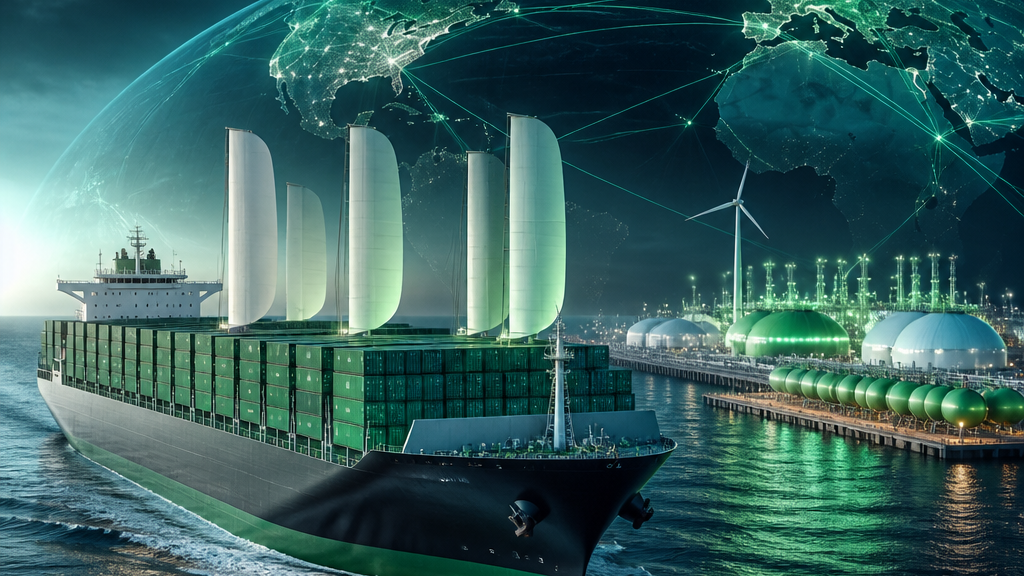
Around 90% of everything you own — your phone, your furniture, your food — traveled to you by sea at some point. The global shipping industry is the invisible circulatory system of the world economy, and it runs almost entirely on heavy fuel oil, one of the dirtiest fuels on Earth. Shipping accounts for nearly 3% of global greenhouse gas emissions — comparable to a major industrialized nation — and if left unchecked, those emissions could grow substantially as trade expands. In 2026, the industry is being forced to change by binding international regulation, and it faces the most significant technological and financial upheaval in its history: the race to decarbonize. The problem is uniquely hard, the solutions are still immature, and the stakes — for the climate and for global trade — are enormous.
This guide explains why maritime decarbonization matters, why it's so difficult, the competing green fuels vying to replace oil, the regulatory framework driving change, green shipping corridors, the challenges, and where it's all heading. (Figures and timelines vary by source and are evolving fast, so treat them as estimates.)
Why Shipping Must Decarbonize
Maritime shipping is both essential and enormously carbon-intensive. It carries the overwhelming majority of global trade, and its emissions — close to 3% of the global total — rival those of entire countries. Because global trade is projected to keep growing, shipping emissions could rise dramatically without intervention, by some estimates reaching well above 2008 levels by mid-century if nothing changes.
For years, shipping was considered one of the "hard-to-abate" sectors — too demanding for clean alternatives. Ocean vessels need to travel vast distances between refueling, carry enormous loads, and operate for decades, which makes the energy density and reliability of fossil fuels hard to replace. But that view is shifting. Viable decarbonization pathways have become clearer, the regulatory environment now demands action, and the industry has accepted that change is no longer optional but a legally binding necessity.
Why It's So Hard
Understanding maritime decarbonization requires appreciating why it's uniquely difficult. Unlike cars, ships can't simply switch to batteries for most journeys — the energy required to move a massive vessel across an ocean would demand impractically enormous batteries. Ships have very long operational lifespans (often 20–30 years), so vessels built today will still be sailing for decades, and retrofitting or replacing the global fleet is a slow, colossal undertaking. The fuels that could replace oil are mostly just emerging from the pilot phase, aren't yet available at scale, and require entirely new bunkering (refueling) infrastructure at ports worldwide — a build-out estimated to take years and cost trillions of dollars. And international shipping crosses jurisdictions, making it hard to regulate through any single country's laws. These interlocking challenges explain why decarbonizing shipping is one of the toughest problems in the entire energy transition.
The Green Fuel Race
At the heart of maritime decarbonization is an intense competition to find the fuel (or fuels) that will replace heavy fuel oil. There's no clear single winner — the leading candidates each have distinct strengths and weaknesses, and the emerging consensus is that the choice is highly route-dependent.
- Methanol — the pragmatic near-term frontrunner. Methanol burns cleaner than oil, can be produced from renewable sources ("green methanol"), and crucially is a liquid at ambient temperature, making it relatively easy to store and handle with existing infrastructure in some ports. This maturity has made it the favored early choice, especially for shorter routes — major carriers like Maersk and CMA CGM lead in methanol-powered vessels in operation or on order. Its main limitation is the availability and cost of green methanol at scale.
- Ammonia — widely viewed as the primary pathway for long-term, deep-sea decarbonization. Ammonia contains no carbon, so it produces no CO₂ when used, and green ammonia (made from renewable hydrogen) can achieve up to around 90% lifecycle emissions reduction. It also benefits from existing production and distribution infrastructure, since ammonia is already a major global commodity. The catch: ammonia is toxic and requires careful handling, safety regulations are still being finalized (interim guidelines for ammonia-fueled ships have only recently emerged), and it remains in early adoption.
- Hydrogen — the cleanest option in principle, producing only water when used in fuel cells. But hydrogen is extremely difficult to store on ships: it must be kept as a cryogenic liquid at ultra-low temperatures or under high pressure, demanding infrastructure that isn't yet mature. Hydrogen is generally seen as a longer-term option pending those advances, and it's often more practical as the feedstock for making green methanol and ammonia than as a direct ship fuel.
- LNG and biofuels — transitional options. Liquefied natural gas burns cleaner than heavy fuel oil and is available now, serving as a "bridge" fuel, but it's still a fossil fuel with its own emissions concerns (including methane leakage). Biofuels can work in existing engines but face supply and sustainability constraints.
Beyond fuels, other measures help: wind-assisted propulsion (modern sails and rotors), batteries and fuel cells for short routes and port operations, efficiency improvements in hull design and operations, and digital tools like route and port-call optimization. The realistic future is a mix — methanol for shorter and near-term routes, ammonia for long-haul deep-sea shipping, and hydrogen and others filling specific niches.
The Regulatory Framework
The single biggest force driving maritime decarbonization is regulation, spearheaded by the International Maritime Organization (IMO), the UN body that regulates international shipping. The IMO's revised strategy targets net-zero lifecycle ("well-to-wake") greenhouse gas emissions from international shipping by around 2050, with interim checkpoints — commonly cited as roughly 20% reduction by 2030 and 70% by 2040 relative to 2008 levels.
To achieve this, the IMO has developed a Net-Zero Framework (intended as a new chapter of the MARPOL treaty), centered on two mid-term measures: a goal-based marine fuel standard that limits the well-to-wake greenhouse gas intensity of fuels over time, and an economic mechanism that effectively prices emissions — rewarding zero- and near-zero-emission fuels while charging those that exceed limits. Regional rules add pressure too, notably the EU's inclusion of shipping in its Emissions Trading System and its FuelEU Maritime regulation. The key effect is financial urgency: these rules make continued reliance on dirty fuel increasingly expensive, forcing shipowners to act now or face penalties and the risk of their vessels becoming devalued "stranded assets." Importantly, the framework focuses on reducing emissions intensity rather than mandating specific fuels, leaving the industry to choose its technology paths.
Green Shipping Corridors
One of the most practical mechanisms accelerating the transition is the green shipping corridor — a specific maritime route between two major ports where zero-emission shipping is actively developed and deployed, principally using green hydrogen-derived fuels like ammonia and methanol. By concentrating effort on defined routes, corridors solve the chicken-and-egg problem: they coordinate ports, shipping companies, fuel producers, financiers, and governments to build the fuel supply, bunkering infrastructure, and vessel demand together in one place. This creates viable pockets of zero-emission shipping that can then scale outward. Dozens of green corridor initiatives are now under development worldwide, backed by industry coalitions and research centers, and they've become a central strategy for turning decarbonization ambition into real deployment.
The Challenges and Debates
Maritime decarbonization faces genuine hurdles, and honest observers acknowledge real debates about the path forward:
- Fuel availability and cost — green fuels are expensive and scarce today, and scaling their production is a massive undertaking. Green fuels cost significantly more than heavy fuel oil, raising the central economic challenge.
- Infrastructure — retrofitting global bunkering infrastructure will take years and enormous investment.
- The "pay vs switch" concern — a genuine debate is whether some shipping companies will simply pay emissions fees rather than absorb the higher cost of switching fuels, potentially blunting the intended effect. This has prompted calls for more ambitious targets and stricter standards.
- Safety and standards — fuels like ammonia (toxic) and hydrogen (volatile) require new safety regulations still being finalized.
- Pace and ambition — critics argue the targets may not be aggressive enough to meet climate goals, while others (including some governments concerned about fuel availability) worry the timeline is too aggressive given that green fuels are barely out of pilot phase. This tension — between environmental urgency and practical readiness — is real, and reasonable stakeholders disagree.
- Just transition — ensuring the costs don't fall unfairly on developing nations and small island states, a concern the IMO framework attempts to address through a fund supporting those countries.
The honest picture is an industry that has committed to a genuinely difficult transition, with the technology paths clarifying but the costs, infrastructure, and pace all still contested.
The Future
Maritime decarbonization will accelerate through the rest of the decade, driven by tightening regulation and financial pressure. Expect methanol to dominate near-term adoption while ammonia scales for deep-sea routes; green shipping corridors to multiply and expand; continued investment in wind assistance, efficiency, and port electrification; and the gradual build-out of green fuel production and bunkering infrastructure. The transition will be expensive, uneven, and slower than the most ambitious hope — but the direction is now firmly set by binding rules and industry commitment. The question is no longer whether shipping will decarbonize, but how fast, at what cost, and which fuels will win which routes. For an industry that has run on oil for over a century, the shift underway is nothing short of historic.
Conclusion
Maritime decarbonization is the effort to eliminate greenhouse gas emissions from an industry that moves most of global trade and runs almost entirely on dirty fuel oil — one of the hardest challenges in the entire energy transition. Driven by the IMO's binding net-zero-by-2050 framework and regional rules that make polluting increasingly expensive, the industry is racing to adopt green fuels, with methanol leading near-term, ammonia emerging for deep-sea routes, and hydrogen and others playing supporting roles.
The obstacles are formidable — scarce and costly fuels, trillions in infrastructure investment, safety challenges, and genuine debate over pace and fairness. But green shipping corridors, tightening regulation, and real industry commitment are turning ambition into deployment. Understanding maritime decarbonization reveals both the enormous difficulty and the growing momentum of cleaning up the invisible engine of global trade — a transformation that will reshape how the world's goods move for generations to come.
Want more? Explore AxionSquare for ongoing coverage of maritime decarbonization, sustainable aviation fuel, hydrogen, and the technologies driving the future of transportation.
Frequently Asked Questions
What is maritime decarbonization?
Maritime decarbonization is the effort to reduce and ultimately eliminate greenhouse gas emissions from the shipping industry, which carries most of global trade and runs largely on heavy fuel oil. It accounts for nearly 3% of global emissions. Decarbonization involves switching to green fuels (like methanol, ammonia, and hydrogen), improving efficiency, using wind assistance, and adopting batteries for short routes.
Why is shipping so hard to decarbonize?
Ships travel vast distances, carry enormous loads, and operate for 20–30 years, making batteries impractical for most journeys and fleet replacement slow. The green fuels that could replace oil are only just emerging from pilot phase, aren't available at scale, and need entirely new refueling (bunkering) infrastructure at ports worldwide — a build-out expected to take years and cost trillions. Shipping also crosses jurisdictions, complicating regulation.
What are the main green shipping fuels?
The leading candidates are methanol (the pragmatic near-term choice, easy to handle, favored for shorter routes), ammonia (carbon-free and seen as the main pathway for long-haul deep-sea shipping, though toxic and early-stage), and hydrogen (cleanest but very hard to store on ships). LNG and biofuels serve as transitional bridge options. The choice is highly route-dependent, so the future is likely a mix of fuels.
What is the IMO Net-Zero Framework?
It's the International Maritime Organization's set of measures to reach net-zero lifecycle emissions from international shipping by around 2050, with interim targets (roughly 20% cut by 2030 and 70% by 2040 versus 2008). It combines a goal-based marine fuel standard limiting fuel emissions intensity with an economic mechanism that prices emissions and rewards zero-emission fuels, making dirty fuel increasingly expensive.
What are green shipping corridors?
Green shipping corridors are specific maritime routes between two major ports where zero-emission shipping is actively developed using green fuels like ammonia and methanol. By concentrating effort on defined routes, they coordinate ports, shipping firms, fuel producers, and governments to build fuel supply, bunkering infrastructure, and vessel demand together — solving the chicken-and-egg problem and creating scalable pockets of clean shipping.
Sources and further reading
- IMO 2023 Strategy on Reduction of GHG Emissions from Ships — IMO net-zero 2050 targets and emission reduction checkpoints
- IEA: International Shipping — Emissions profiles and decarbonization energy pathways