Mobility as a Service (MaaS) in 2026 Explained
A clear guide to Mobility as a Service in 2026 — what MaaS is, how it works, the integration levels, benefits, the market, key players, real challenges, and the future.
Transportation · Global · 2026-09-28 · 11 min read · By John Awab
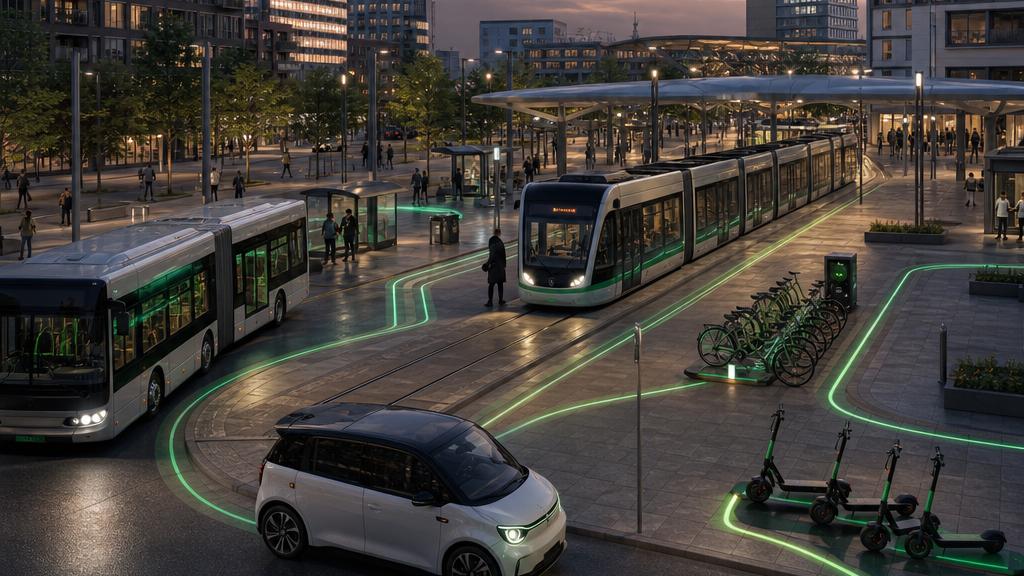
Picture opening a single app, typing your destination, and instantly seeing every way to get there — bus, train, ride-hail, shared bike, scooter, rental car — compared by time, cost, and carbon, then booking and paying for the entire door-to-door journey in one tap, no separate tickets or accounts required. That's the promise of Mobility as a Service, or MaaS: transportation reimagined as a seamless, on-demand digital service rather than a patchwork of vehicles you own or apps you juggle. As cities choke on congestion and younger generations increasingly shun car ownership, MaaS has become one of the most talked-about ideas in transportation. In 2026, it's growing fast and reshaping urban travel — but its journey has also been a humbling lesson in just how hard true integration really is.
This guide explains what MaaS is, how it works, the levels of integration, the benefits, the market, the key players, the real challenges (including a cautionary tale), and where it's heading. (Market figures vary enormously by source and scope, so treat them as estimates.)
What Is Mobility as a Service?
Mobility as a Service (MaaS) is the integration of multiple transportation options into a single, on-demand digital platform — typically a smartphone app — through which users can plan, book, and pay for journeys across different modes of transport. Instead of separately using a transit app for the bus, one app for ride-hailing, another for bike-sharing, and cash or a card for parking, MaaS unifies them all into one seamless experience.
The core idea is a shift from owning transportation to consuming it as a service — much as streaming replaced owning DVDs. Rather than buying and maintaining a private car, a MaaS user accesses whatever mode best suits each trip, on demand, through a single interface that handles planning, booking, ticketing, and payment. The goal is to make car-free (or car-light) living genuinely convenient by removing the friction that makes combining public transit, shared mobility, and other modes so cumbersome today.
How MaaS Works
A MaaS platform brings together several transport modes and functions into one integrated system. On the transport side, it aggregates public transit (buses, trains, trams), ride-hailing (like Uber and Lyft), car-sharing (like Zipcar), bike-sharing and e-scooters (micromobility), car rentals, and sometimes newer modes. On the technology side, it combines trip-planning and navigation, unified booking, integrated ticketing, and a single payment engine, often adding real-time data and, increasingly, AI-driven optimization.
The magic depends on deep technical integration behind the scenes: connecting to each transport provider's systems for availability and booking, aggregating real-time data (enabled by IoT sensors tracking vehicles and arrival times), and settling payments across many operators. Advances in smartphones, mobile networks (4G/5G), IoT, AI, and data analytics have been essential enablers — MaaS simply wasn't possible before ubiquitous connected devices and real-time data. The platforms that win are those that harness data to create a genuinely seamless, intelligent, user-centric experience.
The Levels of MaaS Integration
Not all "MaaS" is equally integrated, and a widely used framework describes levels of integration that clarify how mature a given service really is:
- Level 0 — No integration. Each transport service operates separately with its own app and payment.
- Level 1 — Integration of information. A single app aggregates trip planning and information across modes (like a journey planner showing multiple options), but you still book and pay separately.
- Level 2 — Integration of booking and payment. You can book and pay for individual trips across modes in one app — a major convenience leap.
- Level 3 — Integration of the service offer. The platform bundles mobility into subscriptions or packages (like a monthly plan covering transit, bikes, and a ride-hail allowance), treating mobility like a utility.
- Level 4 — Integration of societal goals. MaaS is coordinated with public policy to actively shape travel behavior toward societal aims like reduced congestion and emissions.
Most real-world MaaS in 2026 sits at levels 1 and 2 (information, booking, and payment), while the more ambitious levels 3 and 4 — subscription bundles and policy integration — remain the harder, less common frontier. Understanding these levels cuts through marketing hype: many apps labeled "MaaS" are really just information aggregators.
The Benefits
MaaS promises significant benefits for individuals, cities, and the environment:
- Convenience — one app to plan, book, and pay for any journey, eliminating the friction of juggling multiple services.
- Cost savings — research suggests MaaS could save an individual meaningfully on annual transport costs (one study cited around $1,200) versus car ownership, by paying only for what you use.
- Reduced congestion — by optimizing trips and encouraging shared and public modes, MaaS could cut urban traffic (one estimate suggested around 15%).
- Lower emissions — shifting travel from private cars toward public and shared transport supports sustainability goals (with estimates of CO₂ reductions up to around 20%).
- Better public transit use — integration can boost ridership; in Helsinki, an early full MaaS implementation, public transport use reportedly rose notably in the first year.
- Reduced car dependence — MaaS makes car-free living more viable, appealing especially to younger, urban demographics who increasingly prefer access over ownership.
These benefits explain why cities and governments are enthusiastic backers — MaaS aligns individual convenience with public policy goals around congestion, sustainability, and equitable access. (These figures come from specific studies and pilots and vary by context, so treat them as illustrative rather than universal.)
The Market
The MaaS market is growing rapidly, but here's an important caveat: market-size estimates vary wildly depending on what's counted. Some analyses that include the full value of ride-hailing and shared mobility place the market in the hundreds of billions (one values it around $255 billion in 2025 heading toward $960 billion by 2033); others measuring narrower MaaS-platform revenue put it at just a few billion to a few tens of billions in 2026. What's consistent is strong double-digit growth, with CAGRs commonly cited between roughly 17% and 28%. The wide range reflects genuine disagreement about where "MaaS" ends and "ride-hailing" or "public transit" begin — a reason to treat any single headline number with caution.
Growth is driven by rapid urbanization (55% of people live in cities today, rising toward 68% by 2050), worsening congestion, rising smartphone penetration, the expansion of shared and electric mobility, real-time data availability, and stronger public-private partnerships. Asia-Pacific leads and is the fastest-growing region (around 40% share, driven by dense megacities and rapid urbanization in China, India, and Japan), with strong activity also in Europe (an early MaaS pioneer) and North America. Ride-hailing typically accounts for the largest share of MaaS activity today.
The Key Players
The MaaS landscape is a dynamic mix of ride-hailing giants, transit-tech firms, automakers, and dedicated MaaS platforms. Major players frequently cited include ride-hailing and super-app companies like Uber, Lyft, Didi, Grab, and Ola (increasingly positioning as broad mobility platforms), transit-planning and aggregation apps like Moovit (now part of Intel), Citymapper, Transit, and SkedGo, and dedicated MaaS platform providers. Automakers like BMW and Daimler have invested in mobility services, and a notable consolidation dynamic is underway — for example, the technology behind Finland's pioneering Whim app (MaaS Global) was acquired by another platform company. The competition is essentially about who can build the most complete, seamless integrated platform, and partnerships between technology companies, mobility providers, and public transit authorities are central to the model.
The Challenges and a Cautionary Tale
For all its promise, MaaS has proven genuinely hard to execute, and honesty about the obstacles matters:
- Integration complexity — technically and commercially integrating many independent transport operators (each with its own systems, pricing, and incentives) into one seamless platform is extremely difficult.
- Getting operators to cooperate — transport providers may resist ceding the customer relationship, sharing data, or letting a third party resell their service, especially profitable ride-hailing firms with little incentive to be one option among many.
- Business model viability — this is the crux. The cautionary tale of the field is Whim, the Helsinki app once held up as the global model for MaaS: despite pioneering the vision, its operator faced severe financial difficulties, illustrating how hard it is to build a profitable MaaS business. Making the economics work — who pays, how revenue is split, whether subscriptions attract enough users — remains unsolved for many.
- Public vs private tension — questions over whether MaaS should be led by public authorities (for societal goals) or private companies (for profit and innovation) create friction.
- Data sharing and standards — seamless integration requires open data and interoperability that operators and cities are still working toward.
- Reaching the higher levels — moving beyond information and payment integration (levels 1–2) to true subscription bundles and policy integration (levels 3–4) has proven slow.
The honest picture: MaaS is a compelling vision growing quickly, but the path to seamless, profitable, deeply integrated mobility is harder than early enthusiasm suggested, and many implementations remain partial.
The Future
MaaS will continue evolving, with several trends shaping its path. Expect deeper multi-modal integration and wider adoption of unified payment and ticketing; growing integration of micromobility (bikes and scooters) into MaaS platforms; increasing use of AI to optimize routes, personalize options, and improve the user experience; and stronger public-private partnerships as cities embrace MaaS for policy goals. The likely future also includes convergence with autonomous vehicles and robotaxis, which could eventually become a MaaS mode, and continued consolidation as platforms compete and combine. Whether MaaS achieves its full vision — genuinely replacing car ownership at scale — will depend on solving the integration, cooperation, and business-model challenges that have humbled early pioneers. But the direction is clear: transportation is steadily shifting from something we own toward something we access, and MaaS is the framework for that shift.
Conclusion
Mobility as a Service reimagines transportation as a unified, on-demand digital service — one app to plan, book, and pay for journeys across public transit, ride-hailing, shared bikes, scooters, and more. Built on smartphones, real-time data, IoT, and AI, and structured across levels of integration from simple information to full policy coordination, MaaS promises real benefits: convenience, cost savings, less congestion, lower emissions, and freedom from car ownership.
In 2026, MaaS is growing rapidly, led by Asia-Pacific and a competitive field of ride-hailing giants, transit apps, and dedicated platforms. But its history — including the financial struggles of pioneers like Whim — is a sobering reminder that seamless integration and a viable business model are genuinely hard to achieve. Understanding MaaS reveals both an inspiring vision of frictionless urban mobility and the real complexity of stitching a fragmented transport world into one. The destination is compelling; the journey is still very much underway.
Want more? Explore AxionSquare for ongoing coverage of Mobility as a Service, micromobility, electric vehicles, and the technologies reshaping how we move.
Frequently Asked Questions
What is Mobility as a Service (MaaS)?
MaaS is the integration of multiple transportation options — public transit, ride-hailing, car-sharing, bike-sharing, scooters, rentals — into a single digital platform (usually a smartphone app) where users can plan, book, and pay for journeys across modes. It represents a shift from owning transportation (like a private car) to consuming it as an on-demand service through one seamless interface.
How does MaaS work?
A MaaS app aggregates many transport modes and combines trip-planning, booking, ticketing, and payment into one experience. Behind the scenes, it integrates with each operator's systems for availability and booking, uses real-time data (via IoT sensors) for arrivals and tracking, and settles payments across operators. Smartphones, 4G/5G networks, IoT, AI, and data analytics are the key enablers that made MaaS possible.
What are the levels of MaaS integration?
A common framework defines five levels: Level 0 (no integration), Level 1 (integrated information/trip planning), Level 2 (integrated booking and payment for individual trips), Level 3 (integrated service offers like mobility subscriptions), and Level 4 (integration with societal goals and public policy). Most real MaaS in 2026 sits at levels 1–2; the ambitious subscription and policy levels remain harder and less common.
What are the benefits of MaaS?
Benefits include convenience (one app for any journey), cost savings versus car ownership, reduced traffic congestion, lower emissions by shifting to shared and public transport, increased public transit ridership, and reduced car dependence — appealing especially to younger urban users who prefer access over ownership. These align individual convenience with city goals around sustainability and congestion, which is why governments back MaaS.
Why is MaaS hard to make profitable?
Integrating many independent operators (each with its own systems and incentives) is technically and commercially complex, and profitable providers like ride-hailing firms often resist becoming one option among many. The business model — who pays, how revenue is split, whether subscriptions attract enough users — remains unsolved for many. Finland's pioneering Whim app, once the global MaaS model, faced severe financial difficulties, illustrating how hard profitability is.