Robotaxis: The Economics of Autonomous Ride-Hailing
A study of fully driverless ride-hailing models, industry competition, and operational deployment metrics in urban markets.
Transportation · Global · 2026-06-29 · 11 min read · By John Awab
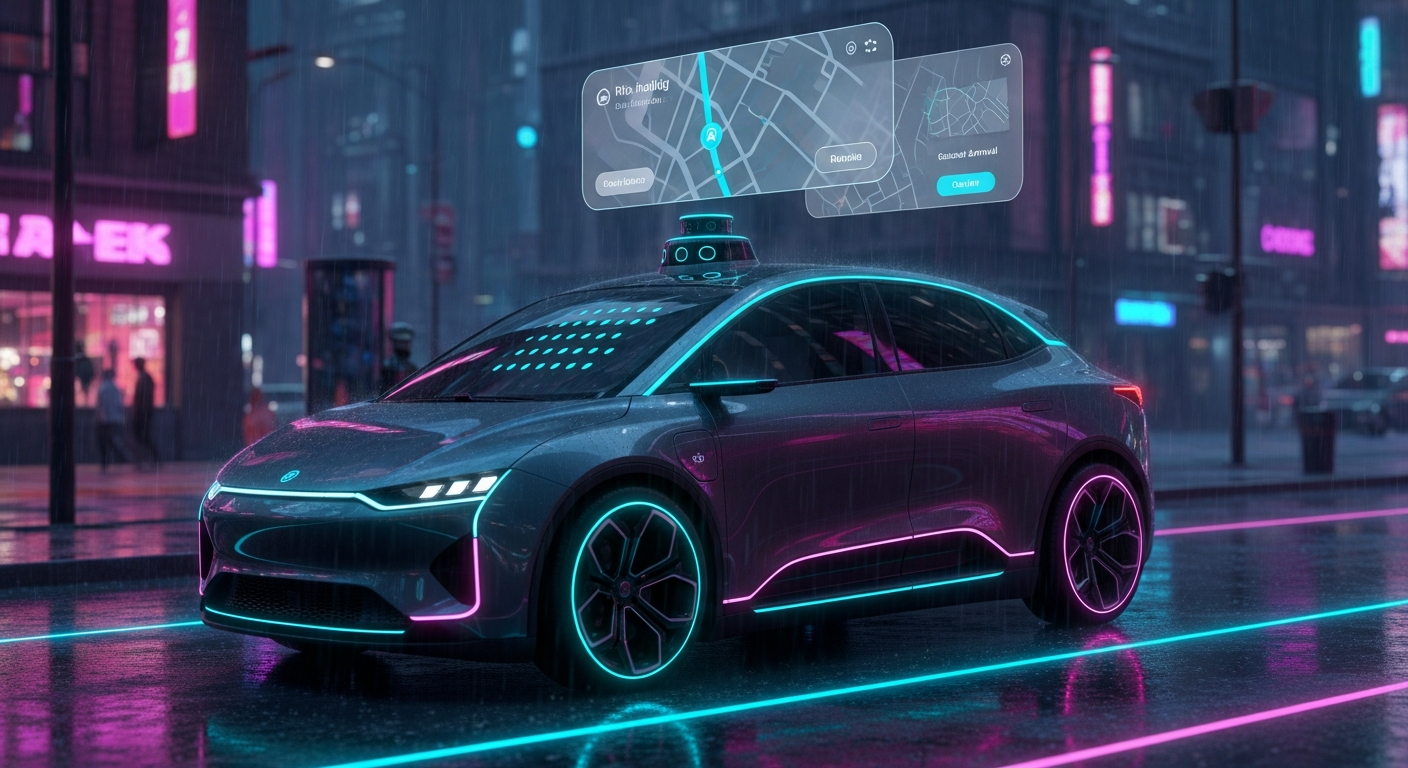
In a growing list of cities, you can now open an app, request a ride, and watch a car pull up with nobody behind the wheel. Robotaxis — fully driverless ride-hailing vehicles — have crossed the line from science experiment to real industry. In San Francisco, riders may soon be able to choose among four competing robotaxi services. Waymo alone is now giving roughly half a million paid rides every week, and rivals from Tesla to Amazon's Zoox are racing to catch up. After more than a decade of testing, the driverless ride-hailing race is finally real.
This guide explains what robotaxis are, how they work, the major players and their fierce rivalry, the competing business models, the economics, the challenges, and what's coming. (Several companies mentioned are publicly traded or part of public companies; this is general information, not investment advice.)
What Is a Robotaxi?
A robotaxi is a fully autonomous vehicle that provides on-demand ride-hailing without a human driver. You summon it through an app much like a traditional rideshare, but the car drives itself from pickup to destination — no one in the driver's seat. Robotaxis combine self-driving technology (sensors, AI, and computing) with the ride-hailing business model, aiming to deliver cheaper, safer, and more scalable transportation than human-driven taxis and rideshares.
The key distinction from "self-driving cars" generally is that a robotaxi is a commercial service — a fleet operated to carry paying passengers — rather than autonomous technology sold to individual car owners.
2026: From Pilot to Real Industry
The robotaxi has graduated from pilot project to genuine business. The journey began in 2018, when Waymo (a spinoff of Google's parent Alphabet) launched what it calls the world's first commercial autonomous ride-hailing service in the Phoenix area. By 2026, that single-city novelty has become a multi-city, multi-company industry with real revenue and intense competition. The white-driverless car is becoming a normal part of the urban landscape.
How Robotaxis Work
Robotaxis perceive the world through a suite of sensors and navigate using AI — but the industry has split into two competing technical philosophies. The dominant approach, used by Waymo and most others, combines LiDAR, radar, and cameras with detailed HD maps and, crucially, remote human operators who can assist when the vehicle encounters a situation it can't resolve. This is robust but expensive. The contrarian approach, championed by Tesla, relies on cameras only — no LiDAR — guided by neural networks trained on vast amounts of driving data.
The Major Players and the Race
The competitive landscape in 2026 is crowded and fast-moving:
- Waymo is the clear leader, operating roughly 3,000 robotaxis delivering about 500,000 paid rides per week across some 11 US cities including San Francisco, Los Angeles, Phoenix, Austin, Dallas, Houston, and Nashville. It has begun freeway driving, deployed a sixth-generation vehicle built with EV maker Zeekr, and started international testing in London with a commercial launch targeted for later in 2026. It is widely regarded as years ahead technically, though not yet profitable.
- Tesla is the most-watched challenger. It launched a small Austin pilot in 2025 and, by April 2026, expanded unsupervised (no safety driver) service to Dallas and Houston, having logged hundreds of thousands of paid miles. It plans to enter several more cities and is ramping production of its purpose-built Cybercab. Its rides have undercut competitors on price in some comparisons, though it still awaits driverless permits in California.
- Zoox (owned by Amazon) takes a distinctive path with a purpose-built, bidirectional pod that has no steering wheel or pedals, operating in San Francisco and Las Vegas with plans for paid service in 2026.
- Uber and Lyft aren't building the technology — they're positioning as platforms that aggregate many autonomous fleets, partnering with Waymo, Nuro, May Mobility, Lucid, and others to offer robotaxi rides alongside human drivers.
- China's players — Baidu's Apollo Go, Pony.ai, and WeRide — lead a parallel, rapidly scaling robotaxi market.
- Cruise, once a major contender backed by GM, serves as a cautionary tale: after spending around $10 billion, it pivoted hard away from robotaxis following a serious 2023 incident, proving that capital alone doesn't guarantee success.
Two Business Models: Build vs Aggregate
The industry is splitting along a strategic fault line. On one side are vertically integrated operators — Waymo, Tesla, and Zoox — that build the self-driving technology, own the vehicles, and run the service themselves. The bet is that controlling the whole stack will eventually allow the lowest prices and best margins. On the other side is the platform aggregation model led by Uber (and Lyft), which leaves vehicle-building and AV development to partners while providing the customer demand, matching, and marketplace infrastructure.
The Economics
The economic promise driving billions in investment is straightforward: remove the human driver, the largest cost in ride-hailing, and rides can eventually become dramatically cheaper while vehicles run nearly around the clock. In some head-to-head comparisons, robotaxi fares have already undercut both human rideshare and rival robotaxis significantly. But the path to profit is steep. Building and operating fleets requires enormous capital — vehicles, depots, charging, cleaning, and remote operations centers with teams of human supervisors.
Why Now?
Several forces have converged to make robotaxis viable in 2026: years of accumulated autonomous-driving data and dramatically improved AI; the maturation of sensors and onboard computing; the spread of electric vehicles that pair naturally with fleet operations; labor shortages and rising costs in human-driven transport; and growing public and regulatory familiarity after years of testing. The result is a tipping point where the technology is finally reliable enough — in the right conditions and geographies — to serve paying customers commercially.
The Challenges
Significant obstacles remain. Safety is paramount and scrutinized — incidents and recalls (Waymo, for instance, recalled vehicles over a software issue with closed construction lanes) draw intense attention, and high-profile crashes fuel controversy, especially around camera-only systems. Regulation is a patchwork that varies by state and country, with California requiring extensive supervised miles before granting driverless permits. Liability and insurance questions remain unresolved — who pays when an autonomous vehicle causes an accident?
The Future
The trajectory points toward rapid expansion. Expect Waymo to push into 20-plus cities and international markets like Tokyo and London, Tesla to scale aggressively if it clears safety and regulatory hurdles, Zoox to grow its purpose-built fleets, and platforms like Uber to weave autonomous and human rides into a single seamless marketplace. Costs should fall as fleets scale and hardware improves, gradually making robotaxi rides cheaper than today's rideshare. Longer term, autonomous mobility could reshape urban planning, car ownership, and how cities are designed.
Conclusion
Robotaxis have arrived as a real, competitive industry in 2026 — driverless ride-hailing services carrying hundreds of thousands of paying passengers every week. Waymo leads with proven commercial operations across many cities, Tesla charges forward with a cheaper camera-only bet, Zoox brings purpose-built pods, and Uber dominates as the platform connecting them all, while China races in parallel.
The technology splits between LiDAR-rich robustness and vision-only scalability, the business splits between building and aggregating, and the economics promise cheaper rides but demand enormous capital first. Real challenges around safety, regulation, liability, and jobs remain. Understanding the robotaxi race reveals one of the most consequential transformations in transportation — the moment the driver disappeared and the ride kept going. As always, this is general information, not investment advice.
Want more? Explore AxionSquare for ongoing coverage of robotaxis, self-driving cars, autonomous trucking, and the future of transportation.
Frequently Asked Questions
What is a robotaxi?
A robotaxi is a fully autonomous vehicle that provides on-demand ride-hailing without a human driver. You summon it through an app like a normal rideshare, but the car drives itself from pickup to destination. It combines self-driving technology with the ride-hailing business model to offer cheaper, safer, scalable transportation.
Who is winning the robotaxi race?
Waymo is the clear technical and commercial leader in 2026, operating around 3,000 robotaxis and about 500,000 paid rides per week across roughly 11 US cities. Tesla is the most-watched challenger with its cheaper camera-only approach, Zoox brings purpose-built vehicles, and Uber dominates as the platform aggregating many fleets. China's Baidu, Pony.ai, and WeRide lead a parallel market.
How do robotaxis work?
Robotaxis use sensors and AI to perceive and navigate. Most (like Waymo) combine LiDAR, radar, cameras, HD maps, and remote human operators for backup — robust but costly. Tesla uses a cheaper, controversial camera-only approach guided by AI. Both operate at "Level 4" autonomy: fully driverless within a defined service area and conditions.
Are robotaxis safe?
Robotaxi companies report strong safety records over millions of miles and argue autonomous vehicles avoid human errors like distraction and fatigue. However, incidents and recalls draw intense scrutiny, edge cases like severe weather and construction remain challenging, and liability questions are unresolved. Safety is the industry's most important and watched issue.
Are robotaxis cheaper than Uber?
Potentially yes over time — removing the human driver, ride-hailing's biggest cost, can make fares significantly cheaper, and some robotaxi rides already undercut human rideshare in head-to-head comparisons. But companies face enormous upfront costs for fleets, depots, and support, so industry-wide profitability is still ahead, not yet achieved.
Sources and further reading
- NHTSA: Automated Driving Systems (ADS) — Safety and regulatory framework for ADS
- California DMV: Autonomous Vehicle Testing Permit Holders — Active market deployment data