Semiconductor Geopolitics: Global Supply Chains and Strategic Manufacturing
An analysis of the strategic importance of advanced silicon manufacturing, focusing on TSMC's role and the global dependency on centralized chip supply chains.
Technology · Global · 2026-07-27 · 9 min read · By John Awab
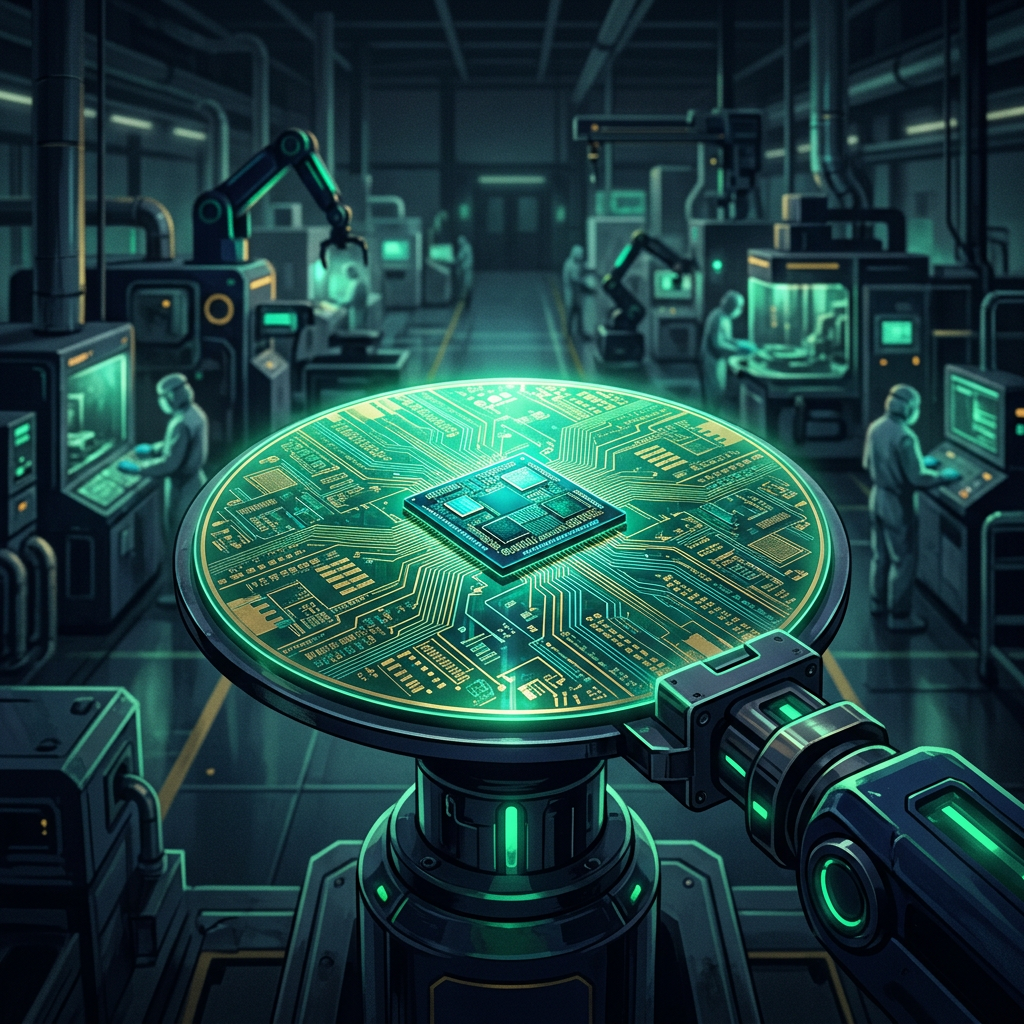
They're the most important product almost nobody thinks about. Every smartphone, car, data center, medical device, and AI model depends entirely on tiny slivers of engineered silicon — and the world can only make the most advanced ones in a handful of factories, most of them on a single island. In 2026, semiconductors have moved from obscure component to the defining strategic technology of the age: the fuel of the artificial intelligence boom, the flashpoint of superpower rivalry, and the first industry most governments now classify as a national asset alongside energy and defense. The global market is on track to pass $1 trillion, driven by an AI "giga-cycle" that shows no sign of slowing. Understanding semiconductors means understanding the physical foundation of the entire digital and AI economy.
This guide explains what semiconductors are, how they're made, why AI has transformed the industry, the key players, the fragile supply chain, the geopolitics, and where it's all heading. (Market figures vary by source and scope, so treat them as estimates.)
What Is a Semiconductor?
A semiconductor is a material — most commonly silicon — whose ability to conduct electricity sits between a conductor (like copper) and an insulator (like glass). That in-between property is the key: by carefully adding impurities (a process called doping) and applying voltage, engineers can precisely control whether and when current flows. This controllability is what makes semiconductors the foundation of all modern electronics.
In everyday language, "semiconductor" usually refers to the chip (or integrated circuit) built from that material — a small piece of silicon containing millions or billions of tiny switches called transistors. These transistors, switching on and off billions of times per second, are the fundamental building blocks of all computing. A modern advanced chip can pack tens of billions of transistors onto a piece of silicon smaller than a fingernail. Every calculation your devices perform ultimately comes down to these microscopic switches.
Types of Chips
Not all semiconductors are the same. The main categories include logic chips (processors like CPUs and GPUs that perform computation), memory chips (which store data — including DRAM and the high-bandwidth memory now critical for AI), analog chips (which handle real-world signals like sound and radio), and specialized accelerators (like the GPUs, TPUs, and NPUs purpose-built for AI workloads). A key distinction in 2026 is between leading-edge chips — the most advanced, made on the smallest manufacturing processes for AI and high-end computing — and mature-node chips — older, larger designs that remain essential for cars, appliances, and industrial equipment. The industry's growth has become sharply polarized between these two.
How Chips Are Made
Semiconductor manufacturing is arguably the most complex process humans have ever industrialized. It begins with design, where companies architect the chip's billions of transistors. Then comes fabrication in a "fab" — a facility so clean it's thousands of times cleaner than a hospital operating room. Through photolithography, light projects circuit patterns onto silicon wafers coated with light-sensitive chemicals, etching features measured in nanometers (billionths of a meter). This is repeated in dozens of layers, building the chip up over hundreds of individual steps. Producing a single advanced 3-nanometer chip can take around six months from start to finish.
The extreme miniaturization at the leading edge requires extreme ultraviolet (EUV) lithography — a technology so difficult that only one company in the world can build the machines that do it. After fabrication, chips are tested, cut from the wafer, and packaged — and packaging itself has become a critical frontier, as we'll see. The precision involved is almost incomprehensible: engineers are now manipulating matter at nearly the atomic scale.
The AI Giga-Cycle
The single force reshaping the semiconductor industry is artificial intelligence. Training and running AI models requires staggering amounts of computing power, and that translates directly into demand for advanced chips — especially the GPUs and accelerators that excel at AI's parallel calculations. This demand has been described as a "giga-cycle": a boom of extraordinary scale and duration.
The numbers convey the intensity. The global market is projected to approach $100 billion for a single quarter and pass $1 trillion annually, with AI-driven segments accelerating rapidly even as traditional commodity and mature-node markets grow more slowly. In early 2026, TSMC's blockbuster results — record revenue and a capital-spending plan reported around $56 billion — sent chip stocks rallying and confirmed, in analysts' words, that the AI appetite for compute shows no sign of a ceiling. Nvidia has become the default supplier of AI training hardware, reporting well over $200 billion in revenue. The demand is real and the growth extraordinary — though, as ever in this cyclical industry, so are the risks.
System-Level Performance and Advanced Packaging
A crucial 2026 shift is that raw transistor shrinking is no longer the only path to better chips. As squeezing transistors ever smaller gets harder and costlier, competitive advantage increasingly comes from system-level innovation — how compute, memory, interconnect, and packaging work together as an integrated whole. Advanced packaging, which combines multiple chips ("chiplets") into a single high-performance module, has become a strategic battleground. TSMC now reports that packaging contributes over 10% of its revenue and forms a core pillar of its strategy. This matters because it changes the competitive game: performance gains now come from clever integration, not just from manufacturing the smallest possible features.
The Key Players
The semiconductor industry is defined by extreme specialization, with different companies dominating different links:
- TSMC (Taiwan Semiconductor Manufacturing Company) — the world's dominant chip foundry, manufacturing chips designed by others. It holds roughly 70%+ of the foundry market and produces the vast majority of the world's most advanced processors, making it the linchpin of the entire industry.
- Nvidia — the leading designer of AI chips, though it manufactures nothing itself (a "fabless" company), relying on TSMC.
- ASML — the Dutch company that is the sole maker of EUV lithography machines. Without ASML, chips below 7nm can't be made — an extraordinary single point of leverage.
- Others — Samsung and Intel (both designing and manufacturing, and racing at the leading edge), AMD, Apple, Broadcom, and Qualcomm (major designers), and memory specialists like SK Hynix and Micron.
This division of labor — designers, foundries, equipment makers, memory specialists — makes the industry remarkably efficient but also deeply interdependent, with critical chokepoints at each stage.
The Fragile Supply Chain
Semiconductor supply chains are a study in concentrated risk. The most advanced chips are made overwhelmingly in Taiwan, EUV machines come from a single Dutch company, and specialized materials and chemicals flow from a handful of suppliers. This concentration creates real fragility: TSMC producing around 90% of the most sophisticated processors makes it a single point of failure for AI development, so any disruption — natural disaster, geopolitical conflict, or accident — could ripple through the entire global economy.
In 2026, specific stress points include tight capacity at advanced nodes (with the largest buyers having secured production through the year, leaving smaller customers competing for what's left), reported foundry price increases at leading nodes, and high-bandwidth memory becoming its own chokepoint with much capacity committed well in advance. The industry isn't in outright crisis as it was during earlier shortages, but it requires careful navigation.
The Geopolitics of Silicon
Perhaps no aspect of semiconductors is more consequential than their geopolitics. By late 2025, most major economies had formally reclassified semiconductors as strategic assets, alongside energy and defense. This has triggered a global scramble for "silicon sovereignty":
- Export controls — the US has restricted the sale of the most advanced AI chips and chipmaking equipment to China, while policy can shift within months, injecting uncertainty into revenue projections.
- Domestic manufacturing pushes — programs like the US CHIPS Act and the EU Chips Act aim to bring production home and reduce single points of failure, with TSMC building fabs in Arizona (its second facility expected to begin 3nm production by the end of 2026).
- Technology bifurcation — as China develops domestic chip-design tools, architectures, and manufacturing to reduce reliance on Western technology, the risk grows of two increasingly separate technology ecosystems.
The concentration of the most advanced manufacturing in Taiwan — under long-standing geopolitical tension — is the industry's defining strategic vulnerability, and reasonable analysts disagree sharply on how those risks will play out. This is an area where facts and forecasts are genuinely contested, and outcomes depend on political developments no one can predict with confidence.
The Challenges
Beyond geopolitics, the industry faces real headwinds. Physical limits loom as transistors approach atomic scale, making further shrinking harder and more expensive. Soaring costs mean a single leading-edge fab can cost tens of billions of dollars, concentrating capability among a shrinking number of players. Cyclicality is chronic — the industry has always swung between shortage and glut, and heavy dependence on AI demand raises the stakes if that demand ever cools. Talent shortages and the immense energy and water requirements of fabs add further pressure. And memory cyclicality remains a persistent wildcard.
The Future
Semiconductors will only grow more central. Expect the AI-driven boom to continue driving investment, though with the cyclical risks the industry always carries; continued innovation through advanced packaging, chiplets, and new materials as pure transistor-shrinking slows; ongoing geographic diversification of manufacturing as nations pursue sovereignty (a slow, expensive process); and semiconductors remaining at the heart of geopolitical competition. New frontiers — chips for AI, quantum computing hardware, and ever more specialized accelerators — will keep expanding the field. The fundamental trajectory is clear: as the world grows more digital and more AI-driven, its hunger for advanced silicon will only intensify.
Conclusion
Semiconductors are the invisible foundation of modern civilization — tiny silicon chips packed with billions of transistors that power everything from phones to the AI models reshaping the economy. Made through one of the most complex manufacturing processes ever devised, concentrated in a handful of irreplaceable companies and locations, and now the fuel of an AI giga-cycle propelling the market past $1 trillion, they've become the defining strategic technology of our time.
The industry's extraordinary growth comes paired with extraordinary fragility — a supply chain of critical chokepoints and a geopolitical importance that has turned chips into instruments of national power. Understanding semiconductors reveals the physical machinery beneath the digital and AI revolutions, and why these slivers of silicon have become some of the most valuable and contested objects on Earth.
Want more? Explore AxionSquare for ongoing coverage of semiconductors, artificial intelligence, quantum computing, and the technologies powering the future.
Frequently Asked Questions
What is a semiconductor?
A semiconductor is a material — usually silicon — whose ability to conduct electricity falls between a conductor and an insulator, allowing engineers to precisely control current flow. In common usage, it refers to the chip (integrated circuit) built from that material, containing millions or billions of microscopic switches called transistors that form the basis of all modern computing.
How are semiconductor chips made?
Chips are designed, then fabricated in ultra-clean facilities called fabs through photolithography, where light projects circuit patterns onto silicon wafers, etching features measured in nanometers across dozens of layers and hundreds of steps. The most advanced chips require extreme ultraviolet (EUV) lithography, and a single 3-nanometer chip can take around six months to produce.
Why are semiconductors so important in 2026?
Semiconductors power all modern electronics and, critically, the artificial intelligence boom — AI models require enormous computing power delivered by advanced chips. This "giga-cycle" of demand is driving the market past $1 trillion. Chips have also become strategic national assets, central to geopolitical competition between major powers.
Who are the biggest semiconductor companies?
Key players include TSMC (the dominant chip foundry, making most advanced processors), Nvidia (the leading AI chip designer, which manufactures nothing itself), and ASML (the sole maker of EUV lithography machines). Others include Samsung, Intel, AMD, Apple, Broadcom, Qualcomm, and memory specialists like SK Hynix and Micron.
Why is the semiconductor supply chain considered fragile?
Because it's extremely concentrated: TSMC produces around 90% of the most advanced chips (mostly in Taiwan), ASML is the only maker of EUV machines, and key materials come from few suppliers. This creates single points of failure where any disruption — geopolitical conflict, natural disaster, or accident — could ripple through the entire global economy.
Sources and further reading
- U.S. Department of Commerce CHIPS Act Strategy — Strategic importance of semiconductor supply chain resilience