The Rise of Service Robotics: Drivers and Industry Adoption
Service robots are increasingly addressing labor shortages in healthcare, hospitality, and retail, moving from experimental novelty to foundational operational utility.
Robotics · Global · 2026-06-15 · 10 min read · By John Awab
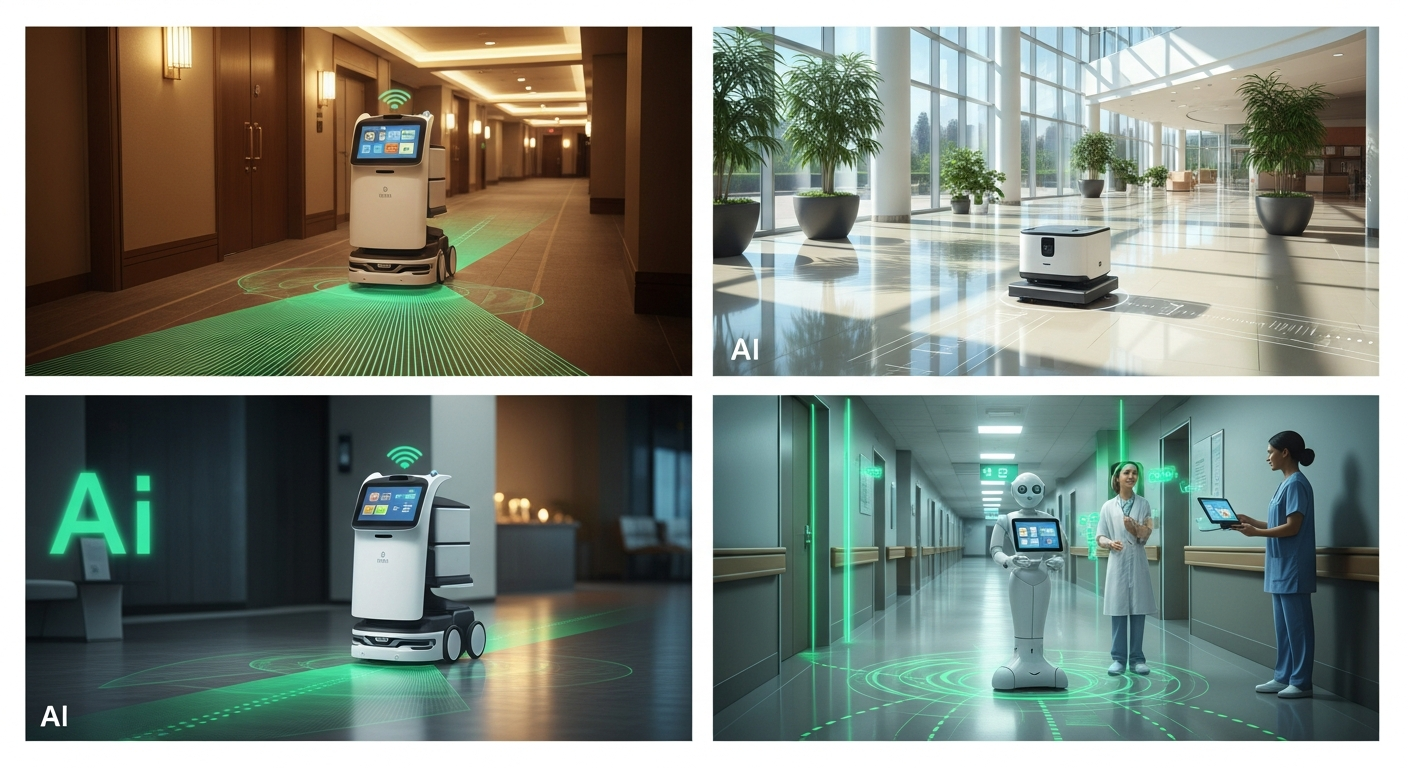
A robot brings your food to the table at a restaurant. Another delivers medication down a hospital corridor. A third trundles along the sidewalk with your dinner, while one more quietly scrubs the floor of a shopping mall overnight. These aren't science fiction — they're service robots, and in 2026 they've moved from novelty to a fast-growing presence in everyday life, driven by labor shortages and rapid advances in AI.
This guide explains what service robots are, the main categories and how they work, the state of the market, the leading companies, and the challenges ahead. Whether you've encountered one in the wild or want to understand the industry, here is the clear picture. (Market figures vary widely by source and segment, so treat them as estimates.)
What Are Service Robots?
A service robot is a robot that performs useful tasks for humans or equipment outside of industrial manufacturing. Where industrial robots weld and assemble on factory floors, service robots operate in the human world — hotels, hospitals, restaurants, homes, sidewalks, and public spaces — interacting with people and navigating unstructured, unpredictable environments.
That distinction matters: service robots must cope with the messiness of real life, from crowded lobbies to elevators to pets and children, which makes them in some ways harder to build than a robot bolted to a factory line.
Professional vs Personal Service Robots
The industry splits service robots into two broad groups. Professional service robots work in commercial and institutional settings — delivery, cleaning, hospitality, healthcare, security, agriculture — and represent the larger, faster-maturing market. Personal (or domestic) service robots serve consumers at home, led overwhelmingly by robot vacuums but extending to lawn mowers, pool cleaners, and companion robots. The professional segment leads in revenue and innovation.
How Service Robots Work
Most service robots share a common toolkit. Autonomous navigation lets them move safely through human spaces using technologies like SLAM (simultaneous localization and mapping), lidar, and cameras to map their surroundings and avoid obstacles. AI and computer vision let them perceive, identify objects and people, and make decisions. Sensors provide awareness of position, proximity, and environment. And human-robot interaction features — touchscreens, voice, lights, and sound — allow them to communicate with people and signal their intentions.
The Main Categories of Service Robots
Cleaning and Disinfection Robots
One of the largest and most established categories. Domestic robot vacuums (from makers like iRobot and Xiaomi) have reached high household penetration at $35–$400, while professional floor-scrubbing and UV-C disinfection robots clean hospitals, malls, and offices at $3,000–$8,000. The category is projected to exceed $20 billion within a decade, driven by staffing shortages in commercial real estate and healthcare.
Delivery Robots
The fastest-growing category by far. Indoor delivery robots ferry food, amenities, and supplies in hotels, hospitals, and restaurants, while outdoor/last-mile robots carry parcels (up to ~35 kg) along sidewalks and campuses. The food-and-beverage sector dominates demand, and the segment is growing at roughly 35% annually — among the steepest growth rates in all of robotics.
Hospitality Robots
Hotels and restaurants deploy front-desk robots, room-service delivery robots, cleaning robots, and concierge assistants. More than 20,000 hospitality service robots were deployed globally by 2024, thousands of hotels use delivery robots, and 150+ airports are adopting them. Modern models offer multi-language support, autonomous elevator navigation, UV sterilization, and even emotion recognition.
Healthcare and Medical Service Robots
In hospitals and care settings, service robots handle disinfection, medication and supply delivery, patient assistance, and telepresence. With aging populations and chronic staffing shortages, healthcare is one of the most promising long-term markets, extending into elder care and assistive robots that support independent living.
Social, Companion, and Domestic Robots
A smaller but emotionally resonant category includes companion robots for the elderly or isolated, robot pets, educational robots, and home assistants. These prioritize interaction and emotional engagement over physical tasks.
Agriculture, Inspection, and Beyond
Service robots also work in farming (planting, monitoring, harvesting), infrastructure inspection, security patrol, and even underwater and marine environments — though these remain more niche.
The Market in 2026
The service robotics market is large and growing fast — estimated around $31 billion in 2026 and projected to reach well over $100 billion by the mid-2030s, growing at roughly 20% annually. Professional service robots lead, thanks to deployment in logistics, healthcare, hospitality, and cleaning. Geographically, Asia-Pacific dominates many segments — China and Japan account for over 40% of hospitality-robot installations, for instance — with North America and Europe close behind.
Why Adoption Is Accelerating
Several forces are converging. Labor shortages in hospitality, healthcare, cleaning, and logistics make robots an attractive way to fill roles humans increasingly avoid. A lasting preference for contactless service continues to drive demand for autonomous delivery and cleaning. Rapid advances in AI, machine learning, and sensors have made robots far more capable and reliable. And robotics-as-a-service (RaaS) — renting robots by subscription rather than buying them outright — has dramatically lowered the barrier to adoption.
The Leading Companies
The field spans global players and specialists. UBTECH and SoftBank Robotics (maker of Pepper and Cruzr) lead in humanoid and social robots; Bear Robotics, Pudu Robotics, and Keenon dominate restaurant and hospitality delivery; iRobot and Xiaomi lead consumer cleaning; Nuro and sidewalk-delivery specialists lead last-mile delivery; and Aethon (ST Engineering) is a healthcare-logistics mainstay. Boston Dynamics and others push the frontier of mobile manipulation and humanoid service robots.
Challenges
Real hurdles remain. Cost still limits adoption for smaller operators, though RaaS helps. Reliability in messy environments — crowded spaces, unexpected obstacles, edge cases — is harder than in controlled settings. Social acceptance and trust vary; some customers love robot service, others find it impersonal. Safety must be engineered carefully around people. And as with all automation, the impact on jobs raises questions, even as robots also create new roles in maintenance, fleet management, and robot oversight.
The Future
Expect service robots to grow more capable, affordable, and ubiquitous. AI will make them better at navigating and interacting, RaaS will spread them to smaller businesses, and the line will blur with humanoid robots as general-purpose machines mature. Cleaning and delivery will remain the volume leaders, healthcare and elder care the highest-potential frontiers. Within a few years, encountering a service robot in a hotel, hospital, restaurant, or on your street will be unremarkable.
Conclusion
Service robots are robotics' most visible everyday face — cleaning floors, delivering food and medicine, greeting hotel guests, and assisting in hospitals. Spanning professional and personal applications, led by cleaning and delivery and growing fastest in last-mile logistics and healthcare, the sector is scaling rapidly toward a $100 billion-plus market.
Understanding the categories, how the robots work, and the forces driving adoption — labor shortages, contactless demand, better AI, and the RaaS model — reveals how automation is moving out of the factory and into the human world. Challenges of cost, reliability, and acceptance remain, but the direction is clear: service robots are becoming a routine part of modern life.
Want more? Explore AxionSquare for ongoing coverage of robotics, AI, and the technologies transforming how we live and work.
Frequently Asked Questions
What is a service robot?
A service robot performs useful tasks for humans or equipment outside of industrial manufacturing — operating in homes, hotels, hospitals, restaurants, and public spaces, where it must navigate unstructured environments and interact with people.
What are the main types of service robots?
The main categories are cleaning and disinfection robots, delivery robots (indoor and last-mile), hospitality robots (front desk, room service, concierge), healthcare and medical robots, social/companion robots, and agriculture and inspection robots.
How big is the service robotics market?
Estimates vary, but the global service robotics market is around $31 billion in 2026 and projected to exceed $100 billion by the mid-2030s, growing at roughly 20% annually, led by professional service robots in logistics, healthcare, hospitality, and cleaning.
Why are service robots becoming popular?
Labor shortages, a lasting preference for contactless service, rapid advances in AI and sensors, and the robotics-as-a-service model — which lets businesses rent robots affordably by subscription — are all accelerating adoption across industries.
How do service robots navigate around people?
They use autonomous navigation technologies like SLAM, lidar, and cameras to map surroundings and avoid obstacles, combined with AI and computer vision to perceive and make decisions, plus interaction features like screens and voice to communicate.
Sources and further reading
- International Federation of Robotics - Service Robots — Market growth and adoption metrics for professional service robots.
- Association for Advancing Automation - Service Robotics — Applications and industry adoption trends.