The Commercial Space Economy: Market and Infrastructure
A breakdown of the expanding commercial space sector, including satellite constellations, launch economics, and orbital infrastructure.
Technology · Global · 2026-06-29 · 11 min read · By John Awab
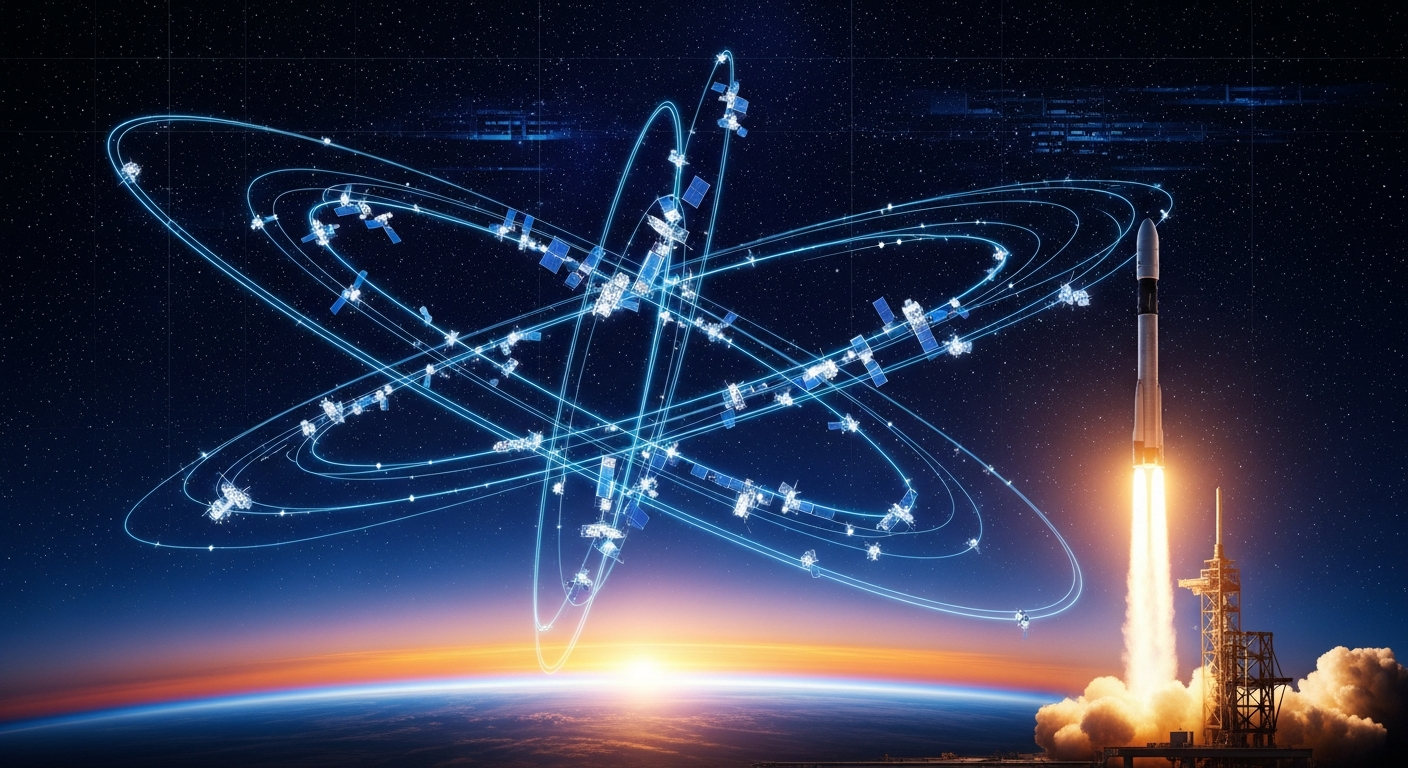
Half a century ago, reaching space was the exclusive domain of superpower governments. Today, private companies launch rockets that land themselves, beam internet to your phone from orbit, and are turning space into one of the fastest-growing sectors of the global economy. In 2026, the space economy has surpassed $600 billion and is racing toward a trillion dollars, driven by a collapse in launch costs, swarms of small satellites, and bold commercial ambitions stretching from low Earth orbit to the Moon and beyond.
This guide explains what the space economy is, the launch revolution powering it, the rise of mega-constellations, the key players, the emerging frontiers, and the challenges ahead. (Market figures vary widely by source and scope, so treat them as estimates; several companies mentioned are public or pursuing IPOs, and this is general information, not investment advice.)
What Is the Space Economy?
The space economy is the full value of all activity that depends on reaching or using space — satellite services, ground equipment, launch, manufacturing, and government programs. Estimates put it at roughly $600–630 billion in 2025, with forecasters broadly expecting it to roughly double within a decade, reaching around $1 trillion by the early 2030s and potentially $1.8 trillion by 2035. Strikingly, commercial activity now makes up the large majority — around three-quarters of the total — a fundamental reversal from the government-dominated industry of a generation ago.
A key shift defines 2026: the industry is moving from a phase where success meant putting systems into orbit fast, to one defined by operating them reliably, sustainably, and strategically — and from selling hardware to selling outcomes like connectivity and intelligence.
The Launch Revolution: Reusability and Falling Costs
Everything in the space economy rests on the ability to reach orbit affordably, and here a revolution has occurred. Reusable rockets — pioneered by SpaceX with the Falcon 9 — have dramatically lowered the cost of access to space, transforming spaceflight from a rare, expensive event into a routine, high-cadence operation. Falcon 9 has become the workhorse of the entire industry, accounting for more than half the world's launches, while Blue Origin (New Glenn and New Shepherd) and Rocket Lab (Electron and the upcoming Neutron) are driving competition further, and a wave of new entrants in the US, Europe, and Asia is adding capacity to the market.
Starship: A Potential Game-Changer
The most-watched development is SpaceX's Starship — a giant, fully reusable rocket designed to carry far more payload at far lower cost. In a landmark 2026 milestone, Starship completed its first fully commercial orbital payload delivery, deploying a large communications satellite with both stages recovered, officially moving it from a development program to a revenue-generating commercial platform. Starship's significance extends well beyond SpaceX: it's designed to deploy next-generation Starlink satellites at massive scale, serve NASA's Artemis program for the return to the Moon, and ultimately underpin long-term ambitions to reach Mars.
Mega-Constellations and Satellite Broadband
The biggest commercial driver is satellite broadband delivered by mega-constellations — networks of hundreds or thousands of small satellites in low Earth orbit. Starlink (SpaceX) leads decisively, generating billions in revenue, with filings outlining ambitions for vastly larger constellations and even in-orbit data processing. Competitors are racing to catch up: Amazon's Project Kuiper is deploying against regulatory deadlines, and Eutelsat's OneWeb serves the market too, particularly enterprise and government customers. These constellations are among the fastest-growing parts of the space economy, enabled by cheap launch and rapid satellite miniaturization.
Direct-to-Device and Earth Observation
Two adjacent trends are surging. Direct-to-Device (D2D) connects ordinary smartphones directly to satellites — no special equipment needed — eliminating dead zones by partnering satellite networks with mobile carriers. Major operators and players like AST SpaceMobile and Lynk Global are embedding satellites into terrestrial telecom rather than competing with it, a defining theme of 2026.
Meanwhile, Earth observation is evolving from simply taking pictures to delivering real-time, actionable intelligence. Powered by AI, modern EO satellites fuse multiple data sources to provide automated insights — for disaster response, defense, agriculture, and climate monitoring — transforming satellites from data collectors into intelligence providers. Companies in this space are increasingly selling the insight rather than the raw imagery, expanding their addressable market.
The Emerging Frontiers
Beyond today's mainstays, several frontiers are moving from science fiction toward commerce. In-orbit servicing aims to refuel, repair, and extend the lifetimes of satellites (potentially by five times) — the equivalent of bringing your car to a mechanic instead of scrapping it. In-space manufacturing seeks to make materials and products that benefit from microgravity. Space tourism is growing as suborbital and orbital flights expand. And further out lies the cislunar economy — Moon-based resource extraction, staging infrastructure, and eventually permanent habitation — attracting serious investment from both governments and private players.
The Key Players
The competitive landscape blends dominant disruptors, legacy giants, and ambitious newcomers. SpaceX stands alone at the top — leading in launch and operating the dominant Starlink network — and reportedly moving toward a public offering. Blue Origin and Rocket Lab (the second-most-prolific commercial launcher, increasingly a national-security prime) are key challengers. Amazon is a major force through Kuiper and acquisitions. Established aerospace primes like Boeing, Lockheed Martin (through ULA), Airbus, and Northrop Grumman remain central to government programs, while a wave of startups and international players — including China's LandSpace, iSpace, and state-owned CASC — add dynamism and competition on a global scale.
The Drivers
Several forces propel the space economy forward. Falling launch costs from reusability are the foundation, making previously uneconomic ventures viable. Sovereignty and defense have become powerful, predictable demand drivers, as nations build independent military and communications capabilities amid geopolitical tension — anchoring the most reliable spending in the industry. Connectivity demand drives the broadband constellations. Commercial maturation is shifting the industry from selling hardware to selling data, connectivity, and intelligence — expanding addressable markets and improving unit economics as the sector professionalizes.
The Challenges
Significant challenges accompany the boom. Orbital debris and congestion are growing concerns as mega-constellations place tens of thousands of objects in orbit, raising collision and sustainability risks. Market concentration is real — SpaceX's dominance in launch and broadband creates an asymmetry that shapes the entire industry and concentrates risk. Regulation and export controls (like ITAR) add complexity, and spectrum competition intensifies as constellations compete for finite radio frequencies. Beyond these, high capital requirements, long development timelines, geopolitical tensions, and the need for long-term sustainability frameworks present ongoing headwinds for the sector.
The Future
The trajectory points toward a larger, more commercial, more integrated space economy. Expect launch costs to keep falling as Starship and competitors scale, broadband and direct-to-device connectivity to become ubiquitous, Earth observation to deliver ever-richer real-time intelligence, and the first real steps toward in-orbit servicing, space manufacturing, and a cislunar economy. Government exploration — returning to the Moon and aiming for Mars — will increasingly rely on commercial partners, blurring the line between public mission and private commerce.
Conclusion
Space technology has undergone a stunning transformation — from a government-monopoly frontier into a $600-billion-plus commercial economy racing toward a trillion dollars. Reusable rockets slashed the cost of reaching orbit, mega-constellations are blanketing the planet in broadband, satellites are connecting directly to phones and delivering AI-powered intelligence, and bold frontiers from in-orbit servicing to the cislunar economy are coming into view.
Powered by falling costs, sovereignty and defense demand, and relentless commercial innovation — and led by SpaceX alongside a vibrant ecosystem — the space economy has become one of technology's most dynamic arenas, even as it grapples with debris, concentration, and sustainability. Understanding space technology reveals an industry quietly building the infrastructure of an off-world future. As always, this is general information, not investment advice.
Want more? Explore AxionSquare for ongoing coverage of space technology, satellites, and the technologies expanding humanity's reach.
Frequently Asked Questions
What is the space economy?
The space economy is the full value of all activity that depends on reaching or using space — including satellite services, launch, manufacturing, ground equipment, and government programs. Estimated at roughly $600–630 billion in 2025, it's projected to approach $1 trillion by the early 2030s, with commercial activity now making up the large majority.
Why have launch costs fallen so much?
Reusable rocket technology, pioneered by SpaceX's Falcon 9, is the main reason. Instead of discarding rockets after one flight, reusing them dramatically lowers the cost per launch and enables far higher launch frequency. This has made spaceflight more affordable and accessible, fueling the entire commercial space boom.
What is Starship and why does it matter?
Starship is SpaceX's giant, fully reusable rocket designed to carry large payloads at low cost. In 2026 it completed its first commercial orbital payload delivery, moving from development to a revenue-generating platform. It's central to deploying next-generation Starlink satellites, NASA's return to the Moon, and long-term Mars ambitions.
What are satellite mega-constellations?
Mega-constellations are networks of hundreds or thousands of small satellites in low Earth orbit that deliver broadband internet globally with low latency. Starlink leads the field, followed by Amazon's Kuiper and Eutelsat's OneWeb. They're among the fastest-growing parts of the space economy, enabled by cheap launch and satellite miniaturization.
What are the biggest challenges facing the space industry?
Key challenges include orbital debris and congestion from mega-constellations, market concentration given SpaceX's dominance, regulation and export controls, spectrum competition, high capital requirements, geopolitical tensions, and long-term space sustainability — keeping orbits usable. Managing these responsibly is essential to continued growth.
Sources and further reading
- FAA Aerospace Forecast 2026–2046 — Commercial Space — Official commercial-space activity and outlook.