Strait of Hormuz Closure: Oil, Shipping, and Global Energy Risks
What a Strait of Hormuz closure would mean for oil flows, tanker insurance, shipping routes, and energy security—and which constraints would shape the disruption.
Transportation · Middle East · 2026-03-05 · 10 min read · By John Awab
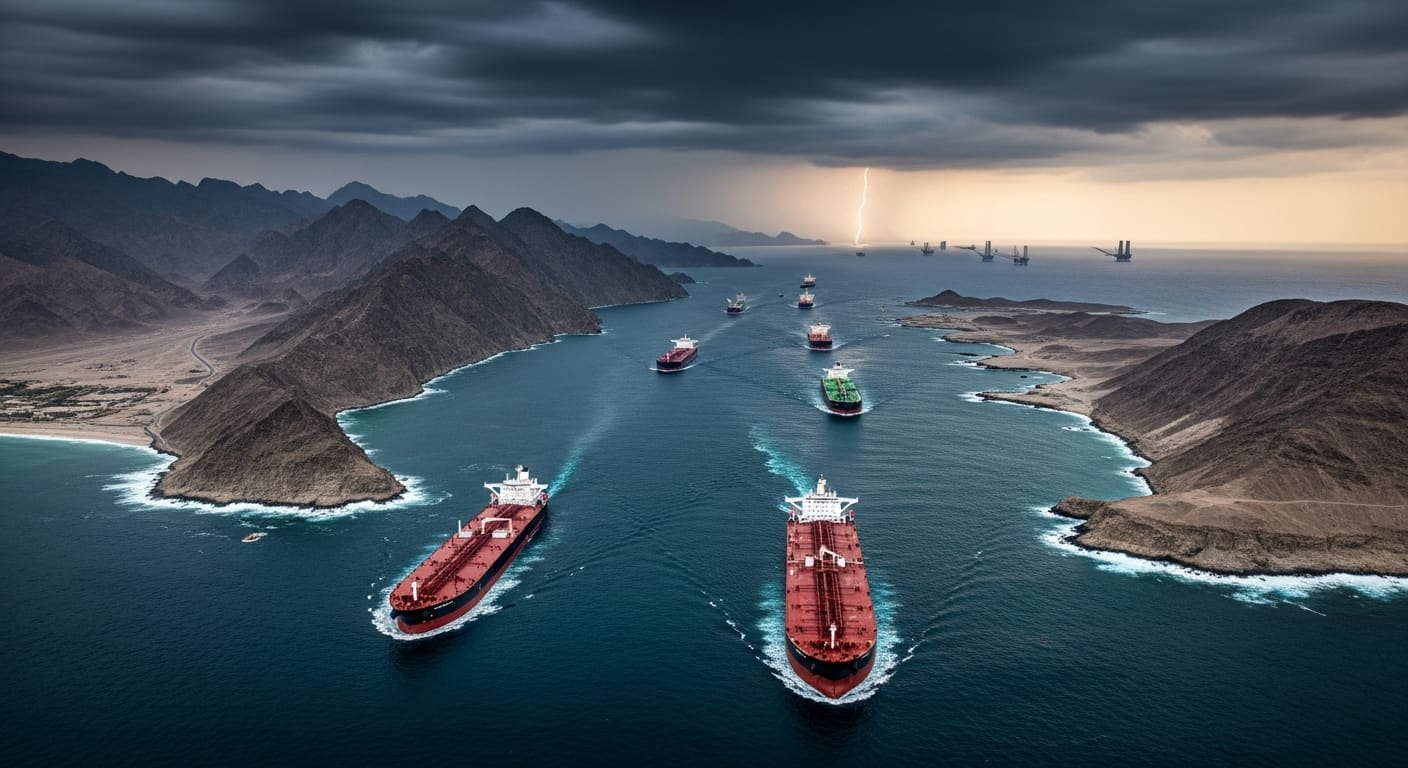
The Strait of Hormuz, a narrow waterway between Iran and Oman at the mouth of the Persian Gulf, is arguably the most strategically significant chokepoint in the global energy supply chain. Approximately 21 million barrels of oil pass through this 33-kilometer-wide corridor every day — roughly 21% of the world's total petroleum consumption. A closure of this strait, whether through military conflict, political tensions, or strategic blockade, would send shockwaves through every corner of the global economy.
The Strategic Importance of the Strait of Hormuz
The Strait of Hormuz connects the Persian Gulf — home to approximately 30% of the world's proven oil reserves — to the Gulf of Oman and the Arabian Sea beyond. The nations that depend on this waterway for their oil exports include Saudi Arabia, Iraq, Kuwait, the UAE, Qatar, and Iran itself. Together, these countries produce roughly one-third of the world's crude oil supply.
At its narrowest point, the strait is only 33 kilometers wide, with shipping lanes just 3 kilometers wide in each direction, separated by a 3-kilometer buffer zone. This makes it extraordinarily vulnerable to disruption. A single vessel sunk in the channel, a naval mine field, or missile batteries positioned along the Iranian coastline could effectively halt global oil shipments virtually overnight.
The strait is also critical for liquefied natural gas (LNG) shipments. Qatar, the world's largest LNG exporter, sends virtually all of its gas exports through the strait. A closure would therefore impact not only oil markets but natural gas supplies to major importers including Japan, South Korea, and countries across Europe.
The Immediate Impact on Oil Prices
Energy analysts and geopolitical strategists have modeled various closure scenarios, and the conclusions are stark. A full closure of the Strait of Hormuz would remove approximately 17-21 million barrels per day from the global oil market — a supply shock unprecedented in the history of petroleum markets.
Historical precedents provide some guidance. During the 1990 Iraqi invasion of Kuwait, which removed approximately 4 million barrels per day from the market, oil prices doubled within months. The 2019 drone attacks on Saudi Arabia's Abqaiq processing facility, which temporarily removed 5.7 million barrels per day, caused a 15% price spike in a single trading session.
A Strait of Hormuz closure would dwarf both events. Analysts at Goldman Sachs, JPMorgan, and the International Energy Agency have estimated that Brent crude oil prices would surge past $150 per barrel within days, potentially reaching $200-250 per barrel if the closure persisted for more than two weeks. Some extreme scenarios project prices exceeding $300 per barrel.
The Strategic Petroleum Reserve (SPR) held by the United States and other IEA member countries contains approximately 1.2 billion barrels in total. While a coordinated SPR release would provide some buffer, it could only compensate for the lost supply for approximately 60-90 days at most — and markets would price in the limited nature of this response from the outset.
Marine Insurance and Shipping Costs
Perhaps the most immediate and quantifiable impact of a Strait of Hormuz crisis would be felt in marine insurance markets. War risk insurance premiums for vessels transiting the Persian Gulf region have historically been highly sensitive to geopolitical tensions.
During the 2019 tanker attacks in the Gulf of Oman, war risk insurance premiums for vessels in the region spiked by 500-1000% virtually overnight. Lloyd's of London and other major marine insurers imposed additional premiums of $250,000-500,000 per vessel transit, up from typical premiums of $20,000-50,000.
A full closure scenario would be far more severe. Marine insurance underwriters would likely classify the entire Persian Gulf region as an active war zone, making commercial insurance effectively unavailable at any price. Vessels already in the Persian Gulf would be stranded, their cargo undeliverable and their insurance voided for war-related risks.
The ripple effects on shipping costs would extend far beyond the Persian Gulf. Alternative shipping routes — primarily the Cape of Good Hope route around Africa — would add approximately 15-20 days to voyages from the Gulf to European and Asian markets. This longer route would increase shipping costs by an estimated $1.5-3 million per voyage for Very Large Crude Carriers (VLCCs), costs that would ultimately be passed to consumers.
Charter rates for oil tankers would surge as demand for alternative routing capacity overwhelmed available fleet supply. During previous Middle Eastern tensions, tanker charter rates have increased by 300-400%. A Strait of Hormuz closure could push rates even higher, potentially reaching $200,000-400,000 per day for VLCCs.
The Global Economic Fallout
The economic consequences of a Strait of Hormuz closure would be immediate, severe, and widespread. The most direct impact would be on energy-importing nations, particularly in Asia, which depends on the Persian Gulf for approximately 65% of its oil imports.
Japan, South Korea, and India would be among the hardest hit, with their economies heavily dependent on Gulf crude. China, which imports approximately 40% of its oil through the strait, would face significant supply disruptions despite having cultivated alternative supply relationships with Russia and Central Asian producers.
European nations, while somewhat less dependent on Gulf oil than Asian countries, would still face severe price increases as global oil markets are interconnected. The loss of Qatari LNG supplies would be particularly damaging for European countries that have increased their reliance on LNG following the reduction in Russian pipeline gas supplies.
The inflationary impact would be enormous. Oil price spikes of this magnitude would push headline inflation rates above 10% in most developed economies within weeks. Central banks would face an impossible dilemma: raise interest rates to combat inflation while economies are simultaneously entering recession due to the energy supply shock.
Global GDP impact estimates range from 3-6% of world output in the first year, depending on the duration of the closure. For context, the 2008 global financial crisis resulted in a GDP decline of approximately 2%. A prolonged Strait of Hormuz closure could therefore be more economically devastating than the worst financial crisis in living memory.
Alternative Routes and Strategic Responses
Nations and energy companies have long recognized the vulnerability of the Strait of Hormuz and have invested in alternative export routes, though none can fully replace the strait's capacity.
Saudi Arabia's East-West Pipeline (Petroline) can transport approximately 5 million barrels per day to the Red Sea port of Yanbu, bypassing the strait entirely. The UAE's Habshan-Fujairah pipeline, completed in 2012, can move approximately 1.5 million barrels per day directly to the Gulf of Oman. Iraq's export pipeline through Turkey to the Mediterranean port of Ceyhan provides another alternative route.
However, these alternative pipelines have a combined capacity of approximately 7-8 million barrels per day — less than half of the volume that transits through the strait. They would also be vulnerable to sabotage or military action in a broader regional conflict.
Strategic petroleum reserves would provide a critical but temporary buffer. The coordinated release of SPR stocks by IEA member countries could provide approximately 5-6 million barrels per day for a limited period. However, the market impact would depend heavily on the perceived duration of the closure and the political context surrounding it.
Lessons from History and Future Preparedness
The Strait of Hormuz has been threatened with closure multiple times since the 1979 Iranian Revolution. During the Iran-Iraq War's "Tanker War" phase (1984-1988), hundreds of commercial vessels were attacked in the Persian Gulf, resulting in significant disruptions to oil shipping. The U.S. Navy's Operation Earnest Will, which provided military escorts for reflagged Kuwaiti tankers, demonstrated both the strategic importance of the waterway and the difficulty of maintaining free passage during regional conflicts.
The current geopolitical environment makes the risk of disruption particularly acute. Rising tensions between Iran and Western nations over nuclear program negotiations, regional proxy conflicts, and strategic competition have kept the Strait of Hormuz at the center of global security concerns.
For investors, businesses, and policymakers, the lesson is clear: the world's dependence on a single narrow waterway for a fifth of its oil supply represents an extraordinary concentration of risk. Diversifying energy sources, accelerating the transition to renewable energy, expanding strategic reserves, and investing in alternative transportation routes are all essential strategies for reducing this vulnerability. The question is not whether the Strait of Hormuz will face another crisis, but when — and whether the global economy will be better prepared.
Sources and further reading
- U.S. Energy Information Administration: World Oil Transit Chokepoints — Quantitative impact of chokepoint disruption
- International Energy Agency: Oil Market Analysis — Supply shock projections