Swarm Robotics in 2026: How Robot Swarms Work
A clear guide to swarm robotics in 2026 — how robot swarms coordinate, the principles behind them, defense, agriculture and rescue uses, the market, and challenges.
Robotics · Global · 2026-09-22 · 10 min read · By John Awab
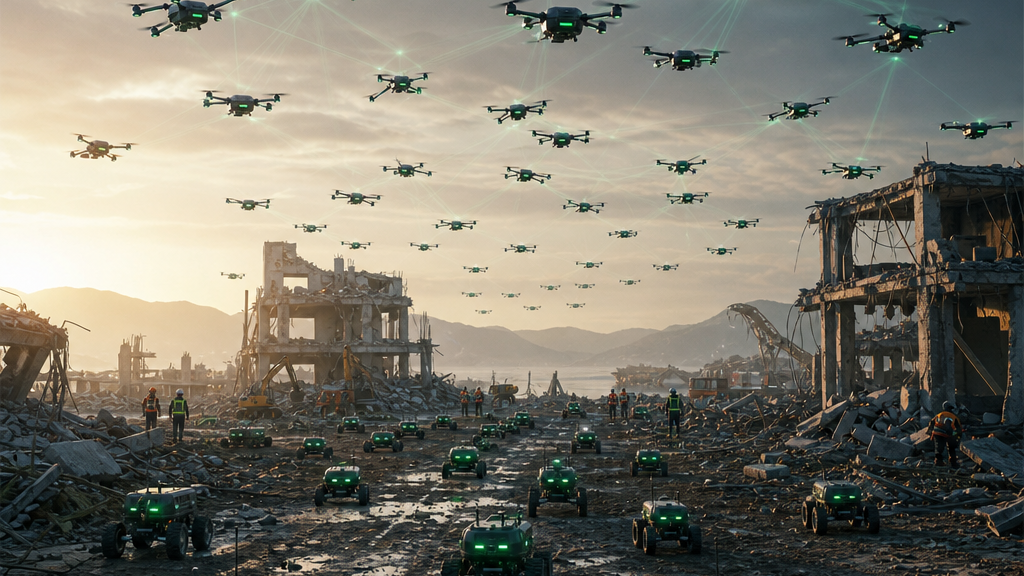
A single robot is impressive. A thousand cheap robots working together — with no leader, no central controller, each following simple rules yet collectively behaving like one intelligent organism — is something else entirely. This is swarm robotics, an approach inspired by the collective genius of ants, bees, and bird flocks, where sophisticated group behavior emerges from many simple individuals. Instead of building one expensive, complex machine to do a job, swarm robotics uses many small, inexpensive, and often disposable robots that coordinate to accomplish tasks no single robot could. In 2026, the field has moved decisively from research labs into the real world — into military procurement, agricultural fields, disaster zones, and warehouse floors — driven by falling hardware costs and advances in AI. It represents one of robotics' most distinctive and rapidly growing frontiers.
This guide explains what swarm robotics is, the principles that make it work, how swarms are built, the major applications, the market, the key players, and the challenges. (Market figures vary by source and scope, so treat them as estimates.)
What Is Swarm Robotics?
Swarm robotics is a field of robotics focused on coordinating large numbers of relatively simple robots to work together as a collective system. Rather than a single capable robot, a swarm consists of many robots — dozens, hundreds, or potentially thousands — that interact with each other and their environment to produce a desired collective behavior. The approach draws direct inspiration from nature's swarm intelligence: the way ant colonies find optimal paths, bees allocate foraging tasks, and starlings flock in perfect coordination, all without any single individual directing the group.
The defining idea is emergence — complex, intelligent group behavior arising from many individuals each following simple local rules. No single robot understands or controls the overall mission; the intelligence lives in the interactions between them. This makes swarm robotics fundamentally different from a fleet of robots taking orders from a central computer. A true swarm is greater than the sum of its parts.
The Core Principles
Three principles define what makes a genuine robot swarm, and they explain both its power and its distinctiveness:
- Decentralization — there is no single leader or central controller. Each robot makes its own decisions based on local information — what it senses nearby and what neighboring robots communicate. This is the most important principle, and the source of the swarm's resilience.
- Local interaction and communication — robots coordinate by communicating with nearby neighbors and sensing their local environment, not by reporting to a central brain. Global behavior emerges from these local exchanges.
- Scalability and redundancy — because control is distributed, swarms can scale from a few robots to many without redesigning the system, and they degrade gracefully. If some robots fail, the rest carry on and the mission continues.
These principles give swarms three signature advantages over a single complex robot: robustness (no single point of failure — losing individual robots doesn't doom the mission), flexibility (the swarm can adapt and reorganize around changing conditions), and scalability (adding more robots extends capability without added complexity). The trade-off is that designing simple rules that reliably produce the desired collective behavior is genuinely hard — a central challenge of the field.
How Swarms Are Built
A swarm robot system combines several elements. Individual robots are typically simple, low-cost, and often small, equipped with sensors to perceive their surroundings and neighbors, some local computing power, and a means of communication (often wireless mesh networks that let robots relay information peer-to-peer). The intelligence comes from decentralized control algorithms and increasingly AI and machine learning, which govern how each robot behaves and responds to its neighbors. Advances in communication protocols, edge computing, and AI have been central to making 2026's swarms more adaptive and capable than earlier generations.
Swarms come in different platform types and sizes. By platform, they split broadly into aerial swarms (unmanned aerial vehicles, or UAVs — drones) and ground swarms (unmanned ground vehicles, or UGVs), with emerging multi-domain swarms combining both. By size, medium swarms of roughly 10 to 100 robots are the workhorses of 2026, balancing capability and manageable complexity, while large swarms of over 100 robots are the fastest-growing frontier for high-scale operations. Simulation platforms for testing large-scale swarm behavior before real-world deployment have become an important supporting technology.
The Applications
Swarm robotics has moved from theory into a striking range of real-world uses:
- Military and defense — the largest and most prominent application. Coordinated drone swarms are used for reconnaissance, surveillance, border monitoring, electronic warfare, and counter-drone defense. Defense programs — notably the US Department of Defense's Replicator initiative, aimed at rapidly scaling production of autonomous swarm-capable systems — have made this one of the field's biggest drivers, and it raises significant strategic and ethical questions.
- Agriculture — a fast-growing commercial frontier. Drone and ground swarms perform precision spraying, soil analysis, pest and weed monitoring, sowing, and yield assessment, covering large or fragmented farmland far more efficiently than single machines.
- Search and rescue and disaster relief — swarms can rapidly cover large disaster areas, map hazardous environments, and locate survivors, going where it's too dangerous or slow for humans.
- Logistics and warehousing — swarms of robots coordinate intra-warehouse transport, sorting, and last-mile optimization, handling dynamic, large-scale operations.
- Inspection and monitoring — coordinated multi-robot coverage inspects infrastructure like bridges, pipelines, and power lines, and monitors environments.
- Mapping and surveying — swarms rapidly map areas and survey terrain.
- Emerging frontiers — smart-city infrastructure and traffic monitoring, environmental monitoring, mining, and even research into swarms for medicine (like coordinated microrobots for targeted drug delivery, still largely experimental).
The unifying theme: swarm robotics excels wherever a task is too large, too dangerous, too dynamic, or too distributed for a single robot to handle well.
The Market
The swarm robotics market is growing rapidly, though estimates vary by how the category is defined. By one widely cited figure, the market reached roughly $1.45 billion in 2025 and is projected to hit around $1.9 billion in 2026, growing toward $5 billion by 2030 at a compound annual growth rate commonly cited between 27% and 31% — among the faster-growing segments in robotics. Related swarm-drone segments show similar momentum, generally in the 19–27% annual growth range. This growth is driven by expanding defense investment, smart-manufacturing initiatives, precision-agriculture demand, falling sensor and computing costs, and government-funded innovation programs. North America has held the largest share (anchored by strong R&D and defense investment, including DARPA-funded programs), while Asia-Pacific (around a third of the market and the fastest-growing region) is propelled by China's manufacturing and drone strength and broader industrial automation. The overall picture is a field transitioning rapidly from research into commercial and defense deployment.
The Key Players
The swarm robotics landscape spans defense contractors, drone specialists, robotics firms, and research institutions. Companies frequently cited in the field include Boston Dynamics and Lockheed Martin (research and defense/industrial applications), Clearpath Robotics, Locus Robotics (warehouse coordination), drone specialists like DJI (integrating swarm capabilities into agricultural and logistics fleets) and Red Cat Holdings (which acquired swarm specialist Apium in 2026), plus dedicated players like Swarm Technology, Sentien Robotics, Hydromea (underwater swarms), and defense-focused firms. Much foundational work also comes from universities and government research programs. A notable dynamic is heavy government and defense funding accelerating commercialization, alongside consolidation as larger players acquire specialized swarm startups.
The Challenges
Despite rapid progress, swarm robotics faces real challenges worth understanding honestly:
- Designing emergent behavior — the core difficulty: writing simple local rules that reliably produce the desired global behavior, without unpredictable or unwanted collective outcomes, is genuinely hard.
- Communication and coordination — keeping many robots reliably communicating, especially in large swarms or challenging environments (underwater, underground, or contested/jammed settings), is technically demanding.
- Scalability in practice — while scalability is a theoretical strength, coordinating very large real-world swarms reliably remains difficult.
- Cost and hardware — though individual robots are cheap, deploying and maintaining large swarms has real costs, and hardware limitations (battery life, sensing) constrain capability.
- Safety, security, and ethics — swarms can be hacked or spoofed, and the heavy defense/military use raises profound ethical questions about autonomous weapons and accountability that societies are still grappling with. These concerns are serious and unresolved, and reasonable people disagree about where the limits should lie.
- Regulation — rules for operating drone swarms, especially in shared airspace, are still evolving.
These challenges are why swarm robotics, despite its promise and momentum, is still maturing — powerful in specific applications but not yet a universal solution.
The Future
Swarm robotics is poised for continued rapid growth and expanding capability. Expect defense to remain the dominant driver even as commercial applications in agriculture, logistics, and disaster response grow quickly; AI and machine learning to make swarms increasingly autonomous, adaptive, and intelligent; larger swarms (100+ robots) and multi-domain swarms (combining air and ground) to advance; and falling costs to broaden access. The maturation of communication protocols, edge computing, and swarm-intelligence algorithms will keep pushing what's possible. Alongside the technical progress, expect intensifying debate over the ethics and governance of autonomous swarms, particularly in military contexts. Swarm robotics is likely to become an increasingly important part of how we handle large-scale, distributed, and dangerous tasks — a quiet but significant shift in what robots can collectively achieve.
Conclusion
Swarm robotics coordinates many simple robots into a collective system that achieves what no single robot could — inspired by the emergent intelligence of ants, bees, and flocks. Built on decentralization, local interaction, and scalability, swarms offer robustness, flexibility, and the ability to grow, tackling tasks that are too large, dangerous, or dynamic for individual machines.
In 2026, the field has moved firmly from the lab into defense, agriculture, disaster response, logistics, and inspection, growing rapidly toward a multibillion-dollar market. Real challenges remain — designing reliable emergent behavior, coordinating at scale, and grappling with serious safety and ethical questions, especially around military use. But the trajectory is clear: coordinated multi-robot systems are becoming one of robotics' most powerful and distinctive capabilities. Understanding swarm robotics reveals a profound idea — that intelligence and capability can emerge not from a single sophisticated machine, but from the coordinated simplicity of many.
Want more? Explore AxionSquare for ongoing coverage of swarm robotics, drones, physical AI, and the technologies shaping the future of automation.
Frequently Asked Questions
What is swarm robotics?
Swarm robotics is a field focused on coordinating large numbers of relatively simple robots to work together as a collective system, inspired by natural swarm intelligence like ant colonies and bird flocks. Instead of one complex robot, a swarm uses many robots that interact through simple local rules to produce sophisticated group behavior. The key idea is emergence — intelligent collective behavior arising without any central controller.
How do robot swarms coordinate without a leader?
Through decentralization and local interaction. Each robot makes its own decisions based on what it senses nearby and what neighboring robots communicate — often via wireless mesh networks — rather than reporting to a central brain. Complex global behavior emerges from these simple local exchanges. This leaderless design is what makes swarms robust: losing individual robots doesn't stop the mission.
What is swarm robotics used for?
Major applications include military and defense (reconnaissance, surveillance, counter-drone operations — the largest use), agriculture (precision spraying, crop and soil monitoring), search and rescue and disaster relief, logistics and warehousing (transport and sorting), infrastructure inspection, and mapping and surveying. Swarms excel wherever tasks are too large, dangerous, dynamic, or distributed for a single robot.
What are the advantages of swarm robotics?
Three main advantages come from decentralized control: robustness (no single point of failure, so losing robots doesn't doom the mission), flexibility (the swarm adapts and reorganizes around changing conditions), and scalability (adding more robots extends capability without redesigning the system). Using many simple, low-cost robots can also be cheaper and more resilient than relying on one expensive, complex machine.
What are the challenges and concerns with swarm robotics?
Key challenges include the difficulty of designing simple rules that reliably produce the desired collective behavior, maintaining reliable communication across many robots, coordinating very large swarms in practice, and hardware limits like battery life. There are also serious safety, security, and ethical concerns — swarms can be hacked, and the heavy military use raises unresolved questions about autonomous weapons and accountability, alongside evolving airspace regulation.