Warehouse Automation: Logistics Scaling and Robotics Infrastructure
With nearly 5 million commercial robots now supporting global logistics, warehouse automation has become a central pillar of modern supply chain efficiency.
Robotics · Global · 2026-06-14 · 10 min read · By John Awab
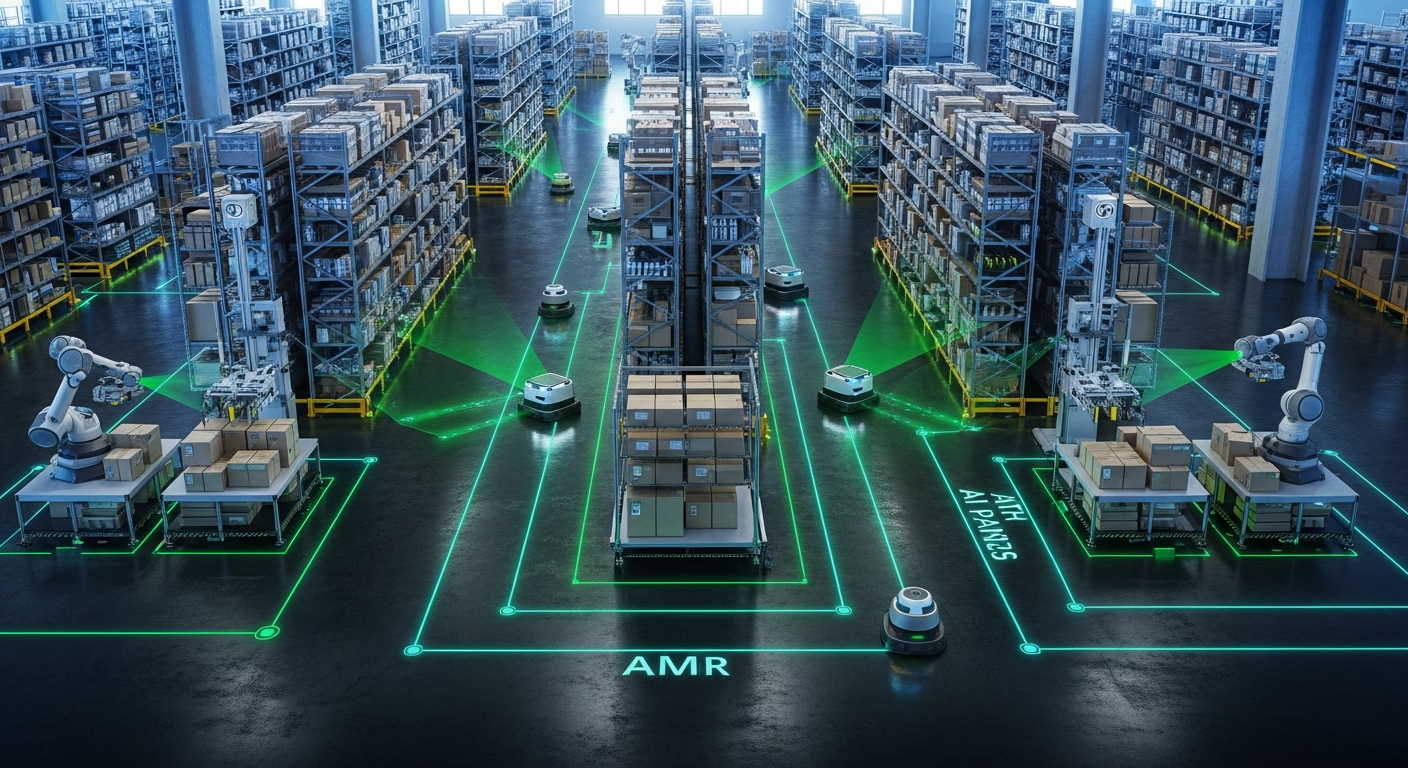
The reason your online order arrives tomorrow instead of next week is increasingly a robot. By the end of 2026, roughly 4.7 million commercial warehouse robots will be working across more than 50,000 warehouses worldwide — and Amazon alone now operates over a million of them. Warehouse robotics has gone from experimental pilots to the backbone of global logistics in barely five years, and 2026 is the year it became truly mainstream.
This guide explains what warehouse robots are, why warehouses are racing to automate, the main types and how they work, the leading players, the market, and the challenges that remain. Whether you run a fulfillment operation or are simply curious how modern logistics works, here is the clear picture. (Market figures vary by source and scope, so treat them as estimates.)
What Are Warehouse Robots?
Warehouse robots are automated machines that perform logistics tasks — picking, sorting, transporting, storing, and packing goods — inside warehouses and distribution centers. Unlike traditional fixed conveyors, modern warehouse robots are intelligent and often mobile, navigating facilities, coordinating with each other, and increasingly using AI vision to handle goods of varying shapes and sizes.
They span everything from wheeled robots that ferry shelves to workers, to robotic arms that pick individual items, to towering storage-and-retrieval systems — all aimed at moving more goods, faster and more accurately, with less manual labor.
Why Warehouses Are Automating
Two forces are driving the boom. First, the e-commerce explosion: global online retail is approaching $7 trillion, and customers expect ever-faster delivery, straining fulfillment operations beyond what manual labor can handle. Second, a labor crisis: warehouse work is physically demanding, turnover is brutal, and hiring during peak seasons is increasingly difficult. A robot that costs a monthly subscription doesn't call in sick, doesn't need benefits, and doesn't quit after two weeks.
The Main Types of Warehouse Robots
Warehouse automation uses several robot categories:
- Autonomous mobile robots (AMRs) — navigate freely using sensors and AI, transporting goods without fixed paths; the fastest-growing category.
- Automated guided vehicles (AGVs) — follow fixed routes (wires, magnets, or markers) to move materials.
- Goods-to-person systems — robots bring shelves or bins directly to human workers, eliminating walking time.
- Automated storage and retrieval systems (ASRS) / cube storage — dense robotic grids that store and retrieve inventory with remarkable speed and space efficiency.
- Robotic picking arms — use computer vision to identify and grasp individual items off shelves.
- Sortation robots — sort packages by destination at high speed.
Most modern warehouses blend several of these into an integrated system.
How Warehouse Automation Works: The Three Architectures
Warehouse automation has settled into three competing approaches, each answering "what do you automate first?" differently. The goods-to-person model (pioneered by Amazon's Kiva system) sends mobile robots to bring inventory shelves to stationary human pickers. The AMR-based model deploys fleets of autonomous robots that roam alongside workers, optimizing travel. And the cube/ASRS model (used by the likes of Ocado, Symbotic, and AutoStore) stores goods in ultra-dense robotic grids for maximum efficiency and space savings.
Inside Amazon's Robot Army
Amazon is the scale benchmark everyone else chases, with more than a million robots across its network. Its specialized fleet shows the breadth of the technology: Proteus roams warehouse floors freely without fixed paths; Sparrow and Vulcan use computer vision to identify and pick items; and Sequoia stores and retrieves inventory up to 75% faster than older methods. Coordinating it all is DeepFleet, an AI system that directs thousands of robots in real time, optimizing movement and reducing congestion across the entire network.
The Real Differentiator: Orchestration, Not Robots
The hard-won lesson from recent years is that reliability beats novelty, and the true differentiator isn't the robot — it's the orchestration layer: the software that coordinates humans, robots, and existing equipment into one coherent workflow. A warehouse running hundreds of robots is fundamentally a traffic-management problem. Operators who designed facilities around how people and machines intersect — rather than around any single flashy robot — consistently outperform those who didn't.
The Leading Warehouse Robotics Companies
The field spans giants and startups. Amazon Robotics (built on its Kiva acquisition) leads by sheer scale. Symbotic, Ocado, and AutoStore dominate dense storage systems; Geek+, Locus Robotics, and Exotec lead in mobile robots; and AI-picking specialists like Covariant are teaching machines to grasp everything from lipstick tubes to lawnmower parts. Swisslog, Fabric, and a wave of newer players round out a rapidly consolidating market, with several major deals reshaping the competitive landscape.
The Market in 2026
The numbers are striking. The warehouse robotics market is valued somewhere around $11–13 billion in 2026 (with broader warehouse-automation estimates near $30 billion), growing at roughly 17–20% annually toward the $25–60 billion range by the early 2030s. Adoption is still early — only about 25% of warehouses have any automation, and just 10% use advanced systems — leaving enormous room to grow. A key enabler is robotics-as-a-service (RaaS), with over a million such subscriptions deployed, letting operators pay per pick rather than absorbing a large capital investment upfront.
The Picking Problem
For all the progress, one challenge remains stubbornly unsolved: fully autonomous picking across the entire range of warehouse goods. Grasping a bag of chips, a bottle of shampoo, and a pair of shoes with the reliability needed to fully replace a human picker is still beyond current systems. AI vision has made huge strides — reducing errors and training time — but universal, human-level picking is the frontier the whole industry is racing toward.
Jobs and the Human Role
Automation is reshaping warehouse work rather than simply eliminating it. Robots take over the repetitive, physically punishing tasks, while new roles emerge in robot maintenance, fleet management, and systems oversight — so much so that many employers now subsidize robotics certifications to build human-machine teaming skills. The likely near future is collaborative: humans and robots working together, with people handling judgment, exceptions, and oversight while robots handle the repetitive, high-volume work.
The Future
Expect warehouses to grow more autonomous, intelligent, and orchestrated. AI will keep improving picking and coordination, RaaS will spread automation to smaller operators, and the software orchestration layer will become the true competitive battleground. Fully "lights-out" warehouses remain aspirational for general merchandise, but the direction is unmistakable: logistics is becoming an intelligent, robot-powered system, and the pace is only accelerating.
Conclusion
Warehouse robots have quietly become the engine of modern commerce — millions of machines picking, sorting, storing, and moving goods so orders arrive faster than ever. Understanding the types, the three automation architectures, the role of AI orchestration, and the leading players reveals how today's supply chains actually run.
Driven by e-commerce growth and labor shortages, warehouse automation is scaling fast, though universal robotic picking and seamless human-robot orchestration remain works in progress. The winners won't be those with the flashiest robots, but those who coordinate people, machines, and software into one smooth, reliable system. The automated warehouse isn't the future — it's already shipping your packages.
Want more? Explore AxionSquare for ongoing coverage of robotics, automation, AI, and the technologies transforming logistics.
Frequently Asked Questions
What are warehouse robots?
Warehouse robots are automated machines that pick, sort, transport, store, and pack goods in warehouses and distribution centers. They range from mobile robots that move shelves to robotic arms that pick items and dense storage-and-retrieval systems.
How many warehouse robots are there?
By the end of 2026, roughly 4.7 million commercial warehouse robots will be deployed across more than 50,000 warehouses worldwide. Amazon alone operates over a million robots, the largest single deployment.
How does Amazon use robots in its warehouses?
Amazon uses specialized robots like Proteus (free-roaming transport), Sparrow and Vulcan (computer-vision picking), and Sequoia (fast storage and retrieval), all coordinated in real time by an AI system called DeepFleet that optimizes movement and reduces congestion.
What are the main types of warehouse robots?
Autonomous mobile robots (AMRs), automated guided vehicles (AGVs), goods-to-person systems, automated storage and retrieval systems (ASRS/cube storage), robotic picking arms, and sortation robots. Most warehouses combine several into one system.
Do warehouse robots replace human workers?
They take over repetitive, physically demanding tasks but also create new roles in robot maintenance, fleet management, and systems oversight. The near-term reality is collaborative — humans and robots working together — since fully autonomous picking across all goods remains unsolved.
Sources and further reading
- Association for Advancing Automation - Warehouse Automation — Categories of warehouse robotics and market deployment stats.